
Anti-inflammatories & time
Reasonable first steps. But pills quiet the ache without touching the inflamed capsule — and “time” is measured in years here, not weeks.

For everyone who’s been told frozen shoulder just has to run its course
The nights are the worst part
If you haven’t slept through one in months, this page is for you.
Frozen shoulder — adhesive capsulitis — can take one to three years to “run its course,” and for some people the pain outlasts even that. Shoulder artery embolization (SAE) is a non-surgical procedure, done through a pinhole in the wrist, that treats the inflamed capsule causing the pain. In the U.S. clinical trial, pain scores fell from 89 to 14 out of 100 within six months. You go home the same day. Covered by most insurance plans, including Medicare and Medicaid.
Covered by most insurance, including Medicare & Medicaid No referral needed for your initial consultation
It’s not just that your shoulder hurts. It’s the zingers — the electric jolts that hit when you reach for a seatbelt, and make you afraid to move at all.
It’s the nights. No position works. Some nights you’ve gotten up in tears and finished the night in a recliner. It’s dressing one-armed — the bra hook, the back pocket, your hair.
Maybe physical therapy made it worse instead of better — and you paid for the privilege. Maybe a steroid shot helped for a few weeks, then faded. And somewhere along the way, someone told you the sentence everyone with frozen shoulder learns to hate: “It resolves on its own. Give it time.”
A year or more of this — and you catch yourself apologizing for even bringing it up.
Stop apologizing. This is one of the most painful conditions we treat. It deserves to be treated like one.
What frozen shoulder actually is
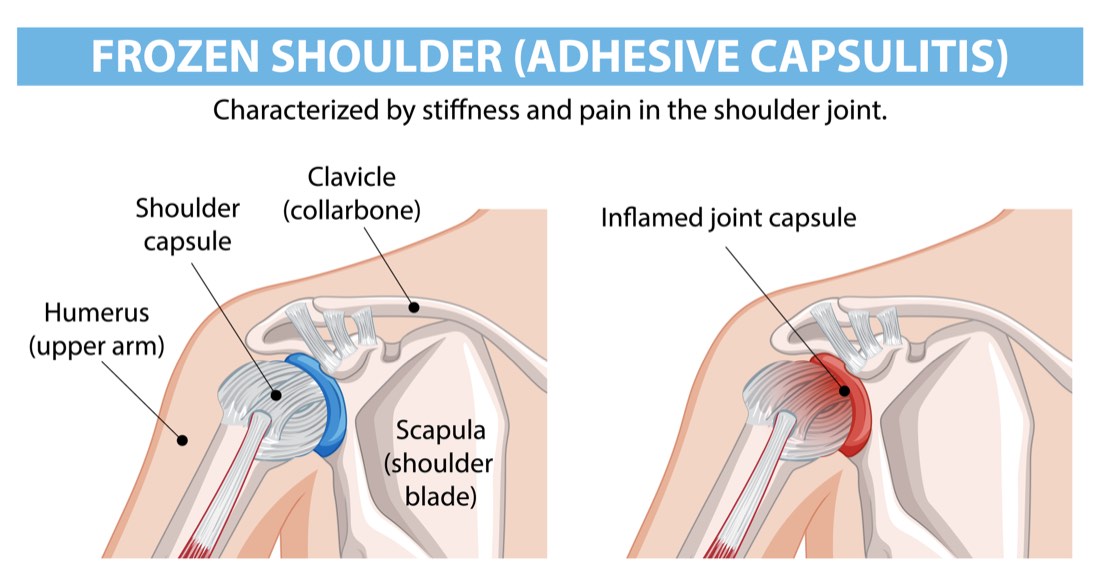
Frozen shoulder starts as inflammation of the capsule, the flexible envelope that wraps your shoulder joint. The inflamed capsule thickens, tightens, and slowly stiffens the joint. But here’s the part that explains the pain — and points at the treatment. When the capsule stays inflamed, your body grows a tangle of abnormal new blood vessels into it. Along those new vessels grow new pain nerves.
That’s why this pain is so deep, so constant, and so far out of proportion to anything an X-ray shows: your shoulder has literally grown extra wiring for it. On an angiogram, those abnormal vessels light up so clearly that doctors found them in 9 out of 10 frozen shoulder patients studied.¹
Frozen shoulder most often strikes between 40 and 60, it’s more common in women, and people with diabetes or thyroid conditions get it more often. It usually isn’t anything you did. And it’s not “just one of those things,” either. It has a mechanism — and the mechanism is treatable.
What you’ve probably tried
Reasonable first steps. But pills quiet the ache without touching the inflamed capsule — and “time” is measured in years here, not weeks.
Genuinely useful — in the right phase, at the right intensity. But if aggressive stretching during the early, angry phase made you worse, you’re not imagining it, and it wasn’t your fault. Forcing a capsule that’s actively inflamed is like stretching a sprained ankle at full effort.
For a shoulder in the early, angry phase, a well-placed steroid injection is one of the genuinely useful things medicine has to offer — and it’s often our first rung. What makes ours different is the word precision: the shoulder joint and the rotator interval are small targets under a lot of tissue, so every injection at ARVC is placed under live imaging, landing exactly where it should — not near it.
The honest limit: steroid calms the inflammation but doesn’t remove the abnormal blood vessels feeding it, so for many people the pain returns when the shot wears off. That’s the point where the next option below earns its place.
These treat the stiffness by stretching or cutting the tightened capsule — pumping it full of fluid, forcing it loose under anesthesia, or releasing it arthroscopically. At the right stage, for some people, one of them is the right call — and we’ll say so when that’s true. But they’re progressively more invasive, and none of them targets the abnormal vessels driving the pain.
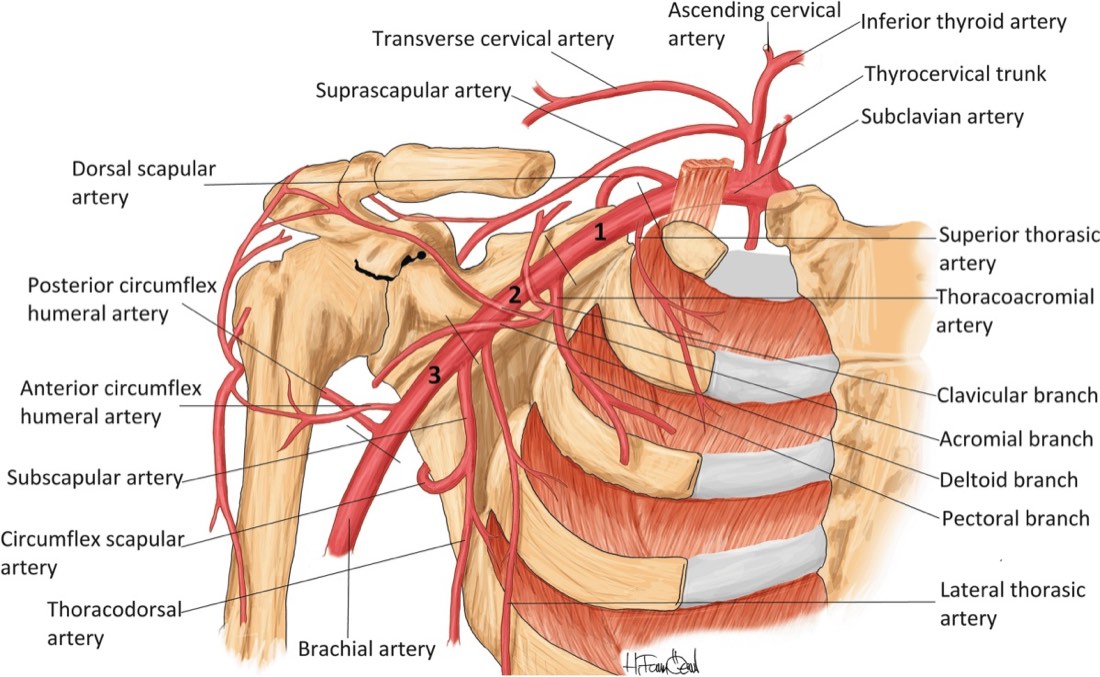
Goes at the mechanism itself. Through a pinhole in the wrist, an interventional radiologist guides a tiny catheter to the arteries feeding the inflamed capsule, then releases microscopic particles that block the abnormal vessels. Starve the tangle, and the extra pain wiring quiets with it. Pain drops over the following weeks — and the study data says night pain drops most of all.³
When the injections stop holding
To be clear about what this section describes: shoulder artery embolization (SAE) — the last option on the list above. It’s the one treatment here that goes after the abnormal vessels feeding the inflamed capsule rather than the pain they cause, and it is the newest, so it deserves the most transparent accounting on this page.
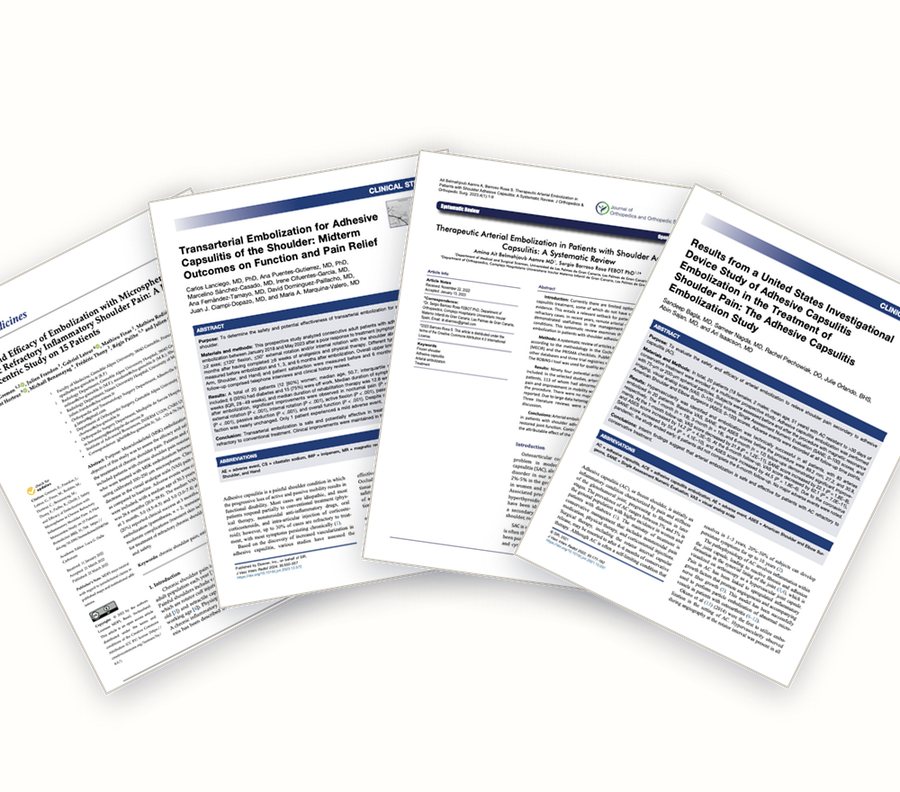
Strong: every published study — 127 patients across 7 studies on three continents — found less pain and better motion within six months, with no major complications in any study.¹ The U.S. trial ran under FDA oversight.³ And the temporary, dissolving embolic we use is the same one used in the longest-running successful series.⁴ ⁵
Young: these studies are small, and none has randomized patients against a comparison group yet. Since frozen shoulder can improve slowly on its own, careful people should ask how much is the procedure and how much is time. Our answer: the improvements in these studies arrived in weeks, in patients already stuck for many months — and in the published series, no one’s symptoms had returned at final follow-up, out to four years.¹ But we’d rather under-promise. This evidence is newer than, say, our fibroid program’s — and we’ll tell you exactly where it stands at your consultation.
Two more things we tell every patient up front. If you have diabetes, expect us to be extra candid — diabetic patients improved in the studies, but less completely, and we won’t pretend otherwise.⁴ And skin effects are worth knowing about: in the U.S. trial — which used permanent particles — about one in three patients got small temporary patches of skin discoloration that faded within three months.³ The embolic we use is temporary and dissolves within the hour; in the longest-running series using it, one patient in twenty had a minor, passing side effect.⁴
We do a complimentary benefits check before any procedure. No surprises.
The published evidence
89 → 14
pain scores (out of 100) six months after embolization in the U.S. FDA-supervised trial. Function scores rose from 31 to 80.³
Night pain: 0
the median night-pain score six months after embolization in the longest-running series — and at 18-month follow-up, 70% of patients were off pain medicine entirely.⁴
0 major
complications across all 127 published patients. Side effects were minor and temporary — most commonly a small patch of skin discoloration that faded within weeks.¹ ³
77%
met the strict bar for clinical success in the longest-followed series (3-year average follow-up) — where the need for PT, anti-inflammatories, and steroid shots each fell to zero.⁵
What we won’t claim: permanence, or certainty. No randomized trial exists yet, and nobody has 15-year data. If anyone promises you “permanent,” be careful.
Sources: 1. Ait Belmahjoub & Barroso, J Orthop & Orthop Surg 2023 — systematic review: 7 studies, 127 patients, abnormal vessels in 89%, no major adverse events, no recurrence reported through 48-month follow-up. 2. Shaffer et al., J Bone Joint Surg Am 1992. 3. Bagla et al., J Vasc Interv Radiol 2022 — U.S. IDE trial, 20 patients: VAS 89.2→13.9, ASES 30.9→80.1, SANE 27.2→86.8 at 6 months. 4. Lanciego et al., J Vasc Interv Radiol 2024 — 20 patients: median night pain 2.9→0; 70% off analgesics at median 18-month follow-up. 5. Okuno et al., J Vasc Interv Radiol 2017 — 25 patients, mean 36-month follow-up.
What the procedure is like
SAE is done in our own IR suite, in our office — not a hospital. You’re given twilight sedation through an IV, with a dedicated sedation nurse watching over you the whole time. The interventional radiologist numbs a spot on your wrist, makes a pinhole opening in the artery — no incision, no stitches — and guides a catheter thinner than a phone-charger cord up to the shoulder. The abnormal vessels show themselves on the X-ray pictures. The doctor blocks them with a temporary slurry — microcrystals smaller than a grain of sand, made from a medication (imipenem/cilastatin) mixed with X-ray dye. The crystals block the abnormal vessels and the pain nerves they feed just long enough to quiet them, then dissolve into the bloodstream within 30 to 45 minutes. Nothing permanent stays in your body. Then the catheter comes out and the pinhole is sealed. You rest with us for two hours, then someone drives you home.
Most patients are back to normal daily activity within one to three days. Some feel a temporary deep ache in the shoulder over the first days as the treated tissue settles — we’ll warn you, and you’ll have a plan for it. Pain relief builds over the following weeks. And because the capsule calms down, gentle physical therapy — the kind that was unbearable before — often becomes possible again. That’s when motion comes back.
Candidacy
We turn away patients who aren’t candidates for what we do. Routinely.
Your care team
Your workup starts with our pain-management specialists — their background is musculoskeletal conditions — and the procedure itself is performed by our Board Certified Vascular and Interventional Radiologists. We measure your progress with the ASES shoulder score — the same instrument the U.S. trial used.
After your procedure
When you go home, you take the on-call doctor’s cell phone number with you. Not an answering service — the doctor.
And you don’t have to wonder whether to bother us: we call you the next day to check in. Every patient, every procedure.
Before you leave, you’ll get this card
Your procedure:
On-call doctor:
Cell phone: written by hand, before you walk out
Call me if anything worries you.
Straight answers
It’s new to most patients — not to the research. The first frozen-shoulder embolization study was published in 2014; since then, studies in Japan, Spain, and the U.S. — including a trial run under FDA oversight — have reported the same pattern: less pain, better motion, no major complications.¹ ³ What doesn’t exist yet is a large randomized trial, and we’ll be straight with you about that. The technique itself is the same one used for decades elsewhere in the body — including the knee-arthritis program we run every week.
Embolization is performed by interventional radiologists — a different specialty, a different referral network. Most orthopedic treatment plans are built from the options orthopedics itself offers. Nobody hid anything from you; the option just lives in a different building. (You found it anyway.)
The studies treated people in the painful and stuck phases — most had been symptomatic for close to a year. Night pain and inflammation are the procedure’s targets, so the pain-dominant phases are the sweet spot. Where you are in the arc is one of the first things we sort out at consultation.
Honest answer: diabetic patients in the studies improved, but less completely than non-diabetics, and some needed additional treatment later.⁴ You’ll get the candid version of what that means for your case — not a brush-off, and not a sales pitch.
In the published series, no symptom recurrence had been reported at final follow-ups — the longest ran four years.¹ That’s encouraging, and it’s also the young part of the evidence: nobody has 15-year data yet. If anyone promises you “permanent,” be careful.
Across all 127 published patients: no major complications.¹ Minor, temporary effects included small patches of skin discoloration (about 1 in 3 patients in the U.S. trial — gone within three months), soreness at the wrist, and a temporary deep ache in the shoulder afterward.³ It’s still a medical procedure — catheter procedures carry rare risks we review with you in plain language before you decide anything. One reassurance worth repeating: the embolic we use is temporary — it dissolves into the bloodstream within 30 to 45 minutes, so nothing permanent stays in your body.
Yes — we encourage it. In several studies patients resumed gentle, guided PT within days of embolization. Think of it this way: embolization quiets the pain and inflammation; therapy then restores the motion. The two work better together than either alone.
Yes — SAE is covered under most insurance plans, including Medicare and Medicaid. And we still do a complimentary benefits check before any procedure, so there are no surprises: you’ll know exactly where you stand before you decide anything.
Free patient guide
Our physicians wrote a plain-English guide to embolization — the mechanism behind our knee, shoulder, and fibroid programs: what it treats, what the studies show, and who it’s for. No appointment required, and no follow-up phone call unless you ask for one.
We’ll email your guide plus occasional patient education. Unsubscribe anytime. Privacy policy.
You’ll leave with an honest read on your stage, every option explained — including the ones we don’t offer — and a straight answer about whether we can help. Call us directly, or send this form and we’ll call you to schedule. We do a complimentary benefits check before any procedure. No surprises.
210-405-1335Closed on major holidays.
3212 Napier Park, San Antonio, TX 78231
Stand-in image (Map © OpenStreetMap) — the live site embeds the interactive Google map here
No referral needed for your initial consultation.
Rather book by phone? Call (210) 405-1335.