Frozen shoulder
The strongest published shoulder-embolization evidence is here — including a U.S. trial run under FDA oversight.² If night pain and a stiffening shoulder are your story, start with our frozen shoulder page.
The procedure behind our frozen shoulder & shoulder arthritis programs
Performed by the physician, start to finish
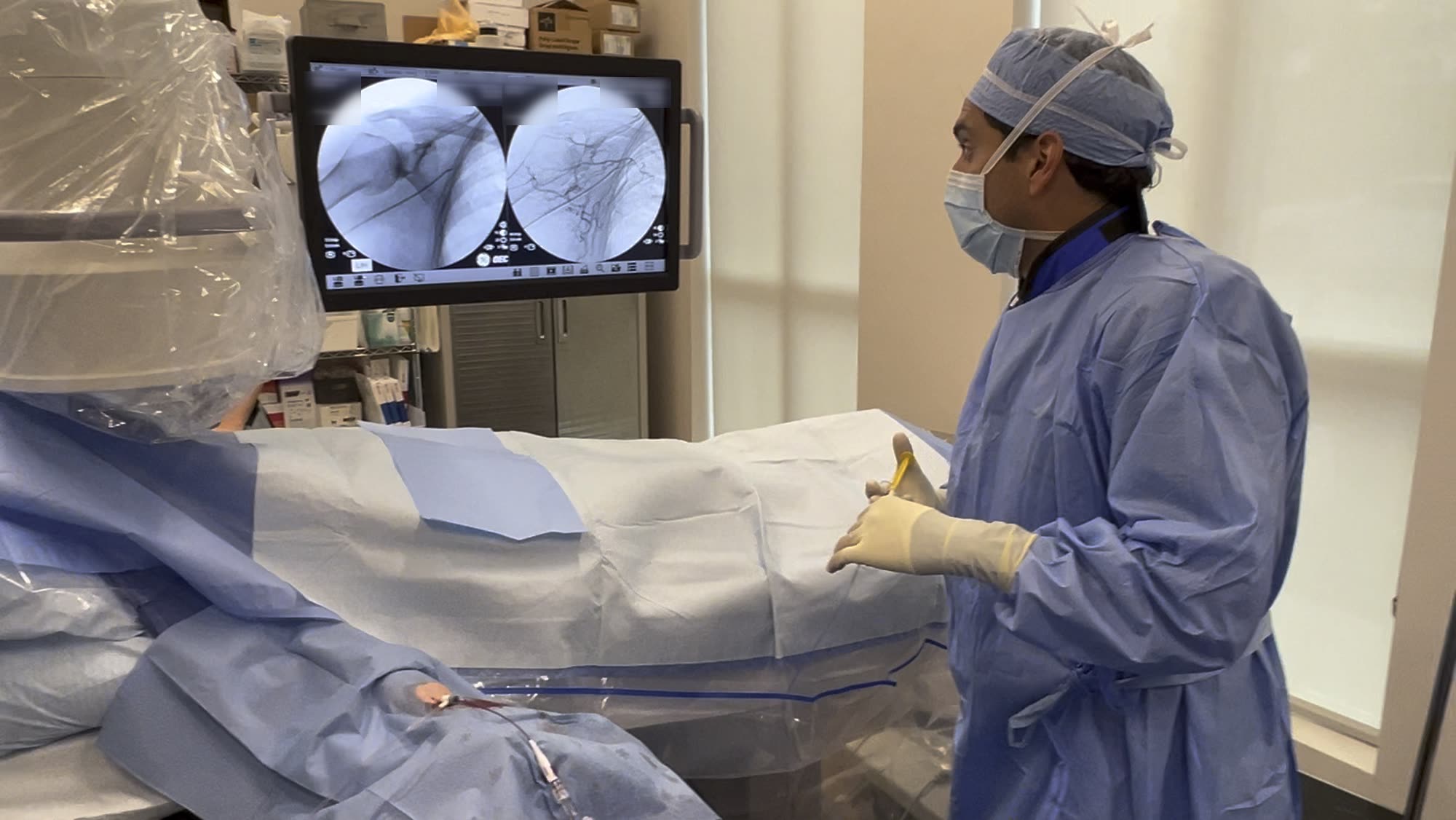
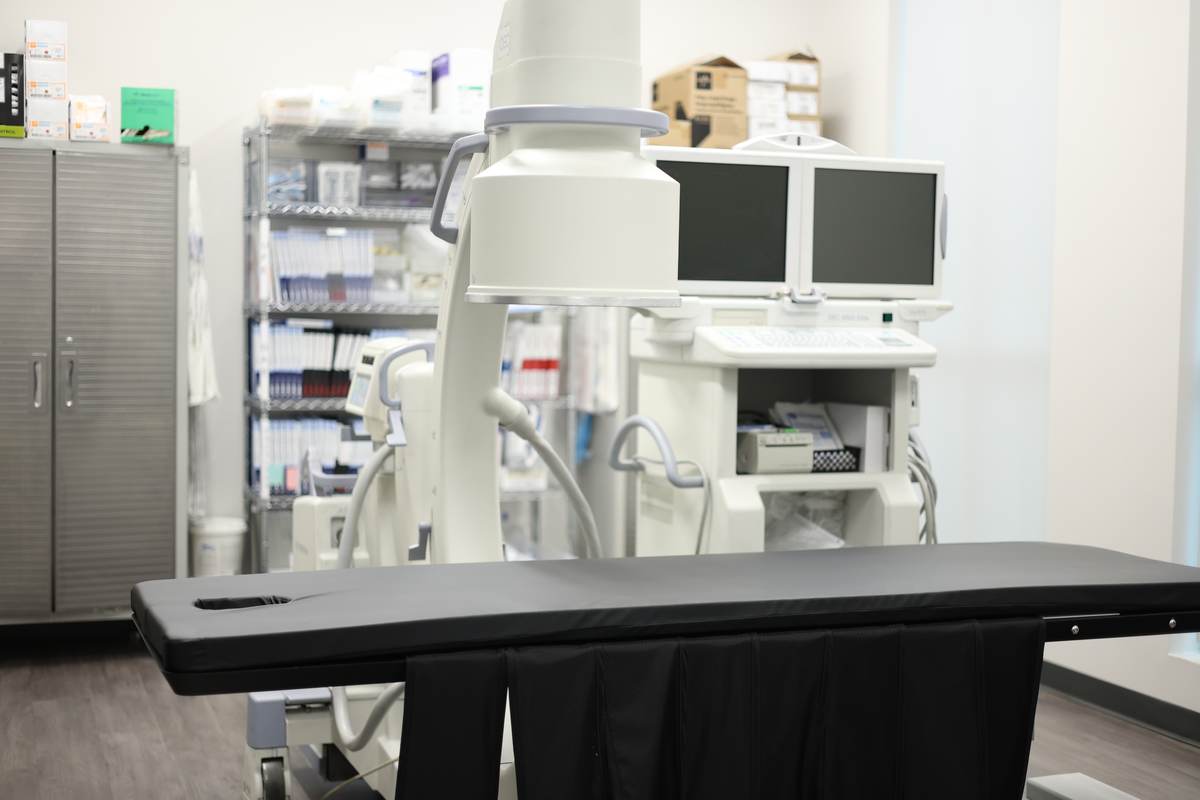
A patient undergoing a shoulder embolization in our angiography suite.
Shoulder artery embolization (SAE) is a non-surgical procedure for frozen shoulder, shoulder arthritis, and chronic tendonitis. Through a pinhole in the wrist, an interventional radiologist blocks the abnormal blood vessels that keep your shoulder inflamed and hurting. Twilight sedation, about an hour of procedure time, home the same day — no implant, no incision, no months of rehab.
Covered by most insurance, including Medicare & Medicaid No referral needed for your initial consultation
Maybe you came here from our frozen shoulder or shoulder pain pages, wanting to know what this procedure actually involves.
Maybe a doctor said “embolization” and you’ve been trying to picture it since. Is it surgery? Does something stay in my arm? Am I awake? Who even does this?
Or maybe you’re just tired — of cortisone that fades, of nights spent in the recliner, of being told to wait it out — and you want to see the option nobody offered you.
This page walks you through all of it — including the before-and-after pictures most practices never show. Judge it with your own eyes.
The procedure
When a shoulder stays inflamed long enough — from frozen shoulder, arthritis, or chronic tendonitis — the body grows a tangle of abnormal new blood vessels into the inflamed tissue. Along those vessels grow new pain nerves. That’s why the ache runs so deep, why it owns your nights, and why it looks so much worse than your X-ray. On an angiogram, the tangle lights up so clearly that doctors found it in 9 out of 10 shoulder patients studied.¹
SAE — called adhesive capsulitis embolization or transarterial embolization in the medical literature — goes at that tangle directly. Through a pinhole in your wrist, a catheter thinner than a phone-charger cord travels to the arteries feeding the shoulder. There, microscopic particles block the abnormal vessels while the healthy arteries around them keep doing their job. Starve the tangle, and the extra pain wiring quiets. The inflammation eases with it.
If this sounds familiar, it should: it’s the same mechanism behind genicular artery embolization, the knee-arthritis procedure we perform every week — the older sibling of this procedure, with the deepest evidence base in the family.
What it treats
The strongest published shoulder-embolization evidence is here — including a U.S. trial run under FDA oversight.² If night pain and a stiffening shoulder are your story, start with our frozen shoulder page.
The same abnormal-vessel tangle is documented in arthritic shoulders, and the deepest arthritis-embolization evidence comes from the knee, where we run the same procedure weekly. The shoulder-specific studies are younger — we say so plainly. Read the shoulder pain page.
Long-standing rotator-cuff-related pain and tendonitis grow the same abnormal vessels. The 100-patient multicenter trial deliberately included 24 patients with symptomatic rotator cuff tears alongside 76 with frozen shoulder — and found no significant difference in how well the two groups did.⁸
See it for yourself
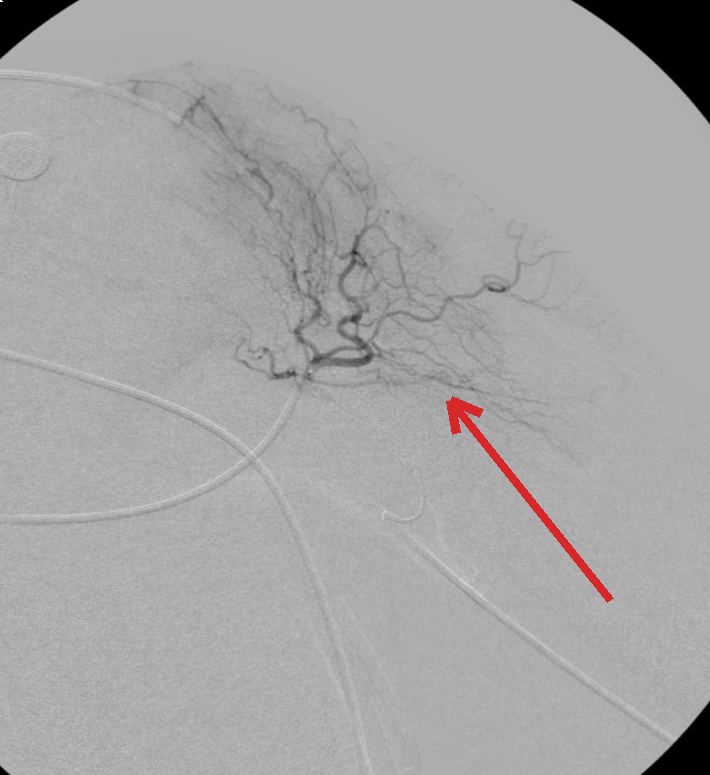
These are angiograms — X-ray pictures taken while dye flows through the arteries — from shoulder embolizations performed here at ARVC. On the left of each pair, the dark cloud is the tangle of abnormal vessels feeding the inflamed tissue. On the right, minutes after embolization: the cloud is gone, and the healthy arteries are still open.
Before
After
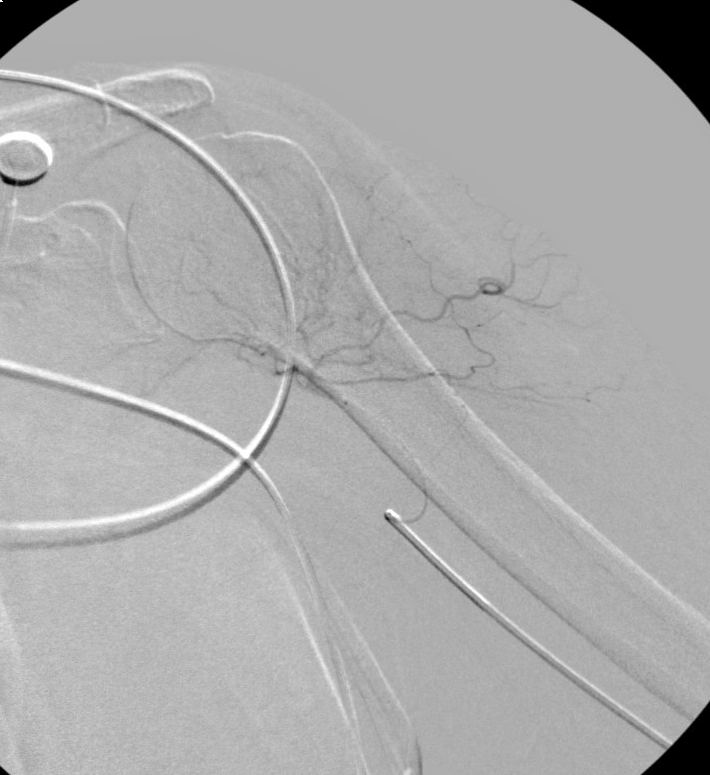
Before
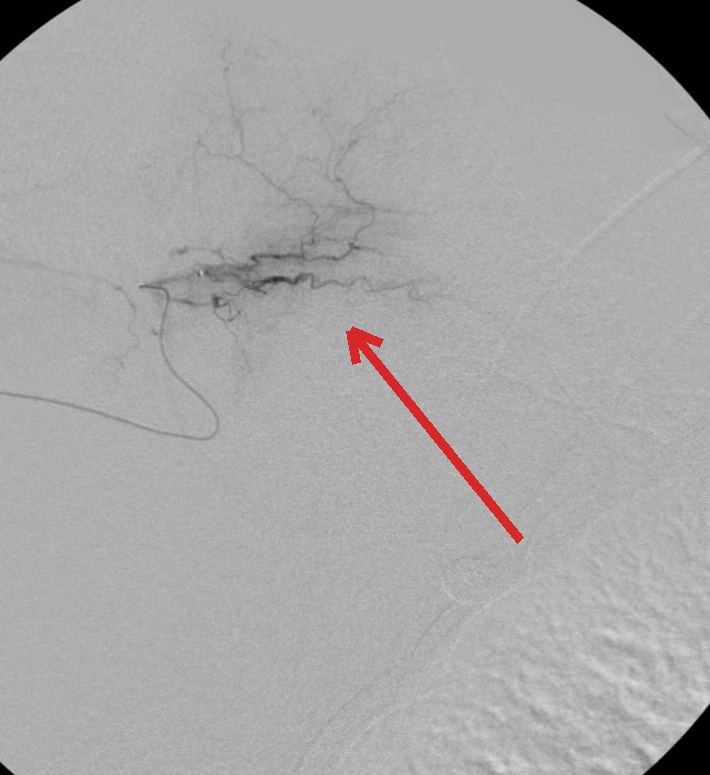
After
The treatment itself, step by step
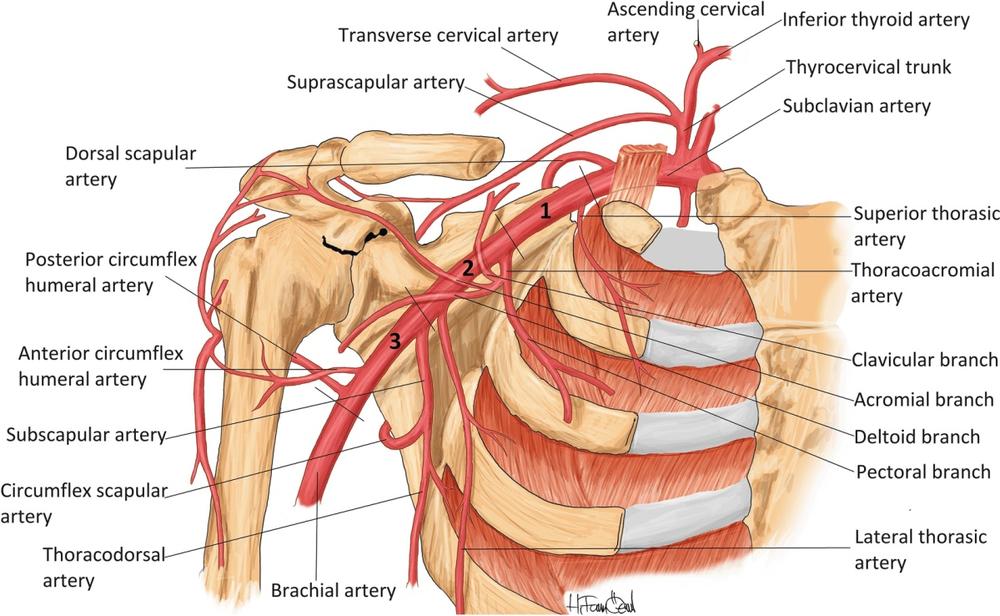
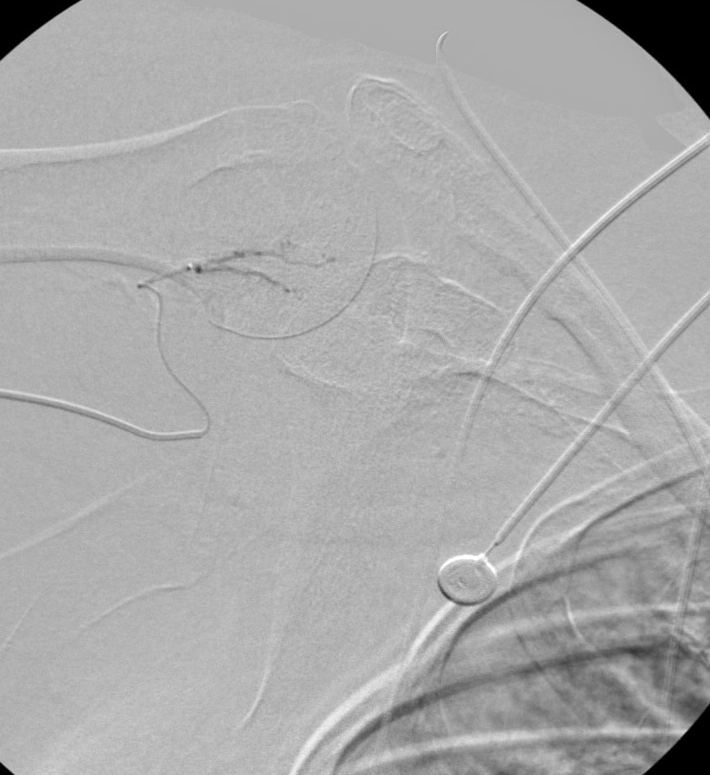
The pairs above are before and after. These four runs are the treatment itself — one artery, one frozen shoulder patient, treated here at ARVC by Dr. Arthur Joseph, in the order it was done. The vessel is the thoracoacromial artery, one of the arteries feeding the inflamed shoulder capsule. Watch the dark cloud at the top of the picture get quieter with each run.
Angiograms from shoulder artery embolization procedures performed at ARV Centers, San Antonio. Patient identifying information removed. Individual results vary — the study data below is the fairer way to set expectations.
Procedure day
You get comfortable. An IV delivers twilight sedation — you’re relaxed and drowsy, breathing on your own, with a dedicated sedation nurse watching over you the whole time. Not general anesthesia.
The pinhole. The doctor numbs a spot on your wrist and makes a pinhole opening in the artery. No incision, no stitches.
The map. A catheter travels to the shoulder, dye flows, and X-ray pictures reveal the abnormal vessels — the same before-pictures you saw above.
The treatment. The doctor releases the temporary blocking slurry into each abnormal cluster. All told, you’re usually on the table about an hour.²
Sealed and resting. The catheter comes out, the pinhole is sealed with a closure device, and you rest with us for an hour or two.
Home. Someone drives you. No driving or big decisions for 24 hours while the sedation wears off. Most patients are back to normal daily activity within one to three days — and we call you the next day to check in.
Some patients feel a temporary deep ache in the shoulder over the first days as the treated tissue settles. We’ll warn you before it happens, and you’ll go home with a plan for it — and the on-call doctor’s cell number.
See the procedure
Prefer reading? Everything in the video is covered on this page as well.
What goes in — and what doesn’t stay
The blocking agent we use is a slurry of a medication (imipenem/cilastatin) mixed with X-ray dye. Mixed together, they form microcrystals smaller than a grain of sand. The crystals block the abnormal vessels — and the pain nerves they feed — just long enough to quiet them, then dissolve into the bloodstream within 30 to 45 minutes. Nothing permanent stays in your body.
This detail matters more than it sounds. The longest-running successful embolization series used this same dissolving agent.³ ⁴ Other studies — including the U.S. trial — used permanent particles, and that version came with a known nuisance: about 1 in 3 patients got small, temporary patches of skin discoloration that faded within three months.² With the dissolving agent, the longest series reported one minor, passing side effect in twenty patients.³ Particle choice is a real medical decision — your doctor will choose the agent best suited to your case, and explain why.
The published evidence
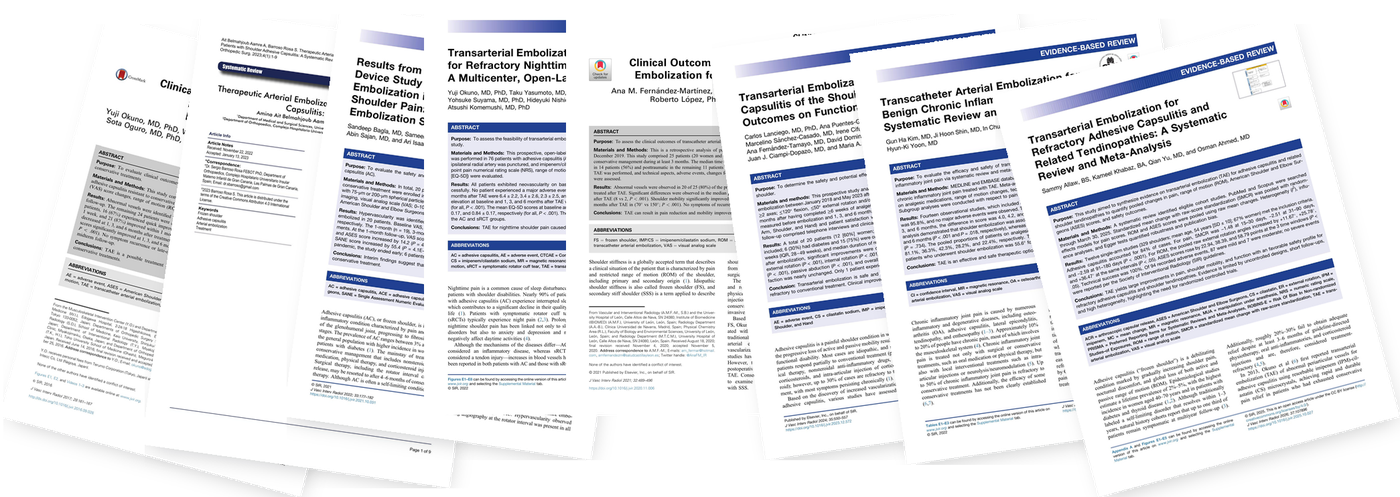
Shoulder embolization has been studied since 2013, and we keep a running index of the literature. It now runs to close to forty published papers — thirteen clinical outcome studies in frozen shoulder alone, plus rotator-cuff and tendon series, two meta-analyses, laboratory work on the mechanism, and, in 2026, the first head-to-head comparisons against capsular-release surgery and against rehabilitation alone. A sample of them:
89 → 14
pain scores (out of 100) six months after embolization in the U.S. FDA-supervised frozen shoulder trial. Function scores rose from 31 to 80.²
Night pain: 0
the median night-pain score six months after embolization in the longest-running series — and at 18-month follow-up, 70% of patients were off pain medicine entirely.³
0 severe
adverse events across 329 treated shoulders in the 2026 meta-analysis of 12 studies. Reported side effects were mild or moderate — and temporary.⁶
100 patients
across five centers in the largest prospective shoulder-embolization trial: nighttime pain fell 6.4 → 1.6 out of 10 and shoulder motion went 97° → 151° by six months. No major adverse events.⁸
And what we see: in our experience shoulder embolization is highly effective — most of the patients we treat get real, meaningful relief, and it tends to arrive within weeks, in shoulders that had been stuck for many months. Safety is the part the published record is clearest on: across 329 treated shoulders, no severe complications.⁶ And this is not new ground for us — blocking abnormal vessels through a catheter is the core of what this practice does, and we perform multiple embolizations every week.
One more thing worth knowing, because it surprises people: when researchers pooled 346 patients across 14 studies and compared embolization in the shoulder against embolization in the knee, the shoulder did better on pain relief at both three and six months.⁹ In that same pooled data, the share of patients still taking pain medicine fell from 81% before treatment to 22% at one year.⁹
Sources: 1. Ait Belmahjoub & Barroso, J Orthop & Orthop Surg 2023 — systematic review: 7 studies, 127 patients, abnormal vessels in 89%, no major adverse events, no recurrence reported through 48-month follow-up. 2. Bagla et al., J Vasc Interv Radiol 2022 — U.S. FDA IDE trial, 20 patients: VAS 89.2→13.9, ASES 30.9→80.1 at 6 months; mean procedure time 69 minutes; permanent 75-µm particles. 3. Lanciego et al., J Vasc Interv Radiol 2024 — 20 patients, imipenem/cilastatin: median night pain 2.9→0; 70% off analgesics at median 18-month follow-up; 1 minor adverse event. 4. Okuno et al., J Vasc Interv Radiol 2017 — 25 patients, imipenem/cilastatin, mean 36-month follow-up: clinical success 77%. 6. Allaw et al., J Vasc Interv Radiol 2026 — systematic review & meta-analysis: 12 studies, 329 shoulders; technical success 100%; 94 adverse events (87 mild, 7 moderate, none severe). 7. Fernández Martínez et al., Cardiovasc Intervent Radiol 2025 — largest series: 118 patients / 128 procedures, imipenem/cilastatin: pain 7.8→2.2 at 6 months; 89.8% clinically improved at 12 months; no major adverse events. 8. Okuno et al., J Vasc Interv Radiol 2022;33:1468–1475 — prospective multicenter open-label trial, 100 patients at 5 institutions (76 adhesive capsulitis, 24 symptomatic rotator cuff tears), imipenem/cilastatin: nighttime pain NRS 6.4→1.6 and anterior elevation 97°→151° at 6 months; no major adverse events; no significant difference in clinical success between the two groups. 9. Kim et al., J Vasc Interv Radiol 2022;33:538–545 — systematic review & meta-analysis, 14 studies / 346 patients: pooled technical success 95.8%, no major adverse events; shoulder embolization produced significantly greater pain reduction than knee embolization at 3 months (P < .001) and 6 months (P = .018); patients on analgesics 81.1% at baseline → 22.4% at 12 months.
Candidacy
We turn away patients who aren’t candidates for what we do. Routinely.
Your care team
Your workup starts with our pain-management specialists — their background is musculoskeletal conditions — and the procedure itself is performed by our Board Certified Vascular and Interventional Radiologists. We measure your progress with the ASES shoulder score — the same instrument the U.S. trial used.
After your procedure
When you go home, you take the on-call doctor’s cell phone number with you. Not an answering service — the doctor.
And you don’t have to wonder whether to bother us: we call you the next day to check in. Every patient, every procedure.
Before you leave, you’ll get this card
Your procedure:
On-call doctor:
Cell phone: written by hand, before you walk out
Call me if anything worries you.
Straight answers
It’s new to most patients — not to the research. The first shoulder-embolization study was published in 2014; since then, studies in Japan, Spain, and the U.S. — including a trial run under FDA oversight — have reported the same pattern: less pain, better motion, no major complications.¹ ² What doesn’t exist yet is a big trial pitting it head-to-head against another treatment, and we’ll be straight with you about that. The technique itself — blocking abnormal vessels through a catheter — has been used for decades elsewhere in the body, including the knee-arthritis program we run every week.
You’ll be under twilight sedation — relaxed, drowsy, and breathing on your own, with a dedicated sedation nurse monitoring you the entire time. Most patients remember little or nothing of the procedure. It’s not general anesthesia: no breathing tube, and a much quicker recovery — which is part of why you can go home the same day.
Relief builds over weeks, not minutes. In the U.S. trial, average pain scores had fallen by more than half within the first month, and kept improving through six months.² In the longest-running series, night pain was the component that improved most.³ And because the shoulder calms down, gentle physical therapy — the kind that felt unbearable before — often becomes possible again. That’s when motion comes back.
The published series treated patients in a single session — every abnormal cluster found gets treated the same day — and reported no symptom recurrence at final follow-ups, the longest running four years.¹ That’s encouraging, and it’s also the young part of the evidence. We won’t promise “once and done” — we’ll show you the data and let it speak.
In the 2026 meta-analysis pooling 329 treated shoulders, no severe adverse events were reported.⁶ Minor, temporary effects included small patches of skin discoloration (about 1 in 3 patients in the permanent-particle U.S. trial — gone within three months²), soreness at the wrist, and a temporary deep ache in the shoulder afterward. The dissolving agent we use is the gentler analogue: one minor, passing side effect in twenty patients in the longest series.³ It’s still a medical procedure — catheter procedures carry rare risks we review with you in plain language before you decide anything.
At ARVC: frozen shoulder, shoulder arthritis, and chronic tendonitis. The strongest published evidence is in frozen shoulder; for arthritis and tendonitis the shoulder-specific studies are younger, and the strongest supporting evidence comes from the same procedure in the knee. Your consultation starts with which condition you actually have — our pain-management specialists work that up first, and the answer decides everything that follows.
Yes, and you deserve to know them. Nobody has run a head-to-head trial against another treatment yet. And one small French study reported poor results — it used much larger, permanent particles in patients who had been symptomatic for years, most after failed surgery.⁵ That study is why technique details matter: the successful series used the small or dissolving agents we use, in patients treated before years of scarring set in. It’s also the honest argument against waiting: every option works worse after years of delay.
Yes — SAE is covered under most insurance plans, including Medicare and Medicaid. And we still do a complimentary benefits check before any procedure, so there are no surprises: you’ll know exactly where you stand before you decide anything.
5. Gremen et al., Biomedicines 2022 — 15 patients, 100–250-µm permanent microspheres, median symptom duration 26.6 months, 60% post-surgical: 20% met the ≥50% pain-reduction bar at 3 months. The authors recommend against large permanent microspheres for shoulder work.
Free patient guide
Our physicians wrote a plain-English guide to embolization — the mechanism behind our knee, shoulder, and fibroid programs: what it treats, what the studies show, and who it’s for. No appointment required, and no follow-up phone call unless you ask for one.
We’ll email your guide plus occasional patient education. Unsubscribe anytime. Privacy policy.
You’ll sit with a physician — not a salesperson. You’ll hear every option, including the ones we don’t offer, and get a straight answer about whether SAE fits your shoulder. Call us directly, or send this form and we’ll call you to schedule. We do a complimentary benefits check before any procedure. No surprises.
210-405-1335Closed on major holidays.
3212 Napier Park, San Antonio, TX 78231
Stand-in image (Map © OpenStreetMap) — the live site embeds the interactive Google map here
No referral needed for your initial consultation.
Rather book by phone? Call (210) 405-1335.