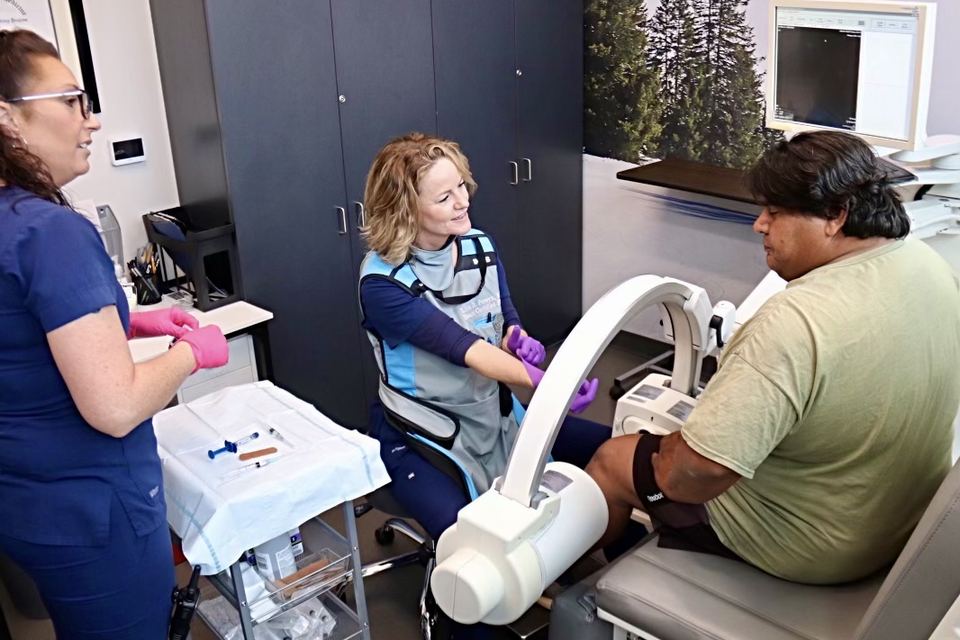
For people in San Antonio with knee arthritis who’ve run out of options that work

“Bone on bone” doesn’t have to mean surgery.

ARV Centers treats knee arthritis pain without surgery — from precision injections guided by live imaging to a newer procedure that treats the inflamed lining of the knee itself. Covered by most insurance, including Medicare. No referral needed for your initial consultation.

Covered by most insurance, including Medicare No referral needed for your initial consultation

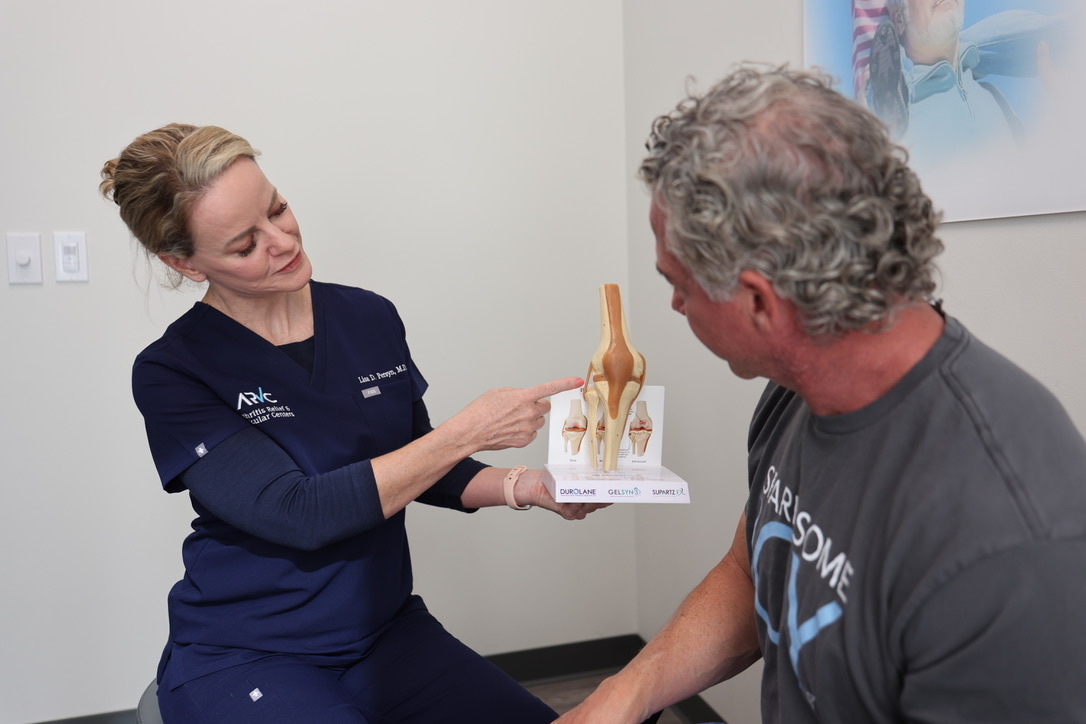
Dr. Lisa Persyn explaining knee arthritis to a patient using a knee joint model at ARV Centers
ARV Centers, San Antonio Dr. Lisa Persyn explaining knee arthritis to a patient in our clinic.

Does this sound familiar?

Maybe the first cortisone shot felt like a miracle. The second one lasted three weeks. The third did nothing.

Maybe you got injections somewhere else that didn’t go where they should.

Maybe a surgeon looked at your X-ray and said “come back when it’s worse.” Or “you’re too young.” Or “at your age, surgery’s too risky.” Or “lose some weight first.”

Or maybe you already had the replacement — and your knee still hurts.

Meanwhile your life keeps getting smaller. The stairs. The dog. The grandkids. Standing at a party. Sleeping through the night.

Between “take an ibuprofen” and “replace the knee,” there’s a whole range of real treatment. That’s what we do.

What knee arthritis is

The most common kind of arthritis — and what it does to a knee.

Osteoarthritis (OA) is what most people mean when they say their knee “has arthritis.” It’s the everyday kind — not the autoimmune kind (rheumatoid) — and it’s the most common cause of long-term knee pain in adults. On a report you may also see it called degenerative joint disease.

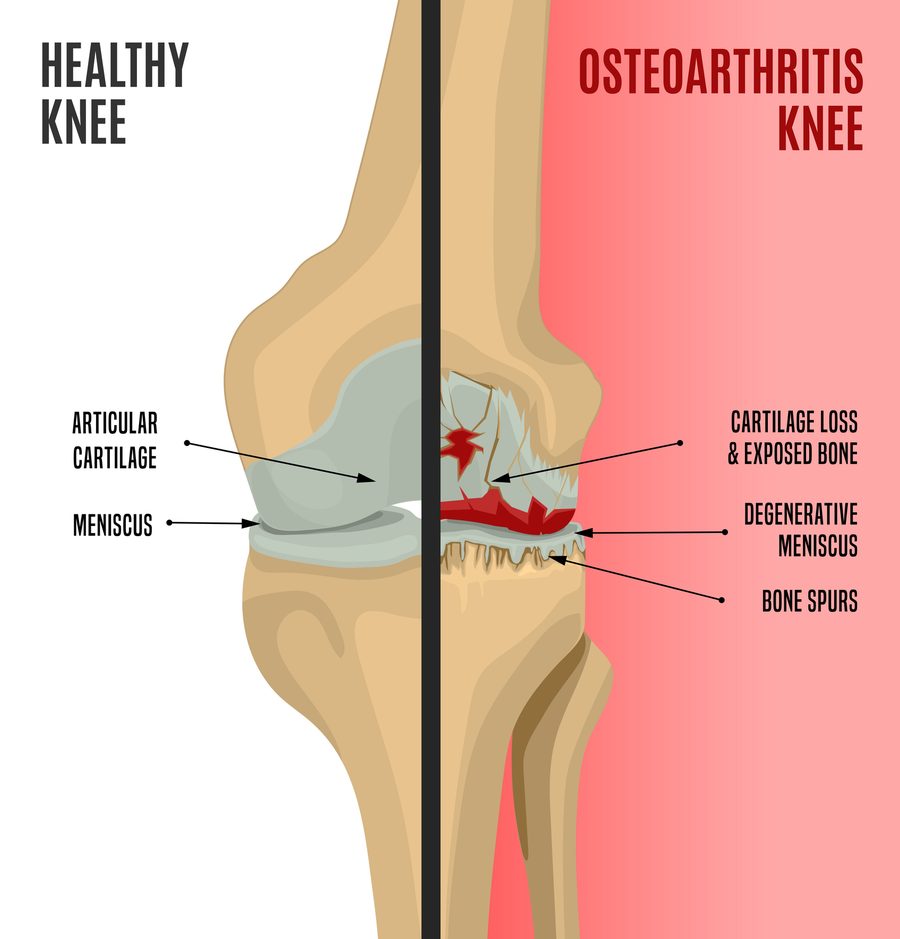
A healthy knee is built to glide. The ends of the thigh bone and shin bone are capped with articular cartilage — a smooth, slippery layer that lets bone move against bone without friction. Between them sit two C-shaped cushions, the menisci, that spread the load and soak up shock. Wrapping the whole joint is a thin lining, the synovium, which makes the fluid that keeps everything slick.

In an arthritic knee, that system wears down. The cartilage thins, cracks, and in places wears through, so bone is left exposed. The meniscus frays and loses its cushion. The bone underneath responds by thickening and growing bony ridges at the edges — bone spurs. And the lining, irritated by all of it, becomes inflamed and swollen. That’s the ache after a long walk, the stiffness when you first stand up, the swelling, the grinding, and the knee that doesn’t quite trust itself on the stairs.

Doctors grade what they see on an X-ray from mild to severe. The grade is useful. But — as you’re about to see — it isn’t the same thing as how much your knee hurts, or how much can be done about it.

Medical illustration comparing a healthy knee, with smooth articular cartilage and an intact meniscus, to an osteoarthritic knee showing cartilage loss with exposed bone, a degenerative meniscus, and bone spurs
Healthy knee vs. arthritic knee Left: smooth cartilage and an intact meniscus. Right: cartilage worn through to bone, a frayed meniscus, and bone spurs along the edges.

The reframe

We treat people, not X-rays.

If a doctor has ever looked at your X-ray and told you that you needed a knee replacement because you were “bone on bone,” you know how final that sounds. Here’s the reality: many people who are bone on bone have no knee pain at all. In published data, most people over 60 with arthritis visible on their X-rays don’t report bothersome symptoms.²

An X-ray can show what a knee looks like. It can’t show how a knee feels. And it cuts the other way too: your pain is real even when the X-ray “doesn’t look that bad.” That’s why we start with the person, not the picture — how your knee behaves in your life, and what’s actually causing the pain.

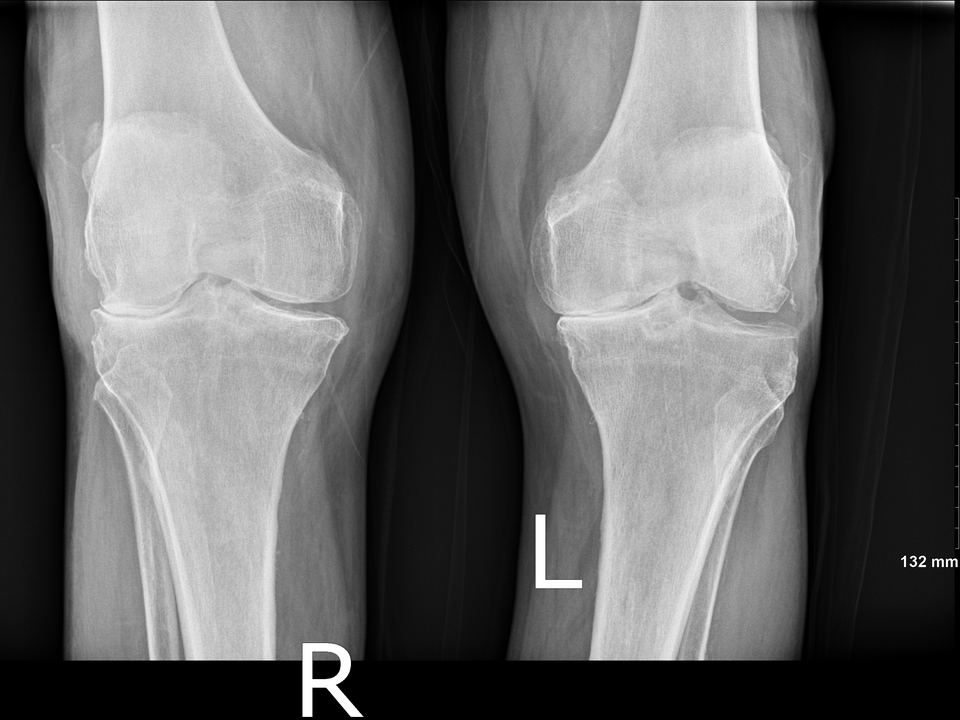
A knee X-ray showing bone-on-bone arthritis
The picture isn’t the pain A “bone on bone” X-ray — from a knee whose owner still has options.

How we treat it

One knee. Two rungs. No operating room.

Dr. Persyn performing an image-guided knee injection

Step one

Injections that actually go where they should.

Cortisone and gel injections have a bad reputation with a lot of patients — often because of how they were done. Placed by feel — what doctors call a blind injection — a shot can miss the joint space entirely. Ours are guided by live X-ray imaging, so they land exactly where they should, without the guesswork.

Many of our patients have gotten years of relief from injections that “stopped working” elsewhere — repeated in six months when appropriate, with a team that knows them by name.

Curious why a gel shot that “did nothing” elsewhere might still work here? Read about our precision gel injections →

For some knees with mild to moderate arthritis, PRP — an injection made from your own blood — is also worth considering, alone or combined with the gel. It’s not covered by insurance, so we publish the price and the research — and we’ll tell you plainly when it’s not worth your money.
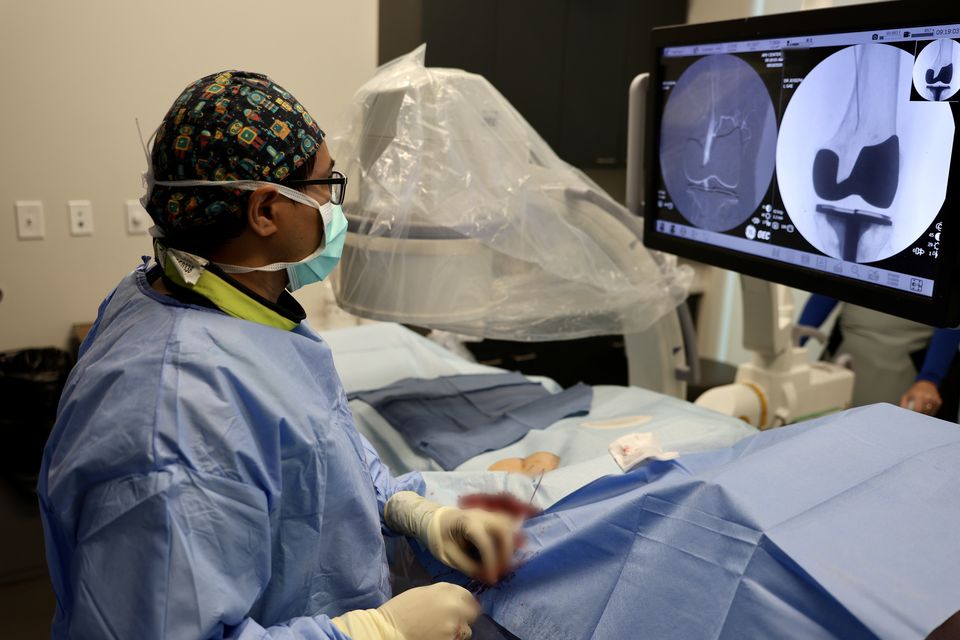

An ARV Centers physician at the imaging equipment in our procedure suite

Step two

When injections aren’t enough — treat the source.

For knees past the point where injections help, we offer genicular artery embolization — GAE for short. It’s not an injection into the joint at all. Through a pinhole in the skin, an interventional radiologist threads a tube thinner than a phone-charger cable to the small arteries feeding the inflamed lining of your knee, and blocks the abnormal blood vessels that keep the inflammation — and the pain — alive.

The healthy arteries stay open. Nothing is cut. Nothing is removed. You go home the same day.

Want to see exactly what that looks like — including live before-and-after angiograms? Read about genicular artery embolization →

The published evidence

GAE is new to most patients. See the research.

4 in 5

patients who got the real procedure improved within a month in a randomized U.S. trial. Patients who got a sham (fake) procedure? Zero out of seven improved. It’s not a placebo.¹

3 in 4

had meaningful pain relief one year after the procedure, across nine clinical studies covering 270 patients.² In a UCLA trial full of severe, bone-on-bone knees, two-thirds cut their pain scores at least in half.³

7 in 10

responders were still doing well at two years. Some symptoms can return between years one and two — and some patients choose a repeat treatment.⁴

1 in 20

went on to a knee replacement within two years in the pooled studies.² And GAE closes no doors: patients who later chose surgery had normal operations with no added difficulty.⁵

What doesn’t it do? GAE doesn’t regrow cartilage, and it doesn’t cure arthritis. It treats the inflammation that drives much of the pain. About one in five patients won’t respond meaningfully — and if we think your knee makes you a poor candidate, we’ll tell you before you spend a dollar.

Is it safe? Across 270 study patients, side effects were minor and short-lived — most commonly temporary skin discoloration near the knee, in about one patient in nine. Serious events were rare.²

And the testing hasn’t stopped. The largest sham-controlled trial of GAE ever run — GENESIS 2, 110 patients, randomized one-to-one against a placebo procedure — is underway right now.⁶ We’ll share its results here when they publish, whatever they show. That’s how real treatments behave.

Sources: 1. Bagla et al., J Vasc Interv Radiol 2022 (randomized, sham-controlled). 2. Taslakian et al., meta-analysis, Osteoarthr Cartil Open 2023 (9 studies, 270 patients). 3. Padia et al., JBJS Open Access 2021. 4. Cusumano et al., J Vasc Interv Radiol 2024. 5. Little et al. (GENESIS), Cardiovasc Intervent Radiol 2024. 6. Little et al., GENESIS 2 protocol, Cardiovasc Intervent Radiol 2023 — results pending.

Candidacy

Who this is for — and who it isn’t.

GAE may be right for you if:

  • Your knee arthritis pain has lasted six months or more
  • Injections, therapy, or medication haven’t given lasting relief
  • You’ve been told you’re “too young” for a replacement — or told to wait
  • You’ve been told you’re too old for a replacement, or that surgery is too risky at your age
  • You’ve been told to lose weight before a surgeon will operate — while the knee pain itself makes exercise impossible
  • You already had a knee replacement and it still hurts — and your surgeon has confirmed the implant is stable (we built a page for exactly this →)
  • You want to avoid surgery, or you’re not a good candidate for it

It’s probably not right for you if:

  • Your pain comes from something other than arthritis (we’ll check)
  • You have certain circulation problems or advanced kidney disease
  • Your knee and your goals are genuinely better served by a replacement — some are, and we’ll say so

We turn away patients who aren’t candidates for what we do. That’s not a slogan; it’s how the practice runs. A frank “this isn’t for you” costs us a procedure and earns your trust.

Your care team

One team for both rungs of the ladder.

Precision injections are performed by Lisa D. Persyn, M.D., board-certified in physical medicine and rehabilitation, with more than 100,000 knee injections behind her — and nurse practitioner Meredith Reynolds handles your exams and care through the visits. Embolization procedures are performed by our Board Certified Vascular and Interventional Radiologists. Same building, same hallway: if your knee needs the second rung, nobody has to refer you anywhere.

Precision injections — step one on the ladder

Embolization (GAE) — step two on the ladder

Meet the whole team →

After your procedure

You go home with the doctor’s cell number.

When you go home, you take the on-call doctor’s cell phone number with you. Not an answering service — the doctor.

And you don’t have to wonder whether to bother us: we call you the next day to check in. Every patient, every procedure.

Patient stories

Knees that got their lives back.

“I was so afraid that my next step would be surgery — but this worked so well that I’m no longer considering it.

— ARVC knee patient

“I’m 85 years old playing singles tennis.”
— ARVC patient

Every patient’s story is their own. Results vary. These are real ARV Centers patients, sharing their experiences with their permission.

Straight answers

Questions patients actually ask.

“Why hasn’t my orthopedic surgeon mentioned this?”

GAE is done by interventional radiologists — a different specialty with a different referral network. Nobody hid it from you; it just lives outside the surgical world you’ve been seeing. The research is published in the major radiology and orthopedic journals, and we’ll gladly share it with your doctor.

“Does it hurt?”

You’re awake but sedated, and most patients describe pressure more than pain. Some feel an ache like their arthritis during the procedure — interestingly, that’s often a sign the right vessels are being treated. Expect some soreness for a few days afterward.

“How fast does it work?”

Most responders notice improvement within the first few weeks, with the full effect by about three months.

“How is this different from the ‘regenerative’ injections I see advertised?”

Three ways. It’s covered by most insurance — stem-cell shots usually aren’t. It has a randomized controlled trial behind it. And we’ll tell you if you’re not a candidate.

“What if it doesn’t work for me?”

Then you’ve lost nothing but a short recovery. Every other option — injections, a repeat GAE, or a replacement — remains fully open.

“Can I still get a knee replacement later?”

Yes. GAE doesn’t change the anatomy a surgeon works with, and in the published trials it added no difficulty to later surgery.

“I already had a knee replacement and it still hurts. Can you help?”

Possibly. About 1 in 5 knee replacement patients report dissatisfaction afterward, most often from persistent pain tied to inflammation of the joint lining — the same tissue GAE targets.² The first step is making sure the implant itself is stable; that’s a question for your surgeon and imaging, and we won’t treat over an implant problem. If the implant is solid and the lining is inflamed, embolization may be worth discussing — early published studies in post-replacement patients report meaningful improvement. Already replaced and still hurting? We built a full page for exactly this situation →

“What does a consultation involve?”

No dinner seminar. No sales pitch. A doctor reviews your imaging and history, examines your knee, and tells you plainly which treatment — ours or someone else’s — fits your situation. Then you go home and decide. We do a complimentary benefits check before any procedure. No surprises.

Free patient guide

Not ready to call? Take the guide instead.

Our free knee arthritis guide explains what’s actually causing your pain, every treatment option — surgical and non-surgical — and the questions worth asking any doctor, including us. Written by our physicians. No appointment required, and no follow-up phone call unless you ask for one.

We’ll email your guide plus occasional patient education. Unsubscribe anytime. Privacy policy.

Tell us what your knee has taken from you. We’ll tell you straight whether we can help get it back.

Bring your X-rays if you have them. Bring your questions. Call us directly, or send this form and we’ll call you to schedule. We do a complimentary benefits check before any procedure. No surprises.

210-405-1335

Consultation hours

  • Monday–Thursday8:00–5:00
  • Morning · last consult11:30 AM
  • Afternoon · last consult4:30 PM
  • FridayProcedures only

Closed on major holidays.

3212 Napier Park, San Antonio, TX 78231

Get directions

Stand-in image (Map © OpenStreetMap) — the live site embeds the interactive Google map here

Schedule an appointment

No referral needed for your initial consultation.

Rather book by phone? Call (210) 405-1335.