“Does it hurt?”
The procedure itself, no — you’re sedated and comfortable, the pinhole at the groin is numbed, and most women describe pressure rather than pain. Recovery is easy, too. As the treated veins close, some women notice a mild pelvic ache and sometimes a low-grade fever for a few days — the body’s normal reaction to a closed vein.³ ⁵ You go home with a plan, we call you the next morning, and you have the on-call doctor’s cell number if it isn’t behaving.
“Will I be awake?”
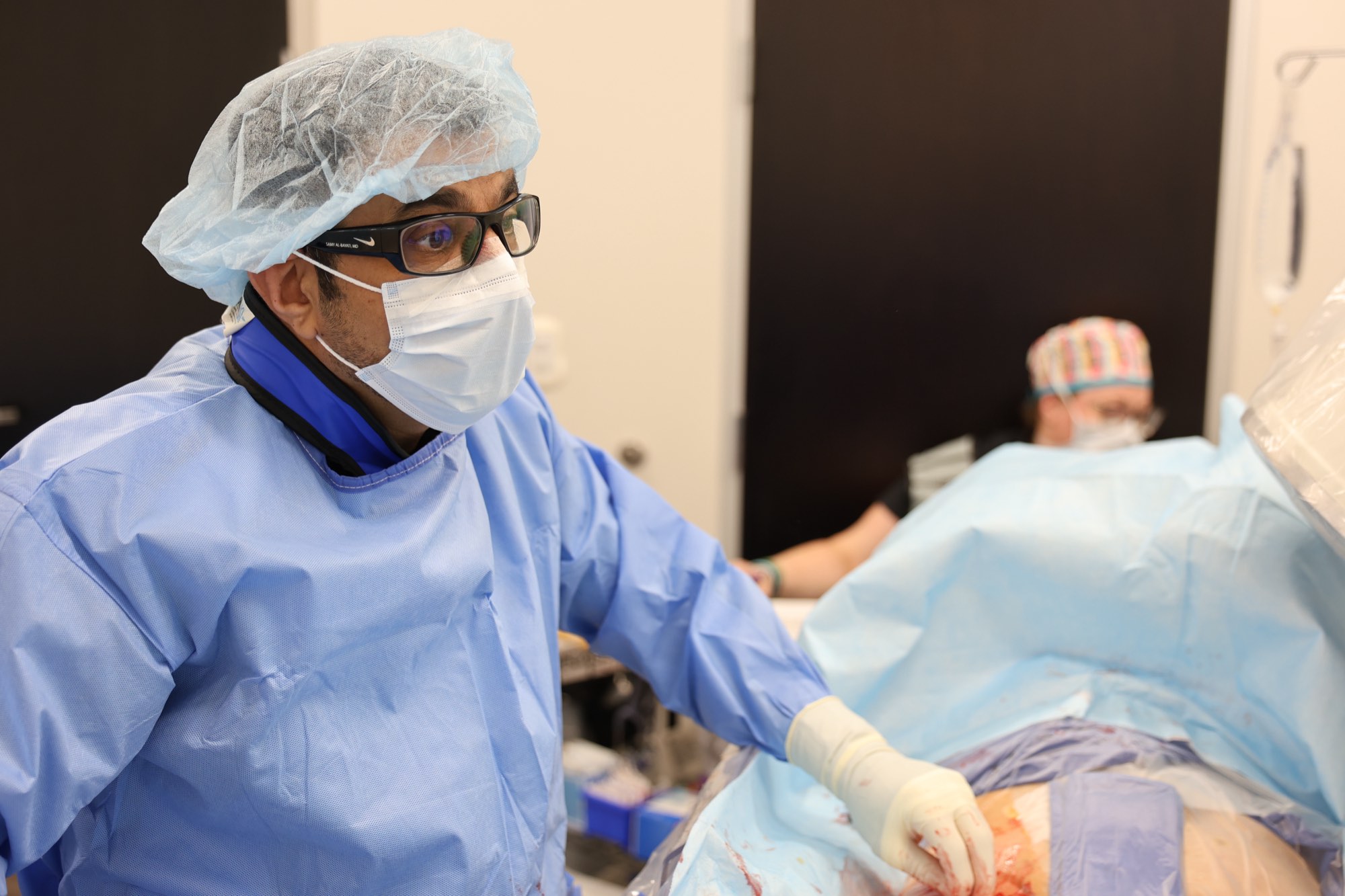
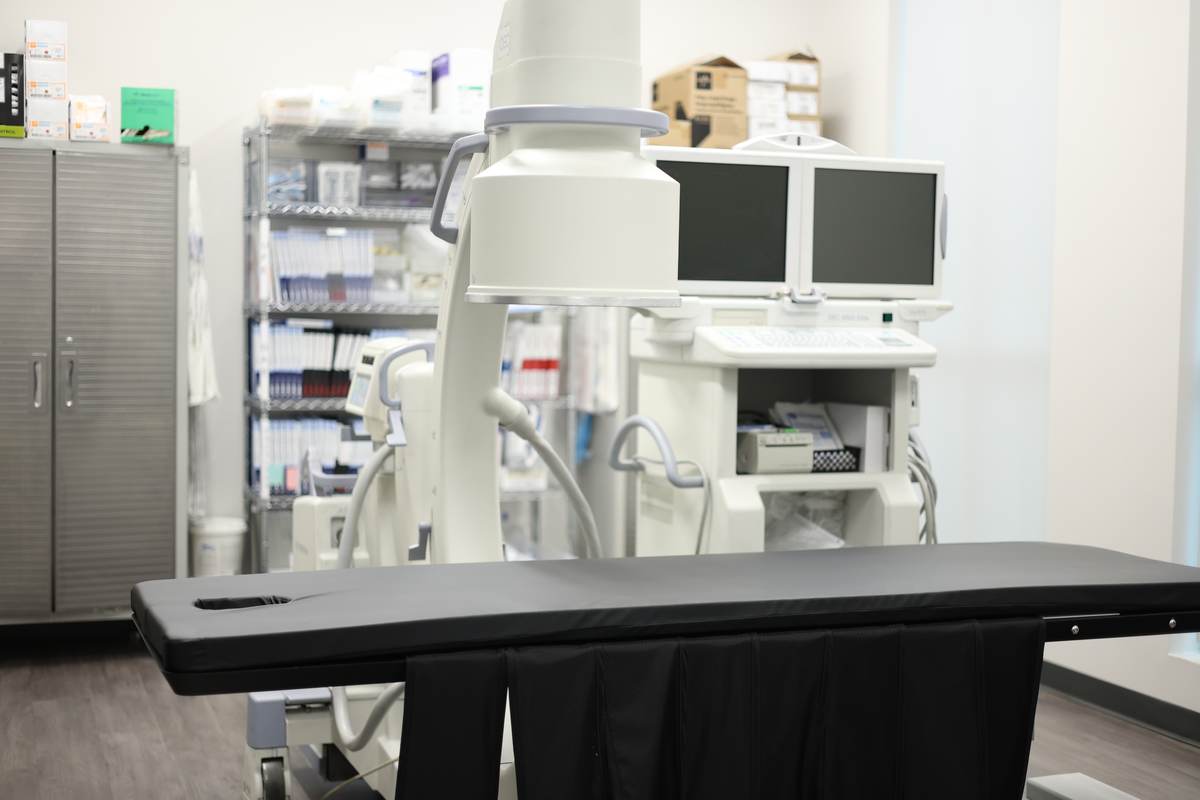
You get twilight or moderate sedation through an IV — relaxed and drowsy, breathing on your own. Not general anesthesia. No breathing tube, no operating room. It is still sedation, so you’ll need a driver to take you home — no exceptions.
“Is the diagnosis really confirmed and treated on the same day? What if the venogram doesn’t confirm it?”
Yes — when it confirms. The venogram is the reference standard for this diagnosis:⁴ the doctor watches, in real time, how blood actually moves through your pelvic veins, measures the ovarian veins, and looks for backward flow. If what we see matches what you feel, we treat right then, through the same pinhole. If it doesn’t confirm, nothing is closed — the catheter comes out and you go home with a real answer and your images, which we’re glad to share with your other doctors. That outcome isn’t a failure. It’s the point of confirming first.
“The coils and the foam — do they stay in? Can I feel them? What about an MRI?”
The foam does its work and is absorbed. The coils stay: small, soft, and permanent, made of the same materials used in vascular procedures for decades, sitting inside a vein high in your abdomen. You won’t feel them. Rarely, a coil can move out of position, which is one reason technique and vein selection matter³ — and one of the things we’ll go over with you before you decide. Airport scanners: no. MRI: the coils are MRI-compatible, but always tell the technologist what’s in you.
“What are the risks?”
Across the published reviews, complications run about 2–3%, and most of that is the post-procedure ache and low-grade fever described above, which settles in a few days.⁴ In the randomized trial there were no major complications.¹ The rare serious ones — a coil moving out of position, a clot travelling to the lung — are recognized, uncommon, and exactly what your physician will go through with you at the consultation.³ Occasionally a vein goes into spasm and can’t be fully treated in one sitting; that happened to about 1 woman in 50 in the trial.¹
“How soon will I feel better — and how long does it last?”
The first few days are ache. Then, over the following weeks, the heaviness eases as the pooled blood clears and the swollen veins shrink back down. Across the published series, 7 to 9 in 10 women get meaningful, lasting relief⁴ — and pain returns in roughly 1 in 10 to 4 in 10 over time.⁴ We print both numbers because you deserve both. If it does come back, we look again with a venogram, and re-treatment is possible.
“What if the pain comes back?”
It can — in roughly 1 in 10 to 4 in 10 women over time, in the published series.⁴ Sometimes a treated vein reopens; sometimes a different vein takes over the job. If it happens, we look again with a venogram, and re-treatment is possible. We’d rather you hear that now than be surprised later. We won’t call this a cure.
“I’ve already had a hysterectomy. Can this still help?”
Possibly — because the veins that cause this aren’t in the uterus. That’s why, in the published surgical series, about 1 in 3 women had pain that persisted after hysterectomy and 1 in 5 had it return.⁵ If your workup shows the ovarian or pelvic veins are still there and still leaking, they can be closed the same way. If it shows something else, you’ll leave knowing what.
“What about May-Thurner or “nutcracker” — the compressed veins upstream?”
Part of the venogram is looking for them. Sometimes the pooling in the pelvis is being driven from above — a squeezed left kidney vein (“nutcracker”) or a squeezed left pelvic vein (May-Thurner) backing blood up into the pelvic veins.³ The current professional guidance specifically recommends checking for kidney-vein compression before the ovarian vein is closed,³ and treatment is different when compression is the cause. If we find it, we’ll tell you, and we’ll explain what it changes — the May-Thurner treatment page covers that route.
“Why didn’t my gynecologist mention it? Is it experimental?”
It isn’t experimental. There’s a randomized trial in which the comparison group had the same catheter procedure without the treatment, and the treated women did significantly better at one year with no major complications;¹ and in 2026 the Society of Interventional Radiology published formal practice guidance for it.³ The reason it may never have come up is that it isn’t performed by gynecologists. Your gynecologist looks for gynecologic causes — that’s their job, and they’re good at it. Veins are a vascular problem, treated by interventional radiologists: a different specialty, with a different referral network. Nobody’s fault; a gap in the map. What we won’t do is tell you anyone was wrong.
“Is it covered by insurance?”
Typically, yes. We do a complimentary benefits check before any procedure, usually ready the same day as your consultation, so you’ll know exactly where your plan stands before you decide anything — and any out-of-pocket cost is discussed with you before any procedure is performed. If a deductible or coinsurance is more than you want to pay at once, we offer Affirm, CareCredit, and in-house payment arrangements.
“Do I need a referral?”
Not for your initial consultation — call us directly. If your plan requires a referral or prior authorization for treatment itself, we’ll identify that during the complimentary benefits check and help you get it.