
For heel pain that’s a year or more in — and has outlasted everything you’ve tried
When the first steps in the morning still hurt a year later, it may be the blood vessels.
Samy A. Al-Bayati, M.D. · ARV Centers, San Antonio
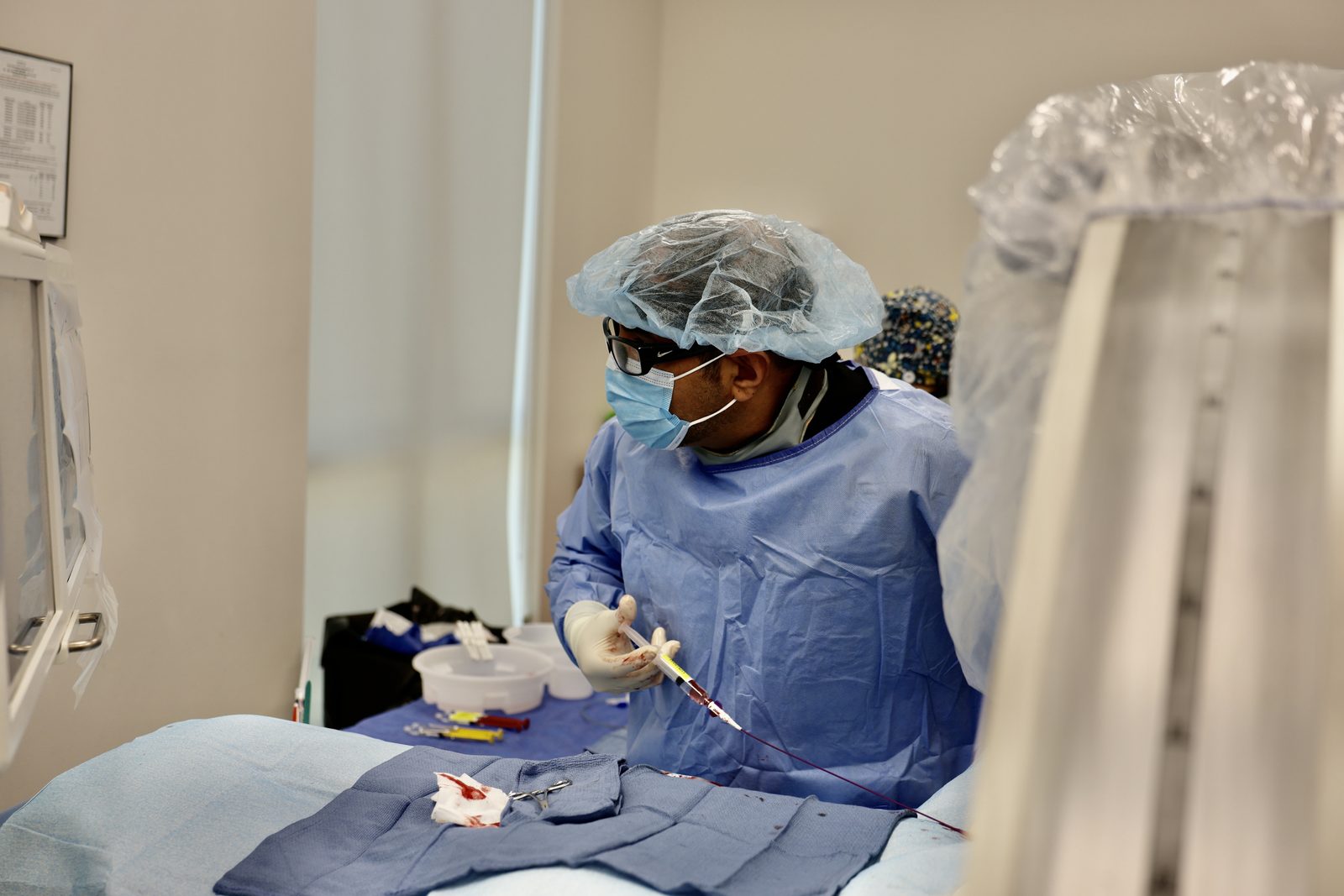
Board Certified Vascular & Interventional Radiology — performing a plantar fascia embolization in our angiography suite, start to finish.
Plantar fascia embolization (PFE) is a non-surgical procedure for plantar fasciitis that has hung on for a year or more despite everything you’ve tried. Through a pinhole at the top of the thigh or at the ankle, an interventional radiologist blocks the abnormal blood vessels feeding the inflamed heel. Light sedation, 30 to 45 minutes, home the same day — nothing cut, no cast, no months off your feet.
No major complications reported in the published studies Complimentary benefits check before anything is scheduled No referral needed for your initial consultation
If you just heard the word “embolization”
Maybe you came here from our plantar fasciitis page, wanting to know what this procedure actually involves.
Maybe someone in a forum mentioned “PFE” and you’ve been trying to find out what it is. Is it surgery? Do they cut the fascia? Am I awake? Who even does this?
Or maybe you’re just tired — of the stretches, the inserts, the shots that wear off, of being told it’ll go away on its own by people who said that two years ago.
This page tells you what the procedure is, what the studies actually show — including how small they are — and who we’ll tell to wait. No number we can’t back up.
The procedure
What PFE actually is.
When the tissue at your heel stays inflamed long enough, the body grows a tangle of abnormal new blood vessels into it. New pain nerves grow along those vessels. That’s part of why a spot the size of a thumbprint can hurt this much for this long — and why the picture (a spur on the X-ray) so often doesn’t match the pain.
PFE goes at that tangle directly. Through a pinhole at the top of your thigh or at your ankle, a catheter thinner than a phone-charger cord travels down to the small arteries feeding the heel. Dye makes the abnormal vessels show up as a blush the healthy side of your foot doesn’t have — that’s the dark cloud filling in the angiogram loop on this page. There, microscopic particles block the abnormal vessels while the normal blood supply to your foot keeps flowing. Starve the tangle, and the extra pain wiring quiets. The inflammation eases with it.
It’s the same mechanism behind genicular artery embolization, the knee-arthritis procedure we perform every week — same doctors, same suite, same dissolving agent. The knee has far more research behind it than the heel does — we lay out exactly how much of each below. What we can tell you from our own suite: in our experience, the results track.
The published evidence
What the research shows — and what we see.
Embolization for the heel is newer than most of what we do, so rather than quote you a success rate, we’ll show you every study there is. They are small, and they all report the same two things: meaningful relief in people who had already failed everything else, and no major complications.
First, the part most pages leave out. Treating joint and tendon pain by blocking abnormal blood vessels isn’t a heel idea — it’s a field, and the heel is its newest corner. The knee is the most studied by a wide margin: three published trials that tested the real procedure against a placebo procedure, a pooled analysis of 270 patients across nine studies, and the biggest placebo-controlled trial yet — 110 patients — currently running.⁷ The shoulder is a few years behind the knee and moving the same direction: a 2026 pooled analysis of twelve studies and 329 treated shoulders, including a trial run under FDA oversight.⁸ The heel is behind both — that’s the honest ranking. What it shares with them is the mechanism, the same dissolving embolic agent, and, here, the same doctors and the same suite: we perform multiple knee embolizations every week.
What the published heel studies are:
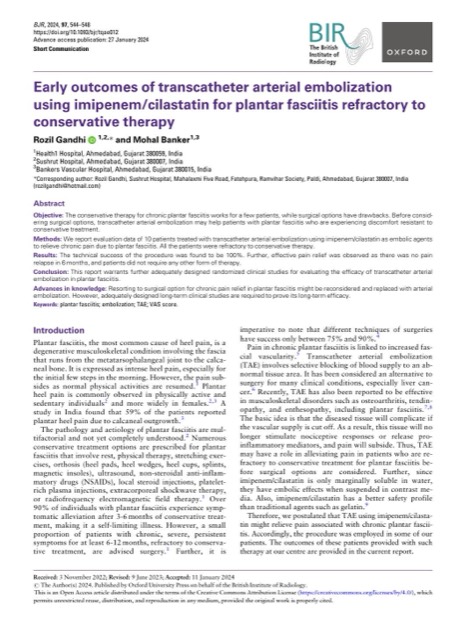
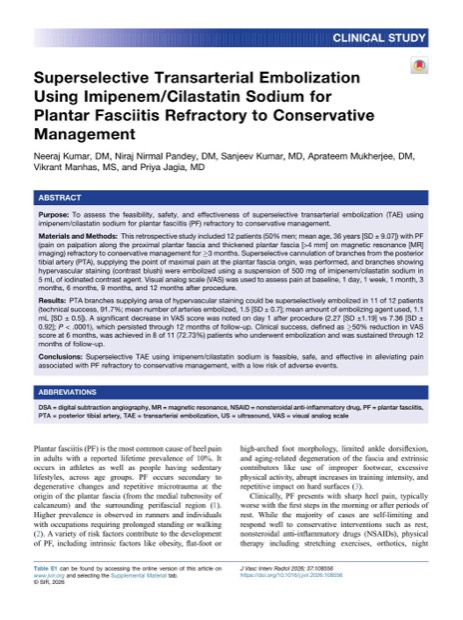
The actual papers — click either one to read it in full. We would rather you checked our work than took our word for it.
66 patients
Japan · the largest series
Treated 2020–2022 and followed up to four years. Function scores rose 65.8 → 92.8 at one year and held at an average of 31 months.
No major adverse events ³
10 patients
UK · the most detailed report
13 procedures, everyone having already failed at least three months of conservative care. Pain fell 8.5 → 1.9 at one month and stayed near 1 at six and twelve.
No significant complications ⁴
Case reports
A handful, single-patient
Individual patients written up on their own — the earliest signal in any new procedure, and the reason the two series above matter more.
Recruiting
United States · what’s coming
A U.S. trial is now enrolling patients.⁵
What we take from that: the improvements in those series are well beyond what time alone explains, and the safety record behind them is as clean as any procedure we offer. Add what PFE actually asks of you — a pinhole, 30 to 45 minutes, home the same day, nothing permanent left behind — and set it against a heel surgery with weeks in a boot. For the right patient, that is not a close call.
Where we’ll tell you to wait: plantar fasciitis has a real tendency to settle down on its own. If you are only a few months in, or your pain is already trending the right way, we will say so and send you back to the conservative plan. The patients we treat are the ones still in serious pain at six months or more, having genuinely tried everything — and giving you that answer honestly is why you can trust the rest of this page.
Procedure day
What happens, step by step.
A consultation, an exam, and an ultrasound of your heel come first. We measure the thickness of the fascia where it attaches and look for the abnormal vessels the procedure targets — published selection criteria use a thickness over 4 mm.⁶ If your scan doesn’t show the pattern, we’ll tell you, and we won’t book you.
-
You get comfortable. An IV delivers twilight sedation — you’re relaxed and drowsy, breathing on your own, with a nurse watching over you the whole time. Not general anesthesia.
-
The pinhole. The doctor numbs a spot at the top of your thigh — or at your ankle, whichever gives the cleanest route to your heel — and makes a pinhole opening in the artery. No incision, no stitches.
-
The map. A catheter travels down the leg to the small arteries of the heel, dye flows, and X-ray pictures reveal the abnormal vessels — a blush the healthy side doesn’t have.
-
The treatment. The doctor releases microscopic particles into each abnormal cluster, leaving the healthy arteries to your foot flowing. All told, you’re usually on the table 30 to 45 minutes.
-
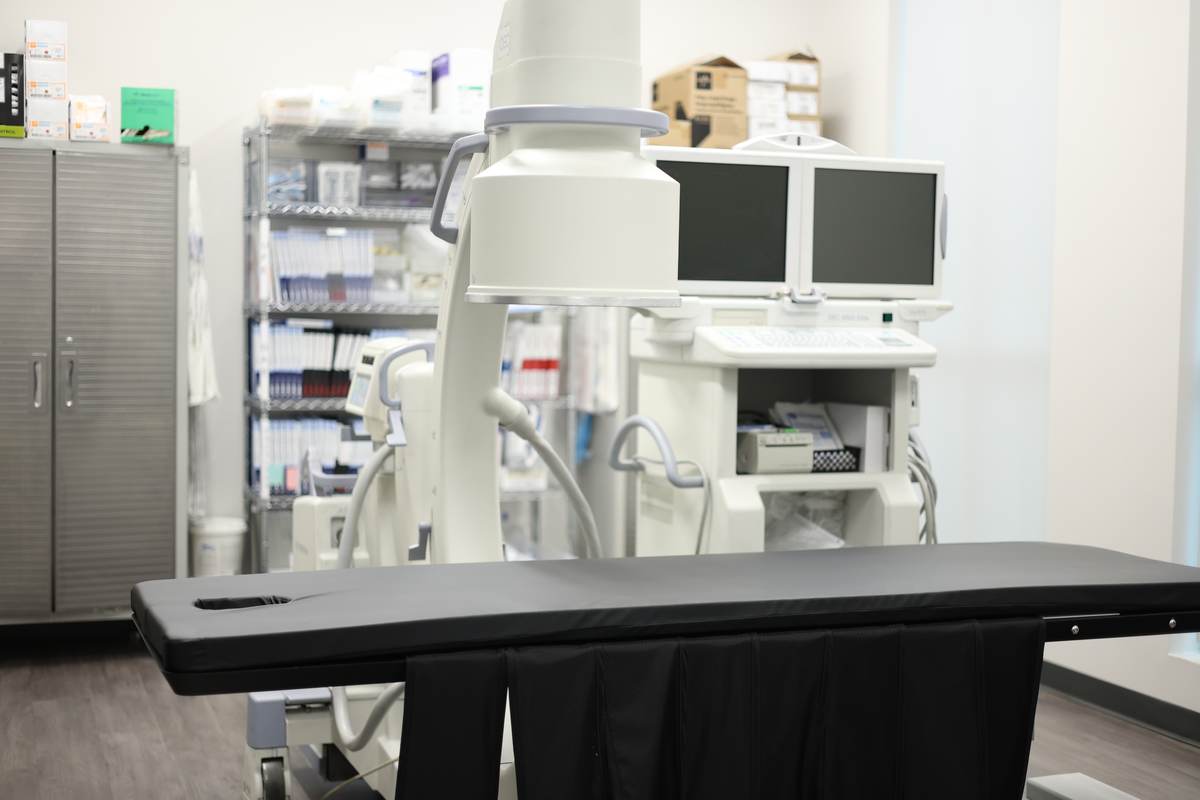
Sealed and resting. The catheter comes out, the pinhole is sealed with a closure device, and you rest with us for about an hour.
-
Home — walking. Someone drives you. No driving or big decisions for 24 hours while the sedation wears off. Expect mild bruising or an ache at the pinhole for a day or two, take it easy for a few days, then get back to your routine — and we call you the next day to check in.
The timeline nobody tells you: this is not a switch. Relief comes on over weeks as the inflammation settles. In the published series, improvement was measured at one month and continued through three, six and twelve.⁴ If you expect to wake up fixed the next morning, you’ll be disappointed by a procedure that may be working.
The published evidence
Four numbers we’ll stand behind.
0
major complications reported across every published series of plantar fascia embolization — no tissue death, no ulcers, no ruptured fascia.³ ⁴ From under a hundred published patients: a good sign, not a guarantee.
8.5 → 1.9
pain scores (out of 10) one month after embolization in the most detailed published series — and still around 1 at six and twelve months.⁴
80%+
of people with plantar fasciitis are completely better within 12 months without any of this.¹ It’s the reason we’ll tell you to wait if you’re early in, or still improving.
46%
of people whose plantar fasciitis was bad enough to reach a specialist still had it an average of nearly ten years later.² You’re not doing it wrong. It’s the reason we take you seriously if you’re years in.
And what we see: in our experience plantar fascia embolization is highly effective — most of the patients we treat get real, meaningful relief, and it tends to arrive within weeks, in heels that had hurt for a year or more.³ ⁴ Safety is the part the published record is clearest on: across every series, no tissue death, no ulcers, no ruptured fascia. And it is a 30-to-45-minute outpatient procedure through a pinhole, with nothing permanent left behind — set that against heel surgery and a boot, and for the right patient it is not a close call.
Sources: 1. Viglione et al., EFORT Open Rev 2023 — meta-analysis of 42 double-blind trials, 1,724 placebo-arm patients: placebo pain improvement 2.13/10, 2.79 at 12 months; more than 80% of patients resolve within 12 months. 2. Hansen et al., Orthop J Sports Med 2018 — 174 patients followed a mean 9.7 years: 46% still symptomatic; heel spur and fascia thickness had no effect on prognosis. 3. Sasaki et al., Foot Ankle Surg 2025 — 66 patients: AOFAS 65.8→92.8 at 1 year, effect held to mean 30.9-month follow-up, no major adverse events. 4. Gandhi & Banker, Br J Radiol 2024 — 10 patients / 13 procedures: VAS 8.5→1.9 at 1 month, about 1.0 at 6 and 12 months, no significant complications. 5. ClinicalTrials.gov NCT06805942 — single-arm, unmasked, 10 participants estimated. 6. Okuno, Endovascular Today Feb 2025 — fascia thickness over 4 mm as a selection criterion; some patients need a second treatment. 7. Knee: Taslakian et al., Osteoarthr Cartil Open 2023 — systematic review & meta-analysis, 270 patients / 339 knees across 9 studies; three sham-controlled randomized trials published to date; Little et al., Cardiovasc Intervent Radiol 2023 — GENESIS 2 protocol, up to 110 patients, results not yet published. 8. Shoulder: Allaw et al., J Vasc Interv Radiol 2026 — systematic review & meta-analysis, 12 studies / 329 shoulders; Bagla et al., J Vasc Interv Radiol 2022 — U.S. FDA IDE trial, 20 patients.
Candidacy
Who this is for — and who we’ll tell to wait.
PFE may be worth a conversation if:
- Your heel pain has lasted six months or more and is still severe
- You’ve genuinely done the conservative work — the fascia-specific stretch, calf stretching, a loading program, a night splint, inserts, hands-on therapy — and it hasn’t held
- Cortisone helped but keeps wearing off, and you’re wary of a third or fourth shot
- You want to avoid surgery that cuts the fascia, or the weeks-to-months of recovery it takes
We’ll tell you to wait — or look elsewhere — if:
- You’re under six months in, or haven’t done the conservative work. You’ll still leave with a plan
- Your pain is genuinely trending better, even slowly. Plantar fasciitis does tend to improve with time — if you’re moving that direction, you may not need a procedure at all
- Your heel pain looks like something else — a stress fracture, a pinched nerve, an inflammatory arthritis, a thinning heel pad. We look before we treat
- You have significant artery disease or poor circulation in the leg or foot, or a serious allergy to X-ray contrast dye
We turn away patients who aren’t candidates for what we do. With this procedure, expect that to be a real possibility — and to leave with a plan either way.
Insurance and cost
We’ll check your coverage before anything is booked.
Embolization is typically covered by insurance, and as with every procedure we perform, what you actually owe comes down to your specific plan. So we handle it the same way here as we do everywhere else: a complimentary benefits check before anything is scheduled. Usually we can tell you what your benefits are on the day of your consultation. If your plan requires a referral or prior authorization, we identify that during the check and help you get it.
There are no surprises and nothing is booked until the numbers are in front of you — you’ll know exactly where you stand before you decide anything.
Your care team
The doctors who perform PFE here.
Your consultation starts with a provider reading your history and your ultrasound with you. The procedure itself is performed by our Board Certified Vascular and Interventional Radiologists, in our own angiography suite — not a hospital.



After your procedure
You go home with the doctor’s cell number.
When you go home, you take the on-call doctor’s cell phone number with you. Not an answering service — the doctor.
And you don’t have to wonder whether to bother us: we call you the next day to check in. Every patient, every procedure.
Before you leave, you’ll get this card
Your procedure:
On-call doctor:
Cell phone: written by hand, before you walk out
Call me if anything worries you.
Straight answers
Questions patients actually ask.
“Is this experimental?”
It’s new to patients — not to the technique. Blocking abnormal vessels through a catheter has been used for decades elsewhere in the body, and it’s the same procedure we run in the knee every week, where the research is deepest. For the heel specifically, the published series are small — 66 patients in Japan, ten in the UK, a handful of case reports — and nobody has yet run a trial comparing it head-to-head against another treatment.³ ⁴ ⁵ What every one of those series reports is the same thing: meaningful relief in people who had already failed everything else, and no major complications. In our experience, the results track.
“Why haven’t I heard of this?”
Because it’s new, the studies are small, and most of the doctors who treat heel pain don’t perform catheter procedures. Some patients find it the way you may have — from another patient. We’d rather you found the evidence here, sized honestly, than a testimonial anywhere else.
“Will I be awake? Does it hurt?”
You’ll be under twilight sedation — relaxed, drowsy, breathing on your own, with a nurse watching you the entire time. It’s not general anesthesia: no breathing tube, and a much quicker recovery. The pinhole is numbed first. Most people describe pressure rather than pain, and go home the same day with mild bruising at the top of the thigh.
“How soon will I know if it worked?”
Weeks, not days. In the published series, improvement was measured at one month and continued through three and six.⁴ Relief builds as the inflammation settles. If you’re expecting to wake up fixed, this isn’t that — and we’d rather say so now.
“What are the risks?”
Across everything published, no major adverse events have been reported — no tissue death, no ulcers, no ruptured fascia.³ ⁴ Two honest qualifiers: that record comes from under a hundred published patients, so it’s a good sign, not a guarantee; and every catheter procedure carries a small risk of bruising or bleeding at the pinhole and of a reaction to contrast dye. If you have peripheral artery disease, poor circulation in the foot, or an iodine contrast allergy, this is likely not for you — and we review the rare risks with you in plain language before you decide anything.
“Why no before-and-after pictures?”
Our knee and shoulder pages show before-and-after angiograms. This page shows you the target — the abnormal blush, live — but not a before-and-after, on purpose. In the longest study of plantar fasciitis, the fascia got thinner and more normal-looking on ultrasound in the people who still hurt and the people who didn’t — equally.² With this condition, the picture and the pain aren’t the same thing, and you’ve probably been shown pictures before. The outcome that matters is whether you can walk the dog. That’s what we’ll ask you about.
“Isn’t the heel spur the problem?”
Almost certainly not. In that same ten-year study, having a spur made no difference to who got better.² Plenty of people with a spur have no pain at all. It isn’t what this procedure treats, and it isn’t why your heel hurts.
“Should I just get another cortisone shot instead?”
One image-guided injection to break a bad patch is a defensible thing to accept — across the randomized trials, no fascia ruptures occurred after a steroid shot; the risk that shows up in clinic reviews goes with repeated injections.⁷ A fourth shot into tissue that hasn’t responded to three is a different conversation, and it’s one we’ll have honestly.
“Do you offer anything else for heel pain?”
Yes — platelet-rich plasma (PRP): your own blood, concentrated and injected into the damaged tissue under ultrasound guidance. For some people it’s the right step before any catheter procedure, and we’ll say so. It isn’t covered by insurance — $900 per injection, and we’d rather print the price than surprise you with it. Which tool fits your foot, if either, is an exam conversation, not a menu item.
“Can you treat both feet?”
Both-feet cases were treated in the published series.⁴ Whether to do them together or one at a time is something we’d decide with you.
“What if it doesn’t work?”
Then you’re where you were, minus a day — and surgery is still on the table. Some patients in the wider literature have needed a second treatment.⁶ That’s the honest answer, and it’s a real part of the decision.
“Is it covered by insurance?”
Embolization is typically covered by insurance, and what you owe depends on your specific plan — the same as it does for any procedure we perform. We do a complimentary benefits check before anything is scheduled, and we can usually give you the answer the same day as your consultation, so you’ll know exactly where you stand before you decide anything.
7. Whittaker et al., BMC Musculoskelet Disord 2019 — systematic review of 47 randomized trials, 2,989 patients: no plantar fascia ruptures in the trial arms; the rupture risk seen in retrospective clinic reviews is associated with repeated injections.
Free patient guide
Not ready to call? Take the guide instead.
Our free heel-pain guide explains what’s actually wrong with your foot, how long this really lasts, and all fourteen ways it gets treated — including the twelve we don’t perform, and what the studies actually found for each. Written by our physicians. No appointment required, and no follow-up phone call unless you ask for one.
We’ll email your guide plus occasional patient education. Unsubscribe anytime. Privacy policy.
One conversation tells you if you’re a candidate — or if you should wait. Either way, you leave with a plan.
You’ll sit with a clinician — not a salesperson. You’ll hear every option, including the ones we don’t offer, and get a straight answer about whether PFE fits your foot. Call us directly, or send this form and we’ll call you to schedule. We do a complimentary benefits check before any procedure. No surprises.
210-405-1335Consultation hours
- Monday–Thursday8:00–5:00
- Morning · last consult11:30 AM
- Afternoon · last consult4:30 PM
- FridayProcedures only
Closed on major holidays.
3212 Napier Park, San Antonio, TX 78231
Stand-in image (Map © OpenStreetMap) — the live site embeds the interactive Google map here
Schedule a heel-pain consultation
No referral needed for your initial consultation.
Rather book by phone? Call (210) 405-1335.