“Is a varicocele dangerous?”
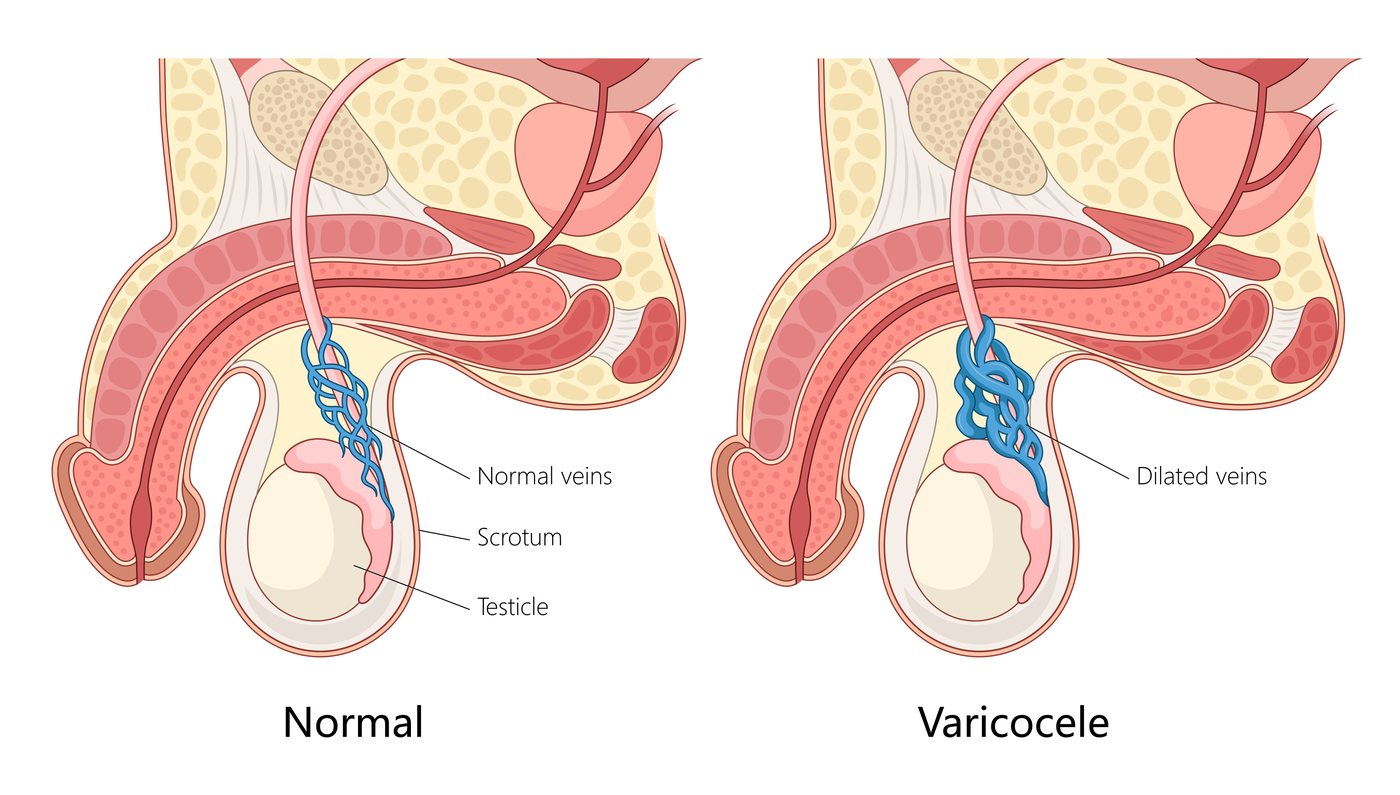
No. It won’t become cancer and it isn’t life-threatening. It can cause pain, and it can affect fertility and the size of the testicle on that side. Those are good enough reasons to treat it if it’s affecting you — and they’re also why nobody should rush you.
“Why does it ache more at the end of the day?”
Because it’s pooled blood. Every hour you’re upright, gravity fills the failed veins a little more; lie down and they drain. That’s why the ache builds through the day, is worse after standing, walking, or lifting, and eases overnight — and it’s the same reason a varicocele can be missed by an exam or a scan done lying down.
“Will it go away on its own?”
No. Nothing shrinks a varicocele except a repair. Scrotal support and anti-inflammatories genuinely help a lot of men and are the right place to start — but they manage the ache; they don’t change the veins. If you’ve given them a fair run and you’re still aching, that’s the point at which the treatment conversation is worth having.
“I was treated for an infection — twice. Was it ever an infection?”
Maybe not. Epididymitis — an infection of the tube behind the testicle — causes scrotal pain and is a reasonable first guess in a short appointment; antibiotics are the right treatment for it. They do nothing whatsoever to a varicocele, because a varicocele isn’t an infection. Repeated courses that didn’t help aren’t a failure of the medicine. They’re a sign the diagnosis hasn’t landed yet — say it out loud at your next appointment, and ask to be examined standing.
“Does standing really matter that much for the exam and the ultrasound?”
Yes — it’s the whole test. A varicocele fills when you stand and drains when you lie down; examined or scanned flat, a real, symptomatic varicocele can simply not be there when someone looks. The physical examination, standing, is the reference standard for finding one. At ARVC we examine you standing and have you scanned standing. If you’ve had an ultrasound before and aren’t sure how it was done, it’s a fair question to ask, and the answer explains a great deal.
“Can it affect my fertility?”
It can. Varicoceles are found in about 40% of men evaluated for infertility; the leading theory is heat — pooled blood warms the testicle, and sperm production is sensitive to temperature. Treating one can improve semen quality. It does not guarantee a pregnancy. If conceiving is your goal, start with a urologist or reproductive urologist and a semen analysis — and know that for men in that position, the American guidelines name surgical repair, not embolization. We’ll tell you the same thing in person.
“Does a varicocele lower testosterone — and does fixing it raise it?”
You’ll find that claim online. There’s a real signal in the research, but it comes almost entirely from studies that looked backward rather than forward, and all of it is from surgery. We don’t print it as a benefit of anything we do. If your testosterone is genuinely low and you have a varicocele you can feel, it’s a fair thing to raise at your consultation — as a conversation, not a promise.
“Which treatment do the guidelines recommend?”
It depends on the question. For men trying to conceive who have a varicocele that can be felt, infertility, and abnormal semen results, the American Urological Association and the American Society for Reproductive Medicine advise considering surgical varicocelectomy. For pain — the reason most men are actually treated — the guidelines say much less, and both surgery and embolization are reasonable; the trade is recovery and risk against a marginally lower recurrence rate with microsurgery. The one thing the guidelines are emphatic about: don’t treat a varicocele that can’t be felt and shows only on a scan. We follow that.
“Mine is on the right side. Does that matter?”
Worth mentioning specifically. About 85% of varicoceles are on the left, for reasons of plumbing. One that appears only on the right — especially suddenly, in an older man, or one that doesn’t drain when you lie down — is unusual enough that doctors look further up for a cause. It usually turns out to be nothing sinister, but it’s the kind of detail that should change how carefully you’re looked at, so say it early.
“When is testicular pain an emergency?”
Sudden, severe testicular pain is an emergency-room visit — it can mean a twisted testicle, and hours matter. So is pain with fever, redness, or swelling of the testicle itself. A varicocele doesn’t do any of those things; it aches. And separately, regardless of any varicocele: a lump on the testicle itself, as opposed to the soft veins above it, should be seen promptly.
“Is treatment covered by insurance? Do I need a referral?”
Varicocele embolization is covered by most insurance plans, and we’re in-network with most plans. You don’t need a referral for your initial consultation — call us directly. If your plan requires a referral or prior authorization for treatment itself, we identify that during the complimentary benefits check and help you get it. And we’re glad to coordinate with your urologist before and after; many stay involved.