For women in San Antonio who’ve been told their pelvic pain is “normal” — and are still in pain

Pelvic pain that’s worse by evening, better lying down — and “normal” on every scan? Let’s look at your veins.

Pelvic congestion syndrome (now also called venous-origin chronic pelvic pain) happens when the veins that drain your pelvis stop working properly and blood pools where it shouldn’t — a dull, heavy ache that builds through the day. It’s commonly missed, partly because most imaging is done lying down, when the veins empty out. Ovarian and pelvic vein embolization is a non-surgical, in-office treatment for it — typically covered by insurance. But first comes the part that matters most: a workup that shows whether your veins are actually the cause. No referral needed for your initial consultation.

A vein-focused workup first — we won’t treat off a scan alone Typically covered by insurance No referral needed for your initial consultation

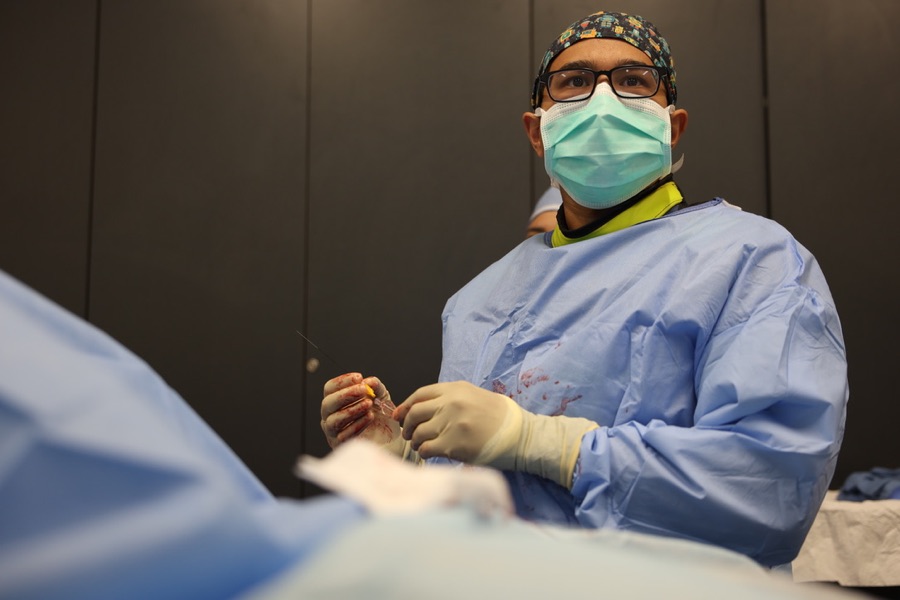
Dr. Arthur Joseph performing an embolization procedure in the ARV Centers angiography suite
ARV Centers, San Antonio Arthur S. Joseph, D.O., M.P.H., performing an embolization procedure in our angiography suite.

Does this sound familiar?

A dull, heavy, dragging ache low in your pelvis. Pressure that builds the longer you’re on your feet and finally lets go when you lie down. Bloating that’s there when you wake up and worse by dinner, whether or not you’ve eaten. An ache after sex that lingers. Maybe varicose veins where you didn’t expect them — the vulva, the upper thighs, the buttocks.

Maybe you’ve had the ultrasound, the CT, the MRI, the bloodwork — and been told, every time, that everything looks “normal.” Maybe someone offered antidepressants instead of another look. Maybe you’ve already read enough to suspect what this is, and the hard part hasn’t been finding the name. It’s been finding someone who will image the right thing.

Pelvic pain that follows gravity — worse upright, better lying down — is a real, physical pattern, and it points at your veins. It’s common. It’s commonly missed. And whether or not it turns out to be the cause in your case, you deserve a workup that actually answers the question.

What pelvic congestion syndrome actually is

Varicose veins — inside the pelvis.

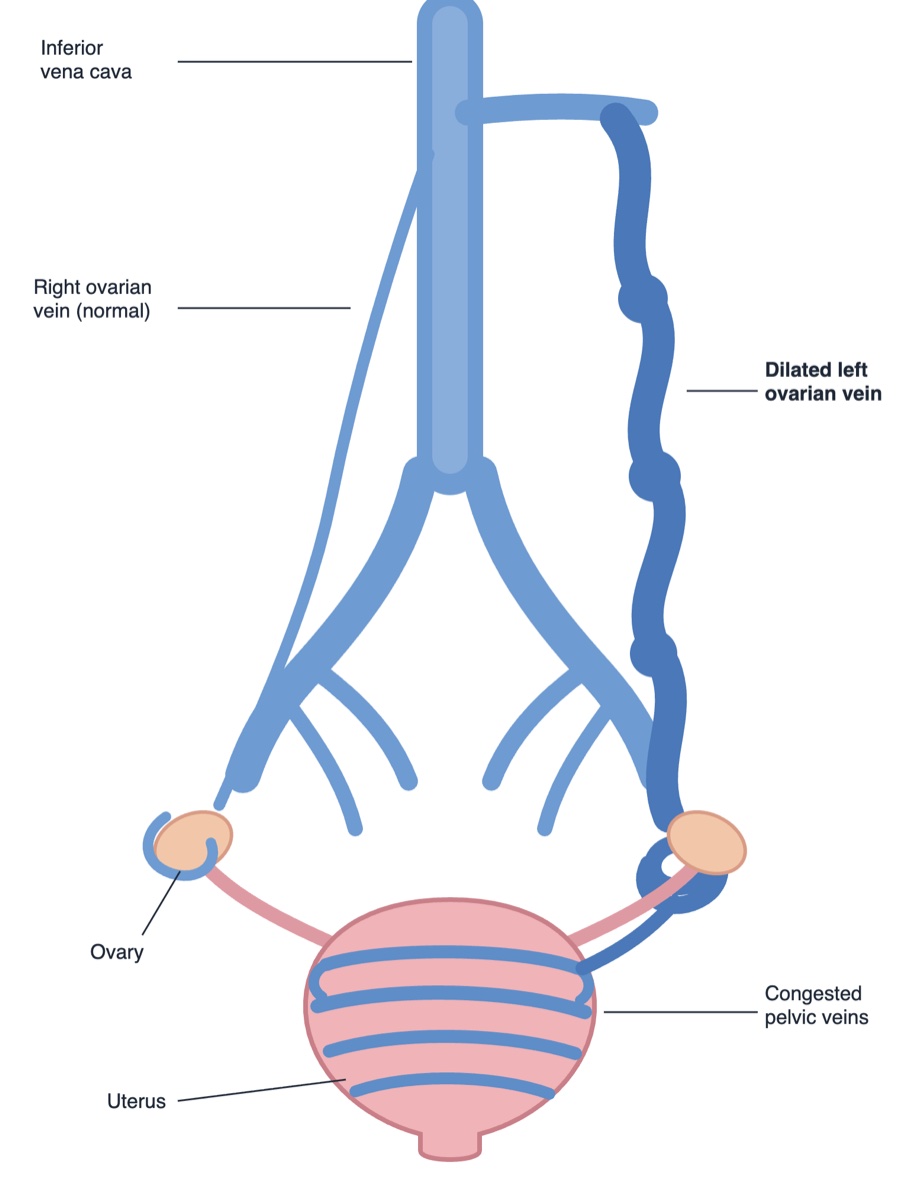
Your pelvis drains through a network of veins — including the ovarian veins, which run from the pelvis up toward the kidneys. Like the veins in your legs, they rely on one-way valves to keep blood moving against gravity. When those valves fail, blood flows backward and pools. The veins stretch, bulge, and press on the nerves around them.

That’s why the pain follows gravity. Standing and sitting let blood pool; lying down lets it drain — which is also why the pain is often at its worst at the end of a long day on your feet, and better first thing in the morning.

Pregnancy is the most common reason the valves give out: vein capacity can rise by more than half during pregnancy, and stretched valves don’t always recover.¹⁴ Estrogen weakens vein walls, which is one reason this is largely a condition of the childbearing years and tends to ease after menopause.¹⁴ Sometimes there’s a plumbing problem upstream — a compressed vein in the abdomen (May-Thurner or “nutcracker” anatomy) that backs blood up into the pelvis.³ ¹⁴ Part of a proper workup is looking for that too.

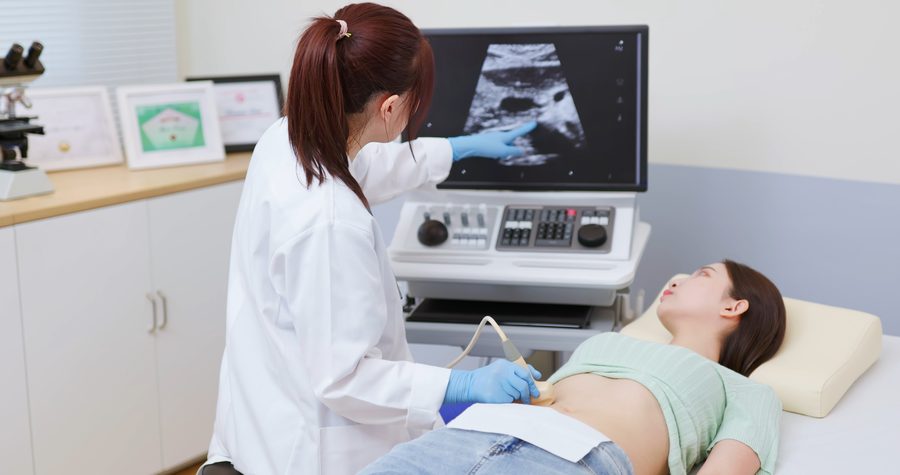
A woman lying flat on her back having a pelvic ultrasound
“Normal” — while lying down Most pelvic imaging is done flat on your back, the one position where these veins empty out. That’s a big part of why it gets missed.

Why it takes years to find

“Normal” scans don’t rule it out. Here’s why.

Chronic pelvic pain affects roughly 15% of women between 18 and 50, and in about 6 out of 10 of those cases the cause is never explained.⁶ That’s not because anyone stopped caring. It’s because the standard workup is built to find the common gynecologic causes — cysts, endometriosis, fibroids, infection — and pelvic veins hide from it in three specific ways:

  • The imaging is done lying down. Ultrasound, CT, MRI, even laparoscopy are all performed with you flat on your back — the position where these veins drain and flatten. Laparoscopy, the surgical look inside the pelvis, can miss pelvic varices in the large majority of women who have them, because the gas used to inflate the abdomen squeezes the veins shut.¹⁴
  • There is no agreed rulebook. The Society of Interventional Radiology’s 2026 guidance says it plainly: no published consensus imaging criteria exist yet for pelvic venous disorders.³ Two good doctors can look at the same scan and disagree. Careful history and the right imaging is what settles it.
  • It sits between specialties. Your gynecologist looks for gynecologic causes — that’s their job, and they’re good at it. Veins are a vascular problem. Nobody’s fault; a gap in the map.

In a recent published series of women eventually diagnosed with this condition, symptoms had lasted six months to twenty years before diagnosis — seven years on average — and one in four found their way to an interventional radiologist by referring themselves.⁹ If that’s you, you’re not being difficult. You’re being right.

Is it your veins?

A self-check before you call.

None of this replaces a workup — but here’s the pattern we listen for:

  • Pain for more than six months that’s dull, heavy, or dragging rather than sharp⁶ ¹²
  • Worse the longer you stand or sit; better when you lie down¹² — the signature
  • Worse at the end of the day, and often before your period⁶ ¹⁴
  • An ache after sex — about 2 in 3 women with this condition report it⁶
  • Bladder or rectal pressure, urgency, or hemorrhoids that keep coming back⁶ ¹⁴
  • Varicose veins in unexpected places — vulva, buttocks, upper thighs¹⁴
  • Pain that’s there through most of the month. This is the one that separates it from endometriosis: with endometriosis there are usually pain-free stretches between cycles. With a venous cause, the ache tends to be present throughout the cycle and simply gets worse around your period.¹²

If most of that sounds like you, it’s worth a proper look. If it doesn’t, we’ll say so — that’s useful too. And if your pain is mainly with your period, with heavy bleeding, start with our adenomyosis and fibroid pages instead — different problem, same team.

The workup — the part that matters most

A picture of dilated veins is not a diagnosis. So we don’t treat off one.

Pelvic congestion syndrome is a diagnosis of exclusion. Before anyone lands on it, the more typical causes of pelvic pain — endometriosis, fibroids, adenomyosis — have to be looked for and ruled out. Once they have been, it comes down to your history and your imaging: if the pattern fits, we target the diagnosis and confirm it.

In one study, nearly half of healthy women being screened as kidney donors — no pelvic pain at all — had dilated pelvic or ovarian veins on imaging.¹³ In another, about 1 in 5 women without pelvic pain had leaky pelvic veins.² Anyone who offers to treat you off a scan alone is skipping the step that matters. So we don’t. What we do instead:

  1. We take the whole history. How long, where, what makes it worse and better, what pregnancy did to it, what’s already been tried, and what every scan and specialist has said. Bring the folder. We’ll read it.

  2. We review the imaging you already have — with an eye trained for veins. Ultrasound, CT, and MRI reports written to look for cysts and fibroids often mention dilated veins in passing, or don’t mention them at all. We look at the images, not just the report.

  3. We normally order an MRI. It’s the study that shows the pelvic veins best — their size, their course, and the network of collaterals that a plain ultrasound report rarely describes — and it rules out other causes at the same time.¹⁴ No radiation, done as an outpatient.

  4. If it still points at your veins, we confirm it the definitive way: a diagnostic venogram. Through a small pinhole in a vein, an interventional radiologist guides a thin catheter to the pelvic veins and watches, in real time, how blood actually moves through them — measuring the ovarian veins, looking for backward flow, checking for the compressed veins upstream that can drive the whole problem.³ ¹⁴ It’s the reference standard for this diagnosis,⁶ and it’s done in our own IR suite.

  5. You get a straight answer. Yes, your veins are the cause and here’s what we recommend. Or: no, they aren’t, and here’s what we found instead — and we’re glad to share our imaging and findings with your other doctors. Either answer is a real answer. That’s the point.

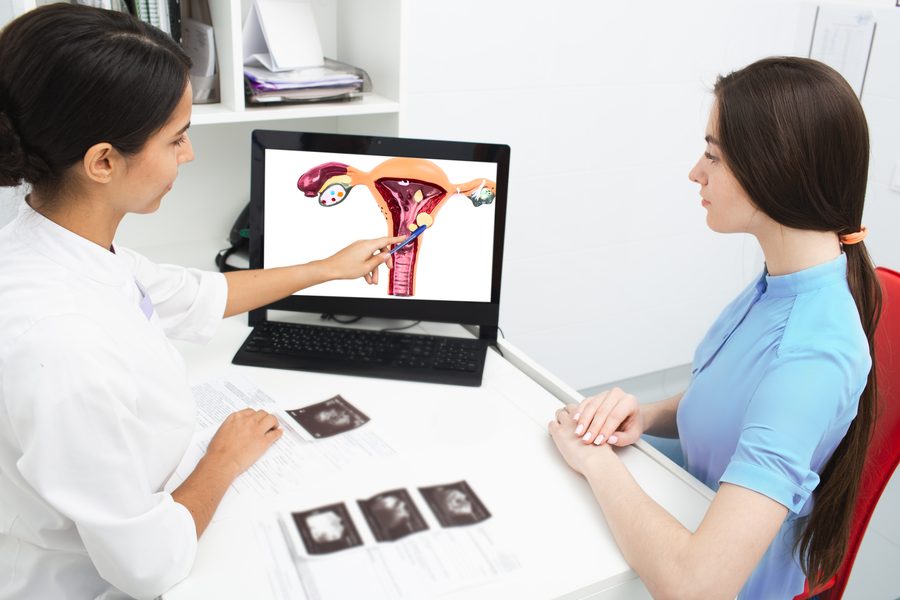
A doctor showing a patient her imaging on a screen
We look at the images, not just the report Bring the discs. Bring the list of who you’ve seen. We start from where you are, not from zero.

What to bring to the consultation: the imaging itself (discs or portal links, not just reports), your pregnancy history, what’s been tried and what it did, and the short version of who you’ve seen and what they said. If you’ve kept a symptom log — what time of day, standing vs lying down, where in your cycle — bring that too. It’s exactly the pattern we’re looking for.

Your real options

All of them. Including the one nobody mentioned.

Hormonal suppression

Progestin pills or injections, or GnRH shots (Lupron-type medications) that quiet the ovaries and shrink the veins. They can help while you’re on them — but the relief tends to fade when you stop, the side effects are real (hot flashes, bone loss, mood changes, weight gain), and the longest follow-up in the medical literature is about a year.¹⁴ Worth knowing about; rarely a long-term answer.

Hysterectomy

Sometimes with removal of the ovaries. Removes the uterus; doesn’t reliably remove the problem, because the veins that cause it aren’t in the uterus. In the published surgical series, about 1 in 3 women had pain that persisted and 1 in 5 had it return.¹⁴ Major surgery, weeks of recovery, and final.

Surgical vein ligation

Tying off the ovarian veins laparoscopically. Rarely done; the published experience is small, and the surgery is performed lying down with the abdomen inflated — the very conditions that hide the veins.¹⁴

Ovarian & pelvic vein embolization

The non-surgical option — and the one most women are never told about. Through a small pinhole in a vein, an interventional radiologist guides a catheter into the faulty veins and closes them from the inside — a medicated foam that seals the tangle of smaller veins, and tiny coils that close the main trunk — so blood stops pooling and reroutes through healthy veins.⁶ ¹⁴ Same session as the diagnostic venogram when it confirms the diagnosis. About 45 minutes to an hour. In our office. Home the same day. Typically covered by insurance.

See what the procedure is like, step by step →

What to know first

Read this before you decide.

First, insurance. Pelvic vein embolization is typically covered by insurance. As with everything we do, we run a complimentary benefits check before any procedure — usually ready the same day as your consultation — so you’ll know exactly where your plan stands before you decide anything, and any out-of-pocket cost is discussed with you before any procedure is performed. If a deductible or coinsurance is more than you want to pay at once, we offer Affirm, CareCredit, and in-house payment arrangements. (Affirm and CareCredit are independent lenders; approval and terms are theirs.)

Second, the evidence. The best study is a randomized trial of 60 women in which the comparison group had the very same catheter procedure without the embolization: at one year, the treated women had substantially lower pain scores and better quality of life, with no major complications.¹ That’s a strong design. It’s also a small trial, stopped early by the pandemic, with one year of follow-up. A larger sham-controlled trial is now under way; we’ll update this page when it reports.¹⁵ We think the evidence justifies offering this to the right woman after a proper workup. We won’t call it “proven.”

Third, it can come back. Across the published series, pain returns in roughly 1 in 10 to 4 in 10 women over time — sometimes because a vein reopens, sometimes because another vein takes over the job.⁶ If it does, we look again, and re-treatment is possible. We’ll never promise permanence — and if anyone does, be careful.

And one more thing, plainly: pelvic pain often has more than one cause. Your veins may be one of several. Treating them well can take a real weight off — and still leave work to do with your other doctors. We’ll tell you which we think it is.

The published evidence

The numbers, with their limits attached.

women with chronic pelvic pain were about six times more likely to have leaky pelvic veins than women without pain — 62% versus 19%, in a 328-woman study.²

3 vs 9

median pain score at one year, embolization versus the same catheter procedure without treatment, in the randomized trial. Quality of life improved too.¹

7–9 in 10

women who get meaningful, lasting relief across the published series — with recurrence in 1 to 4 in 10 over time.⁶

0

major complications in the randomized trial;¹ overall complication rates in the reviews run about 2–3%, mostly a few days of post-procedure ache and low-grade fever.³ ⁶

The limits, attached: the randomized trial enrolled 60 of a planned 100 women and followed them for one year — a strong design, a small study.¹ A larger sham-controlled trial (EMBOLIZE) has been enrolling since 2025; we’ll update this page when it reports.¹⁵

Sources: 1. Hansrani et al., BJOG 2023 — randomized trial, 60 women, coil embolization vs venography alone, 12 months; McGill pain index median 3 vs 9 (p=.016), VAS 15 vs 53 (p=.002), quality of life improved (p=.008); no major complications; stopped early (COVID). 2. Hansrani et al., BJOG 2023;130(11):1355–61 — case–control, 328 women; pelvic vein incompetence 62% vs 19%, OR 6.79. 3. Society of Interventional Radiology, Practice Guidance on Venous-Origin Chronic Pelvic Pain in Women, J Vasc Interv Radiol, March 2026. 6. Kashef et al., CVIR Endovasc 2023;6:25 — technical success 96–100%, long-term relief 70–90%, complications 2–3%, recurrence 10–40%. 9. J Vasc Surg Venous Lymphat Disord 2024 patient-journey series (n=29). 12. Khilnani, Salazar et al., Endovascular Today, Feb 2026. 13. Maratto, Khilnani & Winokur, Semin Intervent Radiol 2021;38:233–8. 14. Ignacio et al., Semin Intervent Radiol 2008;25:361–8. 15. EMBOLIZE trial, ClinicalTrials.gov NCT06168058.

What the procedure is like

In our office. Home the same day.

Embolization is done in our own IR suite, in our office — not a hospital. You’re given twilight or moderate sedation: relaxed and comfortable, breathing on your own, not general anesthesia. Through a small pinhole in a vein at the groin, the doctor guides the catheter to the faulty veins, confirms the diagnosis on the venogram, and — if it confirms — treats in the same session: a medicated foam to seal the tangle of smaller veins, tiny coils to close the main trunk. The whole procedure usually takes about 45 minutes to an hour, and you go home the same day.

The first few days are the hard part. As the treated veins close, expect a deep pelvic ache and sometimes a low-grade fever for a few days — the body’s normal reaction to a closed vein, and in the published experience generally milder than the cramping after fibroid embolization.³ ¹⁴ We counsel every woman about it up front, you go home with a plan and real pain medication, and we call you the next morning. Most women are back to work in two to three days — often less. And every patient goes home with the on-call doctor’s cell phone number, in case any questions or concerns come up.

Want the full detail? Read the pelvic congestion embolization page →

Illustration of the pelvic veins: a normal right ovarian vein beside a dilated, tortuous left ovarian vein draining into congested pelvic veins around the uterus
The problem, mapped A dilated left ovarian vein lets blood flow backward and pool — the congested pelvic veins that drive the ache.

Two things we won’t do: treat you off a scan alone, or promise the pain will never come back. What we will do is confirm the diagnosis the definitive way before anything is treated, and give you the recurrence numbers before you decide, not after.

Candidacy

Who this is for — and who it isn’t.

A workup — and possibly embolization — may be right for you if:

  • Pelvic pain for more than six months that’s worse upright and better lying down
  • Your imaging is “normal” — or mentions dilated pelvic veins nobody followed up
  • You’ve had the gynecologic workup, and it hasn’t explained the pain
  • Hormonal treatment helped only while you were on it, or you don’t want to stay on it
  • You’ve been told hysterectomy is the next step, and you want a real diagnosis first

Embolization may not be right if:

  • Your symptoms don’t follow the venous pattern (we’ll say so at the consultation)
  • Your scan shows dilated veins but your symptoms don’t match — we won’t treat a picture
  • The workup finds another cause — in which case you’ll leave knowing what it is
  • You’re currently pregnant

We turn away patients who aren’t candidates for what we do. Routinely.

Your care team

The doctors who perform pelvic vein embolization here.

Ovarian and pelvic vein embolization at ARV Centers is performed by Board Certified Vascular and Interventional Radiologists — the same team that performs our uterine fibroid and adenomyosis embolization procedures.

Meet the whole team →

After your procedure

You go home with the doctor’s cell number.

When you go home, you take the on-call doctor’s cell phone number with you. Not an answering service — the doctor.

And you don’t have to wonder whether to bother us: we call you the next day to check in. Every patient, every procedure.

Straight answers

Questions patients actually ask.

“I already think this is what I have. Do I have to start from scratch?”

No. Bring everything — reports, discs, the list of who you’ve seen. We’ll read it before we repeat it. Most women who reach us have done more research than anyone gave them credit for; the consultation starts from where you are, not from zero.

“Is pelvic congestion syndrome the same thing as venous-origin chronic pelvic pain?”

Yes — same problem, newer name. Doctors have moved toward “venous-origin chronic pelvic pain” and “pelvic venous disorder” because “congestion” was never very precise. We use the name most women search for, and both names in our records.

“My ultrasound and CT were normal. Could it still be my veins?”

Yes. Standard pelvic imaging is done lying down, which is the position where these veins drain and flatten — so a “normal” scan doesn’t rule this out.¹⁴ Reports written to look for cysts and fibroids also don’t always comment on veins. We look at the images themselves, and if the story fits we go further.

“How is this different from endometriosis?”

They can look alike and can even coexist. The most useful distinguishing sign is timing: with endometriosis there are usually pain-free stretches between cycles; with a venous cause the ache tends to be present through most of the month and simply worsens around your period.¹² The other tell is gravity — venous pain builds with standing and eases lying down. If you’ve had a full endometriosis workup that came back clear, that’s a reason to look at the veins, not a reason to stop looking.

“Is it covered by insurance?”

Typically, yes. We do a complimentary benefits check before any procedure, usually ready the same day as your consultation, so you’ll know exactly where your plan stands before you decide anything — and any out-of-pocket cost is discussed with you before any procedure is performed. If your plan requires a referral or prior authorization for treatment, we’ll identify that during the benefits check and help you get it.

“If it is my veins, what are my options?”

Once pelvic congestion is confirmed, embolization is the treatment. The alternatives are thin: medication that suppresses the cycle tends to help only while you take it, and surgery — tying off the veins, or a hysterectomy — is a much bigger operation for a problem that isn’t in the uterus, and it doesn’t reliably fix vein pain. Embolization treats the veins themselves, through a pinhole, home the same day. And the evidence behind it is real: a randomized trial in which the comparison group had the same catheter procedure without treatment, and the treated women did significantly better at one year with no major complications;¹ systematic reviews pooling more than a thousand women, with 7 to 9 in 10 reporting lasting relief;⁶ and formal practice guidance from the Society of Interventional Radiology in 2026.³ That’s why, for the right woman after a proper workup, it’s what we recommend.

“What about the coils and the foam? Do they stay in? Can I feel them?”

We use both: a medicated foam that seals the tangle of smaller pelvic veins, and tiny coils — made of the same materials used in vascular procedures for decades — that close the main trunk. The foam does its work and is absorbed; the coils stay, permanently closing the vein while blood reroutes through healthy ones. You won’t feel them. Some women notice a few days of ache and low-grade fever afterward as the vein closes; that settles.³ Rarely, a coil can move out of position, which is one reason technique and vein selection matter — and one of the things we’ll go over with you before you decide.³

“What if the pain comes back?”

It can — in roughly 1 in 10 to 4 in 10 women over time, in the published series.⁶ Sometimes a treated vein reopens; sometimes a different vein takes over. If it happens, we look again with a venogram, and re-treatment is possible. We’d rather you hear that now than be surprised later.

“Is May-Thurner syndrome related?”

It can be. May-Thurner is compression of the main left pelvic vein by the artery that crosses it. When that vein is squeezed, blood backs up into the pelvic veins and can drive the same symptoms — so a good workup looks for it, and treatment is different when it’s the cause.³ Read about May-Thurner syndrome →

“Do I need a referral?”

Not for your initial consultation — call us directly. If your plan requires a referral or prior authorization for treatment itself, we’ll identify that during the complimentary benefits check and help you get it.

Free patient guide

Not ready to call? Start with the free guide.

Our physicians wrote a plain-English guide to embolization — the mechanism behind our knee, shoulder, and fibroid programs: what it treats, what the studies show, and who it’s for. No appointment required, and no follow-up phone call unless you ask for one.

We’ll email your guide plus occasional patient education. Unsubscribe anytime. Privacy policy.

Bring the discs, not just the reports. You’ll leave with a plan to actually answer the question.

Bring your imaging — the discs, not just the reports — and the list of who you’ve seen and what they said. You’ll get a straight answer once we have it, including “it isn’t your veins,” if that’s the truth. Call us directly, or send this form and we’ll call you to schedule. We do a complimentary benefits check before any procedure. No surprises.

210-405-1335

Consultation hours

  • Monday–Thursday8:00–5:00
  • Morning · last consult11:30 AM
  • Afternoon · last consult4:30 PM
  • FridayProcedures only

Closed on major holidays.

3212 Napier Park, San Antonio, TX 78231

Get directions

Stand-in image (Map © OpenStreetMap) — the live site embeds the interactive Google map here

Schedule a consultation

No referral needed for your initial consultation. Want a head start? Download the pelvic congestion intake packet (PDF) and bring it filled in.

Rather book by phone? Call (210) 405-1335.