
Rest, anti-inflammatories, PT
Where everyone starts, and a well-run therapy program is worth doing. But when the joint itself stays inflamed, rest and exercises alone often can’t quiet it — if they were going to be enough, they’d have worked by now.
For San Antonio adults whose shoulder now decides how they sleep
First, we find the real driver
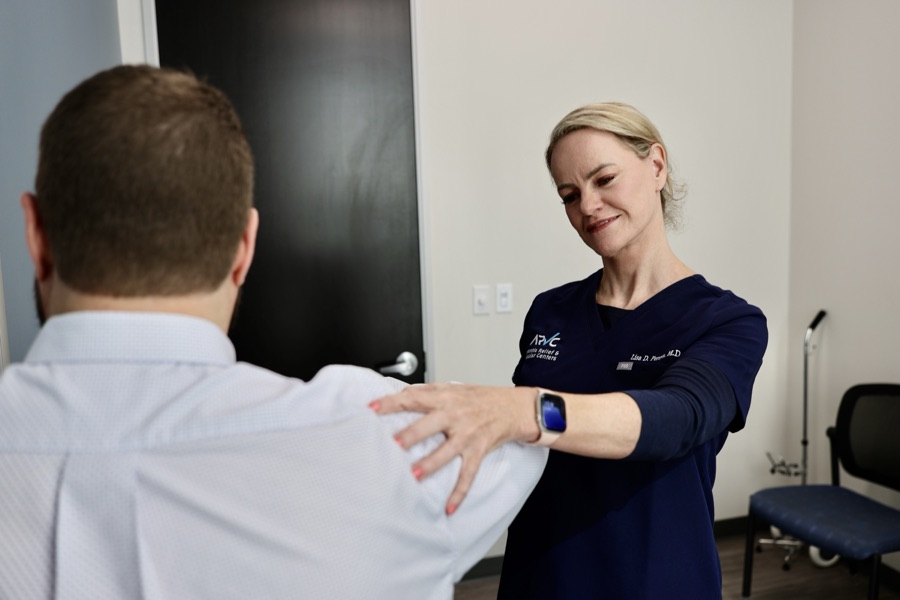
Dr. Lisa Persyn examining a shoulder patient in our clinic.
Shoulder arthritis and chronic tendonitis don’t just wear parts down — they keep the joint inflamed. At ARVC we treat that inflammation directly: precision image-guided injections as the first step, and shoulder artery embolization (SAE) — a non-surgical, same-day procedure through a pinhole in the wrist — when injections stop holding. No implants. No months of rehab. Covered by most insurance plans, including Medicare and Medicaid.
Covered by most insurance, including Medicare & Medicaid No referral needed for your initial consultation
You’ve stopped sleeping on your left side. Or your right — whichever shoulder owns the night now. You wake when you roll over. You’ve rearranged the kitchen so nothing you need lives on a high shelf.
Reaching your back pocket. Tucking in a shirt. Lifting the grandkid who wants “up.” Backing the car out with one arm on the seat. Each one has a cost now, and you’ve quietly budgeted your whole day around them.
Maybe the X-ray said arthritis. Maybe it said tendonitis, or “wear,” or a cuff that’s fraying but not torn. Maybe cortisone helped twice and then stopped helping. And maybe someone has already said the word “replacement” — or the opposite: that you’re too young for one, so come back when it’s worse.
“Come back when it’s worse” is not a plan. Here’s what’s actually going on in there — and the options nobody’s walked you through.
Why it hurts
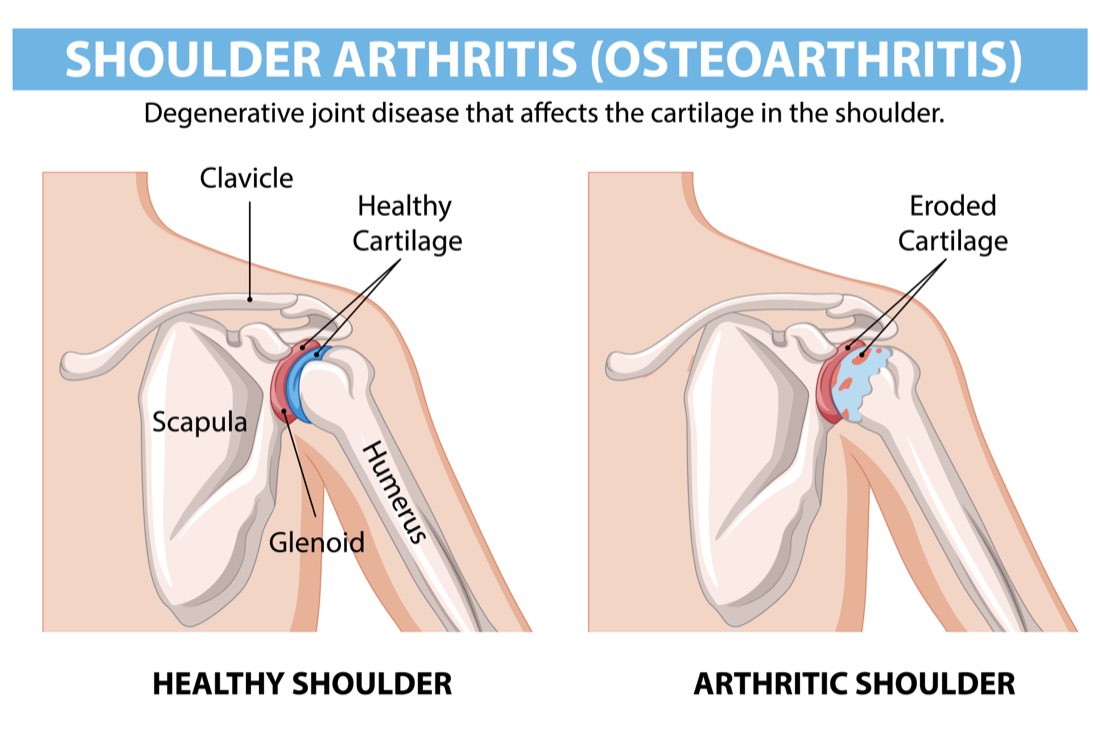
An X-ray shows the parts — the cartilage that’s thinned, the tendon that’s frayed. But parts alone don’t hurt at 2 a.m. while you’re lying still.
What hurts is inflammation that never gets to finish. When a joint or tendon stays irritated long enough, the body grows abnormal new blood vessels into the area — and new pain nerves grow right along with them. The inflammation feeds the vessels, the vessels feed the inflammation, and the loop runs day and night. That’s why the ache is deep and constant, why it spikes with certain moves, and why it can be so much worse than the X-ray “looks.” This loop shows up on angiograms in arthritic shoulders, in chronic tendonitis, and in frozen shoulder alike — it’s the same mechanism we treat in knees every week, and it’s treatable in shoulders too.
Your options, in honest order
Where everyone starts, and a well-run therapy program is worth doing. But when the joint itself stays inflamed, rest and exercises alone often can’t quiet it — if they were going to be enough, they’d have worked by now.
Steroid to calm inflammation; hyaluronic acid (gel) to cushion and lubricate; PRP where it genuinely fits. What makes ours different is the word precision: every injection at ARVC is guided by imaging, so the medication lands exactly where it should — not near it. That’s the difference between “we tried an injection” and “we treated the joint.”
Through a pinhole in the wrist, an interventional radiologist blocks the abnormal vessels feeding the inflamed tissue with a temporary slurry of microcrystals that dissolves into the bloodstream within the hour — nothing permanent stays behind. The inflammation loop loses its supply line; pain eases over the following weeks. It treats the source of the inflammation — not the symptom schedule. No incision, no implants, home the same day.
For advanced arthritis it remains a genuinely good operation — and for some shoulders it’s the right call. It’s also major surgery: general anesthesia, hardware, and months of recovery. Our position is simple: it should be the last rung of the ladder, not the second — and if we think it’s your best option, we’ll say so.
When injections just aren’t enough
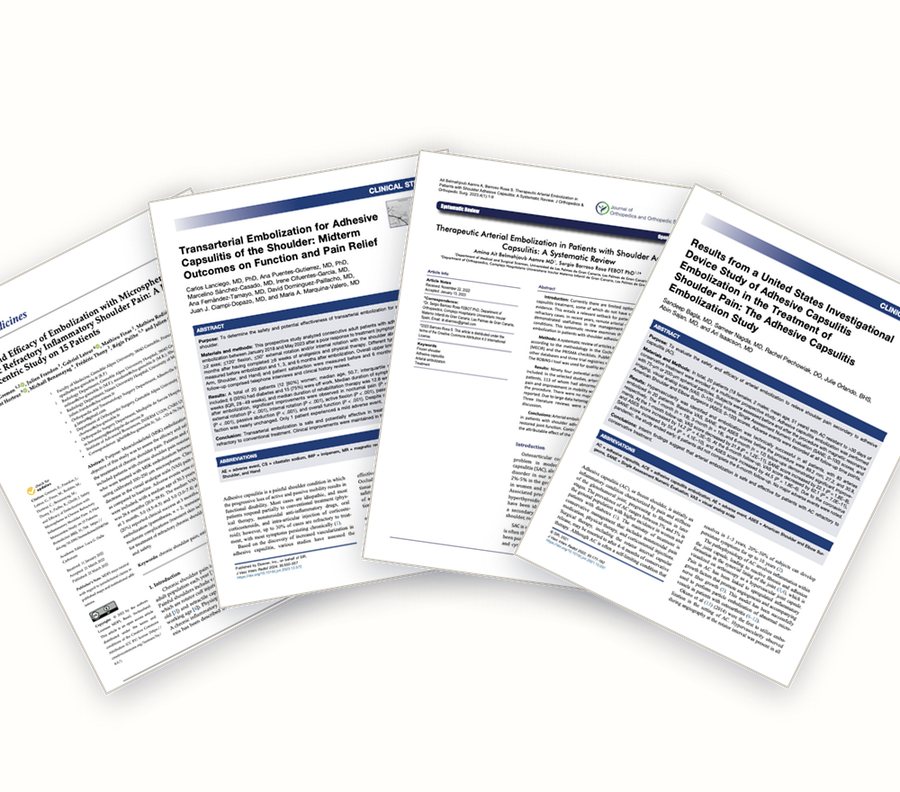
To be clear about what this section describes: shoulder artery embolization (SAE) — the third rung on the ladder above. When precision injections stop holding, SAE goes after the source itself: the abnormal blood vessels that keep the joint inflamed. And it isn’t an experiment. The research behind it has grown fast — and it’s stronger than most patients (and many doctors) realize.
A 2026 analysis pooling 12 studies — 329 treated shoulders — found large improvements in pain, motion, and function, with technical success in every case and no severe complications reported.¹ The largest single series — 118 patients, treated with the same temporary embolic we use — saw pain fall from 7.8 to 2.2 out of 10 by six months, with about 9 in 10 patients still clinically improved at one year.²
And it isn’t only frozen shoulder anymore. A 100-patient trial aimed at refractory nighttime shoulder pain — including 24 patients with rotator cuff tears — saw night pain drop from 6.4 to 1.6 out of 10 at six months, while overhead reach improved from 97° to 151°.³ Smaller series in rotator-cuff tendinopathy, calcific tendonitis, and bursitis report the same pattern.⁴ ⁵ And the first head-to-head comparisons have arrived: against capsular-release surgery, embolization reached comparable six-month results with faster early pain relief — and against rehab alone, patients who added embolization were markedly better off at six months.⁶ ⁷
We do a complimentary benefits check before any procedure. No surprises.
Sources: 1. Allaw et al., J Vasc Interv Radiol 2026 — systematic review & meta-analysis: 12 studies, 329 shoulders; 100% technical success; of 94 recorded adverse events, 87 were mild and 7 moderate — none severe. 2. Fernández Martínez et al., Cardiovasc Intervent Radiol 2025 — 118 patients / 128 procedures, imipenem/cilastatin: pain 7.8→2.2 at 6 months; 89.8% clinically improved at 12 months; no major adverse events. 3. Okuno et al., J Vasc Interv Radiol 2022 — prospective multicenter trial, 100 patients (76 adhesive capsulitis, 24 rotator cuff tears): night pain 6.4→1.6 and elevation 97°→151° at 6 months; no major adverse events. 4. Hwang et al., J Vasc Interv Radiol 2018 — shoulder/elbow tendinopathy: pain 6.1→2.5 at 4 months. 5. Sapoval et al., Cardiovasc Intervent Radiol 2025 — 23 patients (61% adhesive capsulitis, 39% bursitis): pain with movement 82→36 mm. 6. Wang et al., J Shoulder Elbow Surg 2026 — embolization vs. arthroscopic capsular release: comparable 6-month outcomes, earlier relief with embolization (3-month pain 2.6 vs. 4.7). 7. Su et al., BMC Surgery 2026 — propensity-matched, embolization + rehab vs. rehab alone: 6-month pain 1.8 vs. 4.5. Full frozen-shoulder evidence on the Frozen Shoulder page.
What SAE is like
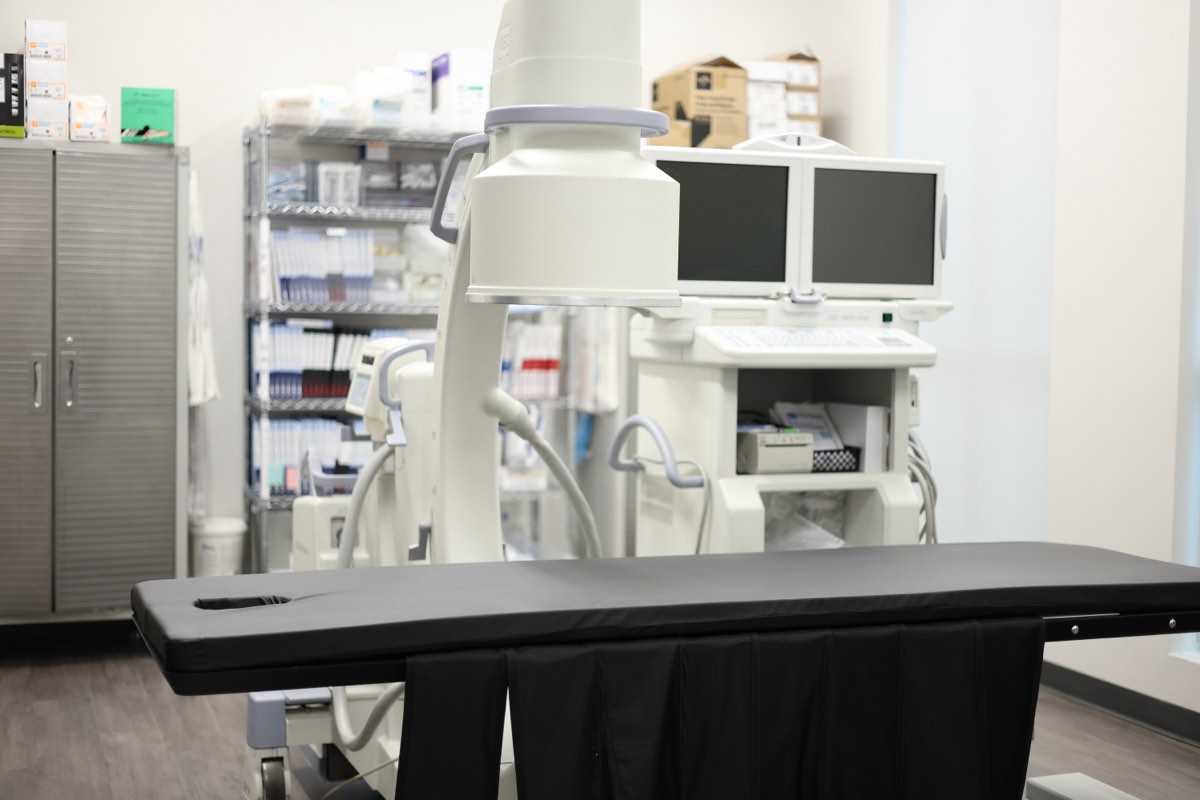
SAE is done in our own IR suite, in our office — not a hospital. Twilight sedation with a dedicated sedation nurse. A numbed pinhole in the wrist — no incision, no stitches. The blocking agent itself is temporary: microcrystals smaller than a grain of sand that quiet the abnormal vessels, then dissolve into the bloodstream within 30 to 45 minutes. An hour or so on the table, two hours of rest, and someone drives you home the same day.
Most patients are back to normal daily activity within one to three days. And if you’ve had shoulder surgery and still hurt, SAE can also target the residual inflammation surgery didn’t resolve.
Candidacy
We turn away patients who aren’t candidates for what we do. Routinely.
Your care team
Your workup and your first rung start with our physical medicine team: Lisa D. Persyn, M.D., Board Certified Physical Medicine & Rehabilitation, performs your image-guided injections — she has more than 100,000 joint injections behind her — and nurse practitioner Meredith Reynolds handles your exams and care through the visits. When embolization is the right rung, you’re handed to our Board Certified Vascular and Interventional Radiologists. The ladder isn’t a referral chain. It’s a hallway.
Precision injections — our first rung

Lisa D. Persyn, M.D.
Board Certified ·
Physical Medicine & Rehabilitation
Performs your injections

Meredith Reynolds, MSN, ACNP-BC
Board Certified ·
Acute Care Nurse Practitioner
Exams & care through your visit
Shoulder embolization — the next rung
After your procedure
When you go home, you take the on-call doctor’s cell phone number with you. Not an answering service — the doctor.
And you don’t have to wonder whether to bother us: we call you the next day to check in. Every patient, every procedure.
Before you leave, you’ll get this card
Your procedure:
On-call doctor:
Cell phone: written by hand, before you walk out
Call me if anything worries you.
Straight answers
Same idea, different address. Genicular artery embolization (GAE) treats the abnormal vessels around an arthritic knee; SAE does the same for the shoulder. The knee version has the deeper research record; the shoulder version uses the identical technique and the same team. Knee Pain & Arthritis →
Depends on the tear. A complete, full-thickness tear is a structural problem — embolization won’t fix it, and the studies excluded it. Partial tears and tendon irritation (tendinopathy) are a different story: chronic inflammation is often a big part of that pain, and it’s exactly what we treat. Bring the MRI; we’ll give you a straight answer.
Guidance. An unguided shoulder injection is aimed by feel, and shoulder anatomy makes “by feel” hard to place precisely. Every ARVC injection is image-guided to the target. Same medication, very different confidence about where it went — and injections that land work better than injections that almost land.
Because it quiets the inflammation without touching what’s feeding it. The abnormal vessels are still there when the medication fades, so the loop restarts. That pattern — relief that shrinks with each shot — is often the signal that it’s time to talk about the next rung.
The studies ran from patients in their 20s to their 80s. Age matters less than what’s driving the pain. “Too young for a replacement” is precisely the situation SAE exists for — the years between “come back when it’s worse” and surgery don’t have to be endured untreated.
Injections are broadly covered. (PRP is the exception — it’s typically cash-pay, and we will tell you plainly when it’s worth considering and when it’s not.) Embolization is covered under most plans too, including Medicare and Medicaid. And the standing promise still holds: we do a complimentary benefits check before any procedure. No surprises.
Free patient guide
Our physicians wrote a plain-English guide to shoulder pain: what’s actually driving it — arthritis, tendonitis, or frozen shoulder — what each treatment can and can’t do, from guided injections to embolization to replacement, and how to tell which rung of the ladder fits your shoulder. No appointment required, and no follow-up phone call unless you ask for one.
We’ll email your guide plus occasional patient education. Unsubscribe anytime. Privacy policy.
X-ray, MRI, whatever exists — bring it. You’ll leave knowing which rung of the ladder fits your shoulder, and whether we can help — including a plain “we can’t, and here’s who can” if that’s the truth. Call us directly, or send this form and we’ll call you to schedule. We do a complimentary benefits check before any procedure. No surprises.
210-405-1335Closed on major holidays.
3212 Napier Park, San Antonio, TX 78231
Stand-in image (Map © OpenStreetMap) — the live site embeds the interactive Google map here
No referral needed for your initial consultation.
Rather book by phone? Call (210) 405-1335.