
Doing nothing — if you have no symptoms
A real option, and for a lot of people the right one. Compression without symptoms is an anatomical variant, not a disease.³ We’ll tell you what to watch for and leave you alone.
For anyone in San Antonio with a left leg that swells, aches, or clotted — and no good explanation
May-Thurner syndrome is a pinch on the main vein draining your left leg — the right-side artery presses it against your spine. It can cause years of swelling and heaviness, or a sudden left-leg clot. It’s treatable with a small procedure through a pinhole. But a narrowed vein on a scan is not, by itself, a diagnosis — and it is not, by itself, a reason to be stented. This page explains both halves of that sentence. Covered by most insurance plans, including Medicare and Medicaid — and we’re in-network with most plans. No referral needed for your initial consultation.
Covered by most insurance, including Medicare & Medicaid No referral needed for your initial consultation
Maybe it started as cramps in your left calf. You figured you’d pulled something, or you were low on magnesium.
Maybe it’s been years of a left leg that’s heavier than the right — swollen by evening, aching after a day on your feet, veins showing up where there weren’t any. And nobody could tell you why. Or worse, nobody believed you.
Or maybe it was one night. The pain woke you up, and by morning your left leg was swollen and the wrong color, and the ER said the words blood clot — and then blood thinners, and then, quietly, for life.
Somewhere in there, someone may have said “iliac vein compression.” Or “May-Thurner.” Or told you that you were too young for a stent — and left it there.
There is a reason it’s the left leg. It’s anatomy. And there’s an honest answer to the stent question — one that starts with whether you need one at all.
What May-Thurner actually is
Two big vessels serve each leg: an artery carrying blood down, and a vein carrying it back. Low in your belly, just in front of the spine, the artery heading to your right leg crosses directly over the vein returning from your left leg. In some people, that crossing pins the vein against the bone.¹
A pinched vein drains slowly. Blood backs up into the left leg — so it swells, it aches, it feels heavy, and the smaller veins bulge as they try to carry the load. Over years, the artery’s pulse against the vein wall can build scar tissue inside the vein — bands and webs that narrow it further.¹ And slow blood clots. That’s why this condition shows up in two very different ways: as years of a heavy left leg, or as a sudden left-leg clot in a young, otherwise healthy woman — often after a pregnancy, a surgery, a long trip, or starting birth control.²
It’s named for the two doctors who described it in 1957. You’ll also see it called iliac vein compression syndrome — same thing. It’s diagnosed most often in women, and most often between 30 and 50.²
Now the part most pages leave out. The anatomy — some compression at that crossing — is common. Very common. In studies of people with no leg symptoms at all, more than one in three had the vein compressed by more than 70%.³ Only a fraction of those ever develop the scarring and symptoms that make it a syndrome.³ So doctors who are careful with words draw a line: May-Thurner anatomy is a finding on a scan; May-Thurner syndrome is that anatomy plus a leg that’s telling you about it. Only the second one gets treated. Keep that distinction — you’ll need it when you read your imaging report.
How we decide
Iliac vein stenting has a reputation problem in medicine: too many stents placed on the strength of a picture alone.³ Vascular specialists have published warnings about it. Our position is the opposite of that, on purpose — and we’d rather you hear it from us before you hear it from Google.
Here is what has to be true before we’ll offer you a stent — all of it, not some of it:
If your compression is real but your leg is fine: you don’t need a stent, and we’ll say so. There is no indication to treat compression that isn’t causing symptoms.³ Some people leave that visit with a plan for compression stockings and a follow-up. That’s a good visit, too.
And if you were told you’re too young for a stent — that doctor was being careful, not careless. This is a permanent implant, and caution is right. What you deserved was the rest of the sentence: an explanation of what they found, what it means, and what to do instead. That’s the conversation we’ll have.
Your real options
A real option, and for a lot of people the right one. Compression without symptoms is an anatomical variant, not a disease.³ We’ll tell you what to watch for and leave you alone.
The foundation for anyone with a swollen leg, stent or no stent. They don’t fix the pinch, but they help the leg cope with it — and for milder cases, they may be all you need.
If you’ve had a clot, blood thinners come first — to treat the clot and prevent the next one. What they don’t do is open the vein. If the pinch is what caused the clot, it’s still there when the clot is gone.
Through a pinhole in a vein, an interventional radiologist passes a tiny balloon to the pinch, opens it, and leaves behind a small mesh tube — a stent — that holds the vein open against the artery. It is the only option that treats the compression itself. In the largest review of the published results, stents placed for compression without a clot were still open in more than 98 out of 100 people two years later, with leg swelling improved in 80–100% of patients across the studies.⁴ It’s also a permanent implant with real trade-offs — which is why the next section exists.
What to know first
It’s permanent. Unlike our embolization procedures, where the material dissolves or stays put harmlessly, a venous stent is hardware — and it doesn’t come back out. Balloon alone isn’t enough here: the narrowing is scar-like and springs back, so a lasting fix means a stent.³ You should know that going in.
New low-back pain afterward is common — and expected. In the pooled studies, up to two in three patients had back pain after a venous stent.⁴ It’s usually mild, it usually settles on its own over days to weeks, and it is alarming if nobody warned you. Consider yourself warned. Bleeding is the other real cost — it was roughly three times as common in the stented group of the NEJM trial (about 12% vs 4%, almost all minor).⁵ Stent clotting or collapse happens in a small minority and can often be treated; we’ll go through the specific numbers with you.⁴
Some questions are yours alone. What medications you’ll take after a stent, for how long, and how any of this fits with a pregnancy you’re planning — those answers depend on your history, and they don’t belong in a web page. We go through them with you, in person, before you decide anything.
We’ll never call this “a simple outpatient fix.” It is an outpatient procedure. It is not simple to live with unless you were told the whole story first — and if anyone tells you it’s a quick fix with nothing to think about, be careful.
The published evidence
98 in 100
Stents placed for iliac vein compression without a clot were still open at two years (98.4%; 99.6% at six months) in a 2025 review of 27 studies and 4,782 patients.⁴
80–100%
Range across those studies for improvement in leg swelling after stenting; pain relief was reported up to 100%.⁴
+14.5
Points better on vein-specific quality of life — and 2.0 points better on symptom severity — at six months with stenting plus usual care vs usual care alone, in a 2026 NEJM randomized trial (C-TRACT, 225 patients). Those patients all had a prior clot — the trial did not study compression without a clot.⁵
2 in 3
Up to two in three patients report new low-back pain after a venous stent. Usually mild and temporary — and worth knowing before, not after.⁴
What the numbers don’t say: the 98% figure is about the hardware staying open — it comes mostly from studies where the doctors chose the patients, and choosing well is the whole game. The randomized trial is six months long and in a different group from most people reading this. Guideline bodies have not yet made stenting a routine recommendation; the trial’s editorial says 12–24-month data are needed first.⁵ We tell you all of this because a stent is permanent and you get one vote.
Sources: 1. May-Thurner Syndrome. StatPearls, NCBI Bookshelf NBK554377. 2. StatPearls; Knuttinen MG et al., Cardiovasc Diagn Ther. 3. Murphy EH, Black SA. Avoiding misuse and overuse of iliac vein stenting for chronic venous disease. Endovascular Today, July 2018 — >1/3 of asymptomatic individuals with >70% compression; syndrome changes in ~25% of those with compression; CT overstates compression in dehydration; no indication to treat asymptomatic compression. 4. Li M, Wang S, Zhao J, et al. Iliac vein stenting outcomes in non-thrombotic and thrombotic diseases: systematic review and meta-analysis. Biomol Biomed 2025;26(5):759–773 — 27 studies, 4,782 patients; non-thrombotic primary patency 99.6% (6 mo), 98.4% (24 mo); edema relief 80–100%; back pain up to 66%; stent thrombosis 0–10.2%; stent collapse 3.3–11.3%; pulmonary embolism 0%. 5. Vedantham S, et al. C-TRACT. N Engl J Med 2026 (published 13 April 2026) — 225 patients with post-thrombotic syndrome and iliac obstruction; VCSS adjusted difference −2.0 (95% CI −3.2 to −0.8); VEINES-QOL +14.5 (9.5–19.4); bleeding 11.6% vs 3.6%; accompanying editorial on 12–24-month data before guideline incorporation. 6. Society of Interventional Radiology practice guidance on venous-origin chronic pelvic pain, J Vasc Interv Radiol 2026.
What the procedure is like
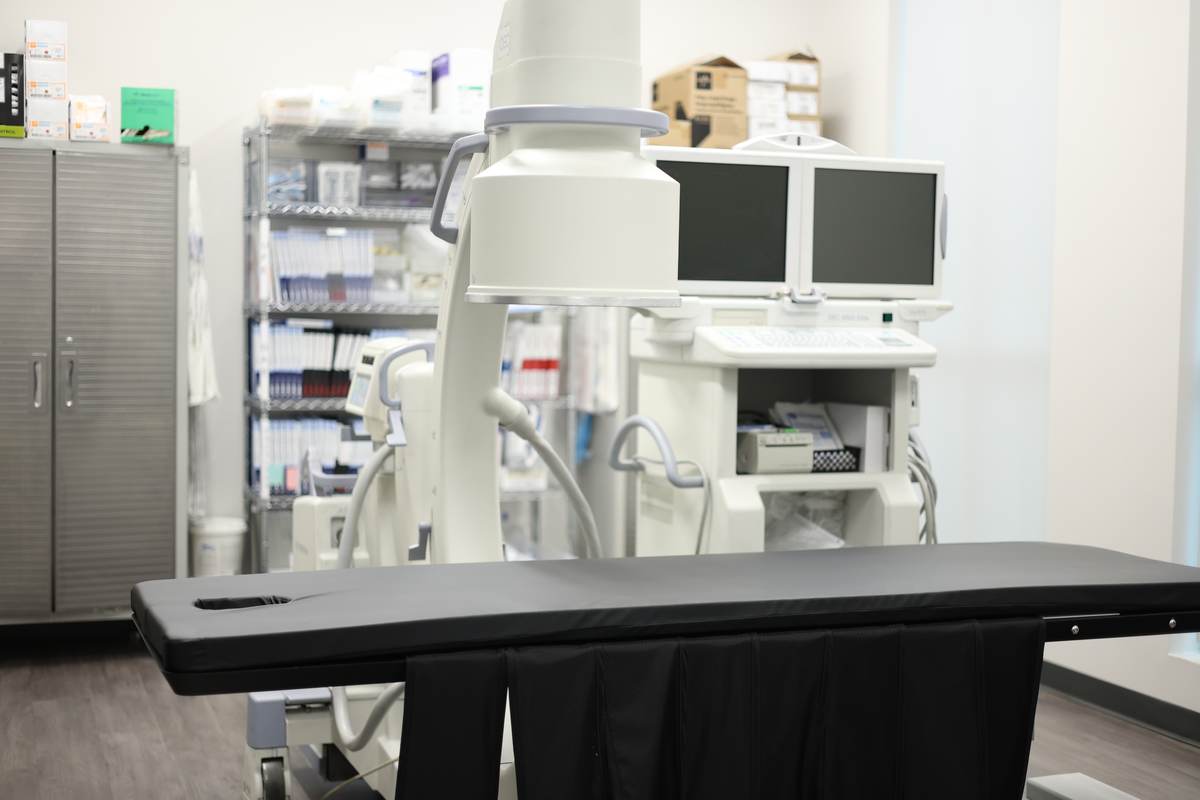
This is done in our own IR suite, in our office — not a hospital. You’re given twilight sedation through an IV, with a dedicated sedation nurse with you the whole time.
The interventional radiologist numbs a spot in your groin and enters a vein through a pinhole — no incision, no stitches. First comes the look: X-ray dye pictures of the vein (a venogram) that confirm the narrowing your scan showed. If it doesn’t match — if the vein isn’t narrow enough to matter — we stop there, and that’s a good outcome, not a wasted one. If it does, a small balloon opens the narrowed segment, and a self-expanding mesh stent is placed across it to hold the vein open against the artery. Over the following weeks, your own vein lining grows over the stent and it becomes part of the wall.
The whole thing takes about an hour to two. You rest with us afterward, then someone drives you home the same day. Most people are walking normally that day and back to ordinary activity within a few days. You go home with your after-care instructions, the back-pain warning you’ve already read, compression stockings, and the on-call doctor’s cell number. Swelling and heaviness often start improving within days to weeks;⁴ skin changes take longer. We see you back with an ultrasound to check the stent — and we keep checking, on a schedule we’ll give you.
Bring your imaging. If you already have a CT, MRI, or ultrasound report that mentions compression, bring it — and the disc if you have one. It often answers half the questions before we start.
Candidacy
We turn away patients who aren’t candidates for what we do. On this page, that isn’t a slogan — it’s the whole point.
Your care team
May-Thurner evaluation and treatment at ARV Centers is performed by Board Certified Vascular and Interventional Radiologists — and we’re glad to coordinate with your hematologist, OB/GYN, or vascular doctor before and after.
After your procedure
When you go home, you take the on-call doctor’s cell phone number with you. Not an answering service — the doctor.
And you don’t have to wonder whether to bother us: we call you the next day to check in. Every patient, every procedure. With a stent, “after” also means scheduled ultrasounds to confirm it’s open — you’ll leave with the dates.
Before you leave, you’ll get this card
Your procedure:
On-call doctor:
Cell phone: written by hand, before you walk out
Call me if anything worries you.
Straight answers
Because of where the vessels cross. The artery to your right leg passes over the vein from your left leg, low in the pelvis, right in front of the spine — so it’s the left vein that gets pinched.¹ It can happen on the right, but it’s rare. If your left leg has been the problem for years, that’s not a coincidence.
Not necessarily. Some compression at that crossing is so common — more than a third of people with no symptoms have a lot of it³ — that many doctors call the finding “May-Thurner anatomy” and save “syndrome” for when it’s actually causing trouble. CT can also exaggerate the narrowing if you were dehydrated. A report like that means it’s worth a proper evaluation. It doesn’t mean you need a stent, and it isn’t a diagnosis on its own.
Probably not — and we won’t pretend otherwise to win you over. A stent is a permanent implant, and doctors are right to be careful about placing one in a young, otherwise healthy person. What you were owed was the rest of the conversation: what they found, how narrow it really is, whether your symptoms match, and what to do in the meantime. Come in and we’ll have it. Sometimes the answer is still “not a stent — here’s the plan.” Sometimes it’s “yes, and here’s why.”
We wish. The narrowing in May-Thurner is scar-like and springs back after a balloon alone, so a lasting fix means a stent.³ If you’d rather not have permanent hardware, that’s a completely legitimate choice — and compression stockings and blood thinners (if you’ve clotted) remain real options. We’ll help you weigh it, not push it.
Venous stenting has been done for decades, and the durability record is strong: in the largest review, stents placed for compression without a clot were still open in more than 98% of people at two years.⁴ In 2026, the New England Journal of Medicine published the first large randomized trial — 225 patients, run by the NIH — and stenting improved symptoms and quality of life at six months compared with standard care alone.⁵ Read the fine print with us, though: those patients all had a prior clot with lasting damage. The trial didn’t study compression without a clot, and guideline groups haven’t yet made stenting a routine recommendation. That’s the honest state of the evidence, and it’s why we’re so careful about who we treat.
The common ones: new low-back pain (up to two in three, usually mild and temporary), and bleeding (about 12% vs 4% in the trial’s stented arm, almost all minor).⁴ ⁵ The less common ones: the stent clotting or collapsing (each in a small minority, often treatable), a clot in the same or the other leg, and the ordinary rare risks of any catheter procedure.⁴ Across the pooled studies, no lung clots (pulmonary embolism) were reported after stenting.⁴ We go through your specific numbers in plain language before you decide anything.
It can. When the left iliac vein is pinched, blood can back up into the pelvic veins and cause the aching, pressure, and varicose veins of pelvic congestion syndrome.⁶ It’s one reason we check for compression before treating pelvic congestion — treating the pelvic veins without fixing an outflow blockage upstream misses the cause. If you have both a heavy left leg and chronic pelvic pain, say so. They may be one problem.
Then you belong in a hospital, not on this page — sudden swelling, pain, or shortness of breath is an emergency-room visit. An active clot is treated there, urgently, and we don’t treat May-Thurner while a clot is active. Once the DVT has been treated and things are stable, the question of why it happened comes next — and that’s where we come in. If the pinch caused the clot, it’s still there when the clot is gone. That’s the point at which we evaluate for the compression and decide on treatment.
Yes — most plans, including Medicare and Medicaid, and we’re in-network with most plans. We do a complimentary benefits check before any procedure is scheduled — usually on the day of your consultation. No surprises.
Not for your initial consultation — call us directly. If your plan requires a referral or prior authorization for treatment itself, we’ll identify that during the complimentary benefits check and help you get it.
Free checklist
Ten questions to ask before anyone stents your vein — including us. A one-page, plain-English checklist from our physicians: what a proper May-Thurner workup includes, the difference between compression and syndrome, what to ask about before and after, and the numbers a good answer should contain. No appointment required, and no follow-up phone call unless you ask for one.
We’ll email your checklist plus occasional patient education. Unsubscribe anytime. Privacy policy.
Bring your imaging if you have it — the CT, the ultrasound, the report that says “compression.” Call us directly, or send this form and we’ll call you to schedule. We do a complimentary benefits check before any procedure. No surprises. Want a head start? Download the May-Thurner consultation packet and fill it in at home.
210-405-1335Closed on major holidays.
3212 Napier Park, San Antonio, TX 78231
Stand-in image (Map © OpenStreetMap) — the live site embeds the interactive Google map here
No referral needed for your initial consultation.
Rather book by phone? Call (210) 405-1335.