
Is it loose?
A loose or shifting implant causes pain that GAE cannot fix — and it needs an orthopedic surgeon, not an embolization. Imaging has to show a stable, well-fixed implant before anything else is discussed.
For people whose knee replacement healed just fine — and still hurts
If your knee still hurts months or years after a replacement — and your surgeon says the implant looks fine — the pain often comes from the inflamed joint lining the surgery couldn’t remove. Genicular artery embolization (GAE) treats that lining through a pinhole in the upper thigh: same-day, no new surgery, and nothing touching the implant. But first things first, always: the replacement itself must be confirmed stable — and revision surgery ruled out — before GAE is ever on the table.
Covered by most insurance, including Medicare No referral needed for your initial consultation More than 700 GAE procedures performed here
Maybe you did everything right — the surgery, the rehab, the months of patience — and the knee that was supposed to be fixed still aches, burns, or swells at night.
Maybe your surgeon took new X-rays and told you the implant looks perfect. Which somehow made it worse: if nothing’s wrong, why does it still hurt?
Maybe you’ve started hearing the quiet suggestions — give it another year, it’s probably scar tissue, some knees just do this.
About one patient in five still has pain after a knee replacement.¹ There’s usually a physical reason — and it shows up on an angiogram. This page shows it to you, live. Judge it with your own eyes.
The reason nobody mentioned
A knee replacement does exactly what its name says: it replaces the worn surfaces of the joint — metal and plastic where the cartilage used to be. What it doesn’t remove is the joint’s living envelope: the synovium, the soft lining that had been inflamed for years before your surgery ever happened.
In most knees, that lining settles down once the joint is resurfaced. In some, it never gets the message. It stays inflamed, keeps its web of abnormal new blood vessels — with new pain nerves growing alongside them — and keeps hurting, implant or no implant.¹ You feel it as the same deep ache the replacement was supposed to end.
GAE goes after that blood supply directly. Through a pinhole in the upper thigh, an interventional radiologist threads a catheter thinner than a phone-charger cord into the small arteries feeding the lining, and a slurry of temporary microscopic particles blocks the abnormal vessels — while the healthy arteries of the leg stay open, and the implant is never touched. Starved of its supply line, the inflamed tissue quiets down. The main GAE page walks the procedure in full depth; this page covers what’s different when the knee has already been replaced.
First things first
This is the part we want you to hear even if you never call us: pain after a replacement has a short list of surgical causes that must be ruled out first — by an orthopedic surgeon, with imaging and sometimes lab work. Only when the implant is confirmed stable, and revision surgery is off the table, does the inflamed lining become the prime suspect.
A loose or shifting implant causes pain that GAE cannot fix — and it needs an orthopedic surgeon, not an embolization. Imaging has to show a stable, well-fixed implant before anything else is discussed.
A low-grade infection around an implant can smolder quietly for years. It’s ruled out with lab work — and joint fluid testing when indicated — because treating over an infection would be a disservice to you.
Malalignment, instability, and component wear are surgical problems. If any of them is driving your pain, the right conversation is a revision — and we’ll say exactly that.
We won’t treat over an implant problem. If your replacement needs a surgeon, we’ll tell you so and help you get there — that’s the whole point of the workup. GAE is only on the table when the implant is stable and revision surgery isn’t the answer.
See it for yourself — in motion
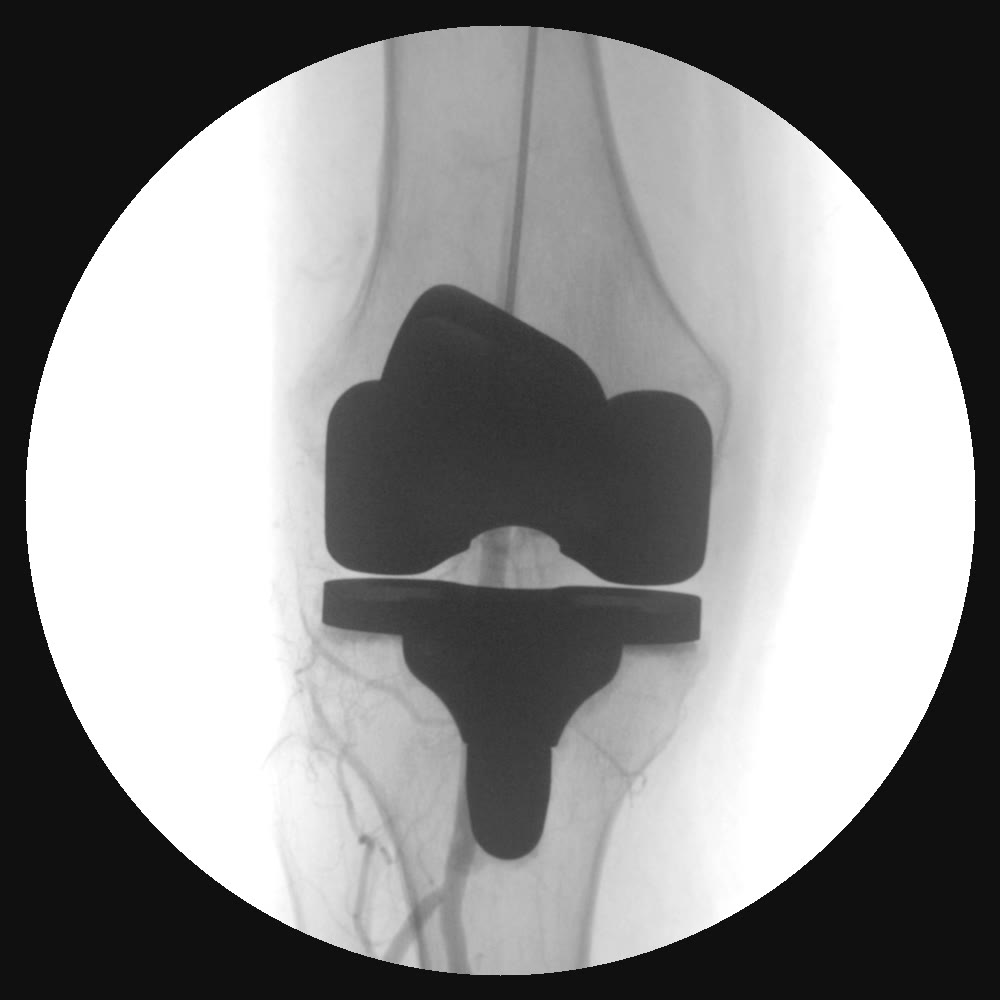
These are angiograms — X-ray movies taken while dye flows through the arteries — from a single GAE performed at ARVC on a patient with persistent pain after a total knee replacement. The implant was confirmed stable first. Eight different arteries feed the knee’s lining — the four pairs below are just a sample of them, each shown before and minutes after embolization. Watch the dark blush of abnormal vessels vanish while the main arteries stay open.
Before
After
Before
After
Before
After
Before
After
Angiograms from a genicular artery embolization performed at ARV Centers, San Antonio, in a patient with persistent knee pain after a total knee replacement — implant confirmed stable before treatment. Patient identifying information removed. Individual results vary — the evidence section below is the fairer way to set expectations.
Procedure day
You get comfortable. An IV delivers sedation — an anti-anxiety medicine plus pain medicine. You’re relaxed and drowsy, breathing on your own. Not general anesthesia.
The pinhole. The doctor numbs a spot on your upper thigh and makes a pinhole opening in the artery. No incision, no stitches.
The map. A catheter travels to your knee, dye flows, and the X-ray reveals the abnormal vessels — the same loops you watched above. The metal implant doesn’t get in the way: the arteries we treat run through the soft tissue around it.
The treatment. The temporary blocking slurry goes into each abnormal cluster. Some patients feel an ache like their arthritis right then — oddly reassuring: it often means the right vessels are being treated.³ You’re usually on the table about 45 minutes.
Sealed and resting. The catheter comes out, the pinhole is sealed, and you rest with us for 30 to 45 minutes — purely for observation. The sedation itself is light: most patients say it feels like a strong margarita, and it wears off fast.
Home. Your driver takes you — no driving for the rest of the day. You can get back to your normal daily activities, to tolerance, right away — just no lifting over 50 pounds for at least 48 hours. Expect the knee to ache for a day or two; ordinary Tylenol and ibuprofen, alternated, handle it. We call you the next day to check in.
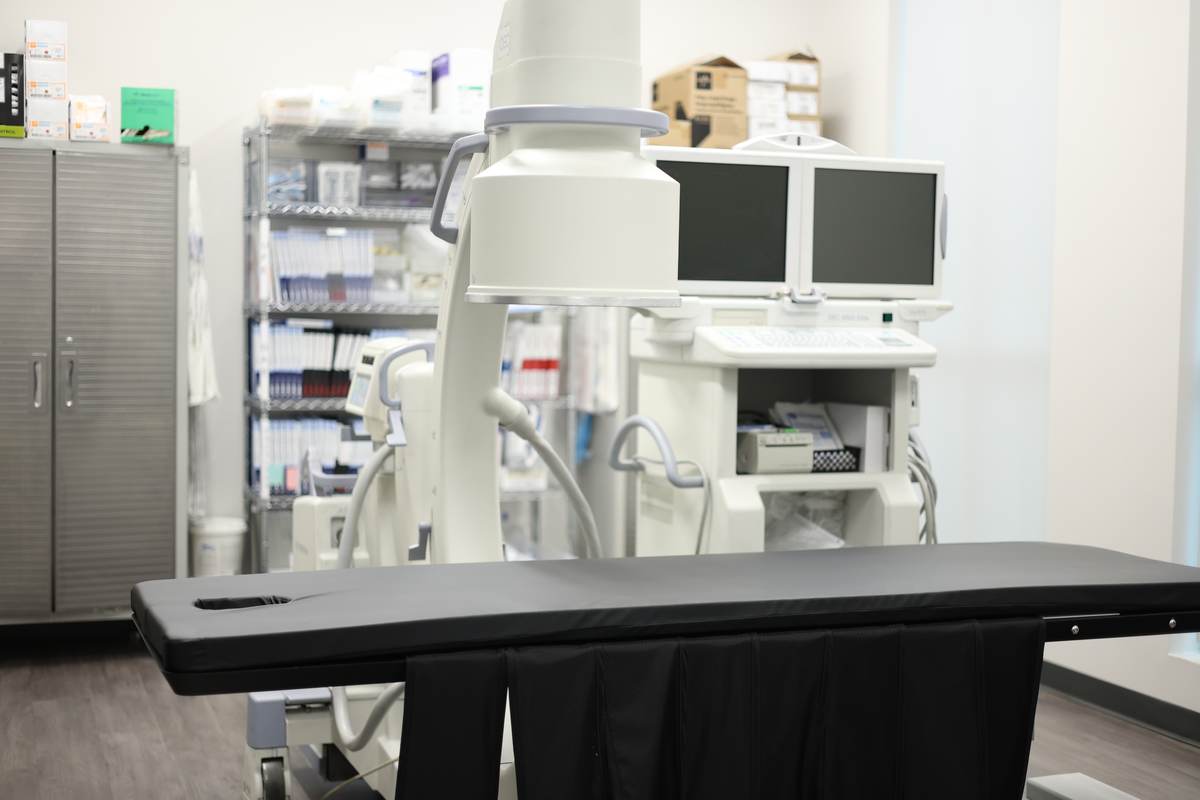
Plan on three to four hours with us all told — prep, procedure, and recovery. You’ll fast for the eight hours before (clear liquids and black coffee are fine up to two hours ahead), and you’ll bring a driver. No exceptions — it’s the sedation, not the knee.
Don’t take our word for any of this: the exact instruction sheets our patients take home are right here. Read them before you ever book anything — pre-procedure instructions (PDF) and post-procedure instructions (PDF).
See the procedure
 After knee replacement
“Knee replacement still hurting? GAE may be the answer” — the what and why, from our team Watch on YouTube →
After knee replacement
“Knee replacement still hurting? GAE may be the answer” — the what and why, from our team Watch on YouTube →
 Knee · GAE explained
“Can GAE really stop your knee pain for good?” — the procedure itself, explained Watch on YouTube →
Knee · GAE explained
“Can GAE really stop your knee pain for good?” — the procedure itself, explained Watch on YouTube →
From our physicians’ patient-education series. Prefer reading? Everything in the videos is covered on this page — and in more detail.
Patient stories
 Patient story · After replacement
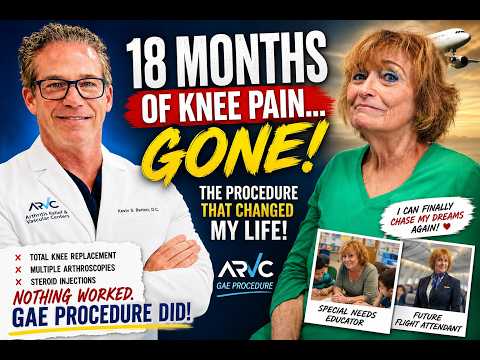
“Knee replacement gone wrong? Here’s what finally helped” — a total knee, arthroscopies, and steroid injections hadn’t worked. Then GAE. Watch on YouTube →
Patient story · After replacement
“Knee replacement gone wrong? Here’s what finally helped” — a total knee, arthroscopies, and steroid injections hadn’t worked. Then GAE. Watch on YouTube →
 Patient story · After replacement
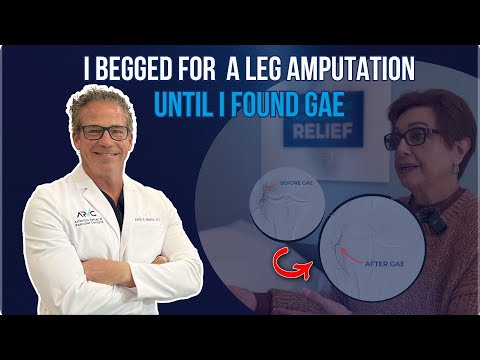
“I had 23 knee surgeries before 60” — she was so out of options she asked her surgeon to amputate. He referred her here instead — and GAE cut her pain by more than half. Watch on YouTube →
Patient story · After replacement
“I had 23 knee surgeries before 60” — she was so out of options she asked her surgeon to amputate. He referred her here instead — and GAE cut her pain by more than half. Watch on YouTube →
Every patient’s story is their own. Results vary. These are real ARV Centers patients who had persistent pain after a knee replacement, sharing their experiences with their permission.
What goes in — and what doesn’t stay
The blocking agent we use is a slurry of a medication (imipenem/cilastatin) mixed with X-ray dye. Mixed together, they form microcrystals smaller than a grain of sand. The crystals block the abnormal vessels — and the pain nerves they feed — just long enough to quiet them, then dissolve into the bloodstream within 30 to 45 minutes. Nothing permanent stays in your body — and nothing goes anywhere near the implant, the bone it’s fixed to, or the space between them. You already have hardware in your knee; we’re not adding more.
If you’re wondering how a temporary blockage gives lasting relief: the crystals stay long enough to shut down the abnormal vessels and calm the inflammation they feed. In the study that compared temporary crystals head-to-head against permanent beads in knees, relief at two years was just as good.⁴ It’s the same dissolving agent we use for shoulder embolization — one agent, one philosophy: block the problem, leave nothing behind.
The published evidence
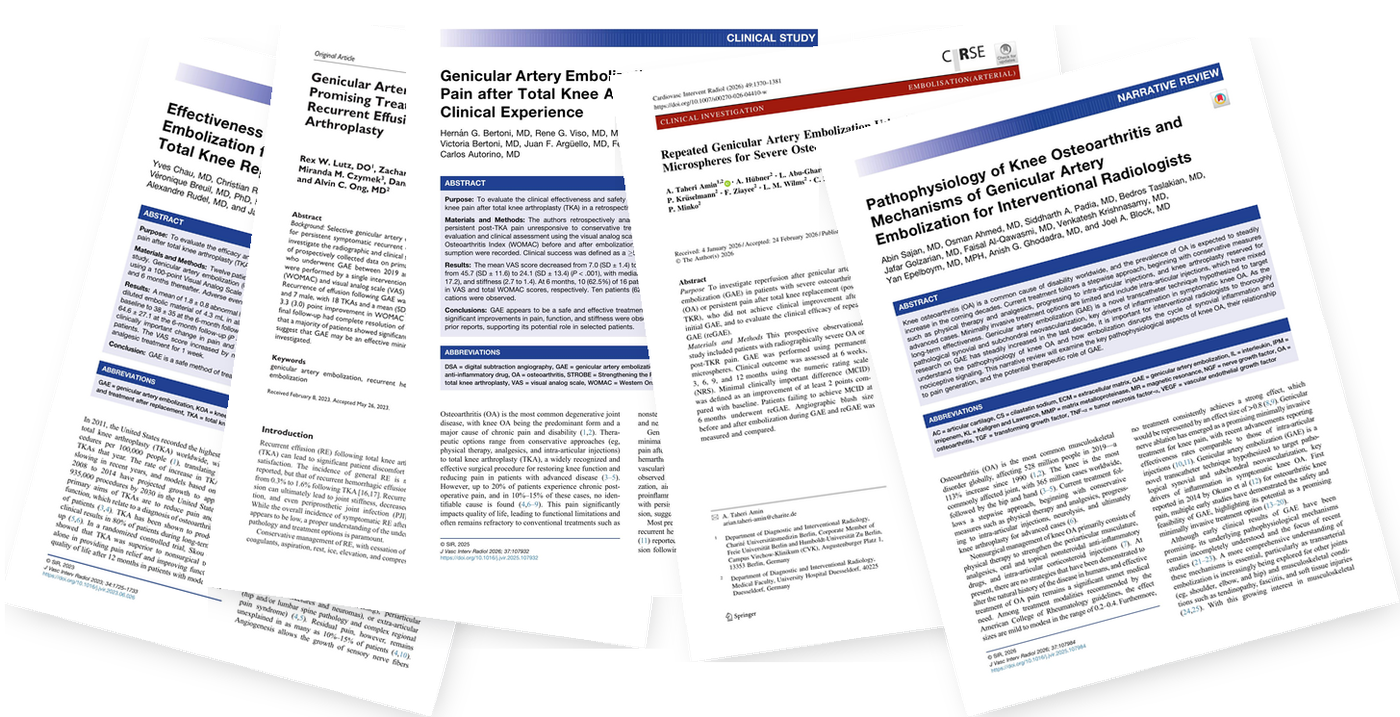
14 of 18
replaced knees whose swelling resolved completely — confirmed on ultrasound six months after embolization — in the Hospital for Special Surgery series of recurrent effusion after TKA.⁵
7.0 → 3.4
pain scores (out of 10) after embolization for persistent post-replacement pain in a multicenter series. Function scores improved alongside them, and 6 in 10 patients cut back on pain medicine.⁶
73 → 38
pain on walking (out of 100) at six months in a prospective pilot study of knees that still hurt after replacement — with about 7 in 10 patients reaching a meaningful improvement in quality of life.⁷
+36%
more patients reached a meaningful improvement after a second embolization, in a 2026 study of 55 patients where imaging showed the treated vessels had reopened. Some knees need a second pass.⁸
And what we see: embolization of the knee is not new or fringe — it has more than a decade of research behind it, including sham-controlled randomized trials and pooled analyses across hundreds of knees.¹ ³ What is newer is aiming it at a knee that has already been replaced. Treating persistent or chronic knee pain after total knee arthroplasty is now one of the most common procedures we perform: patients whose implant is sound, whose surgeon has cleared it, and whose knee still swells and aches months or years after the operation. In our experience most of them get real, meaningful relief.
Two things we will tell you plainly. In the published series a minority of patients had temporary skin discoloration or a short flare of pain in the first week — both settled on their own.⁷ And some knees need a second treatment: when the first one fades, it is usually because the vessels have reopened, and treating them again works.⁸
Sources: 5. Lutz et al., HSS Journal 2024;20(4):508–514 — retrospective review, 17 patients / 18 TKAs with recurrent effusion: mean WOMAC improvement 36.1 points, VAS 3.3 points; 14 of 18 knees (77.8%) with complete resolution of effusion on ultrasound at final follow-up. 6. Bertoni et al., J Vasc Interv Radiol 2025 — retrospective multicenter series, 18 procedures in 16 patients with persistent post-TKA pain: VAS 7.0→3.4 and total WOMAC 45.7→24.1 (both P < .001); 62.5% achieved a ≥50% VAS reduction at 6 months; 62.5% reduced analgesic use; no major complications. 7. Chau et al., J Vasc Interv Radiol — prospective single-center pilot, 12 patients, 75-µm particles: VAS on walking 73→38 and KOOS pain 43.6→64.6 at 6 months (both P < .05); 55% and 73% reached a minimal clinically important change in pain and quality of life; self-limited skin discoloration in 5 patients (42%); transient post-procedure pain in 4 (30%). 8. Taheri Amin et al., Cardiovasc Intervent Radiol 2026;49:1370–1381 — prospective observational study, 55 patients / 87 embolizations for severe osteoarthritis or post-TKR pain: 42% reached the minimal clinically important difference after the first treatment; repeat embolization brought a further 36%; angiography confirmed reperfusion of previously treated vessels. 9. Sanchez et al., Society of Interventional Radiology abstract — single-arm pilot, 10 post-TKA patients: WOMAC −45.7%, KOOS activities of daily living +86.9%, SF-36 physical functioning +140% over 3–6 months; recruitment ongoing. 10. Sajan et al., J Vasc Interv Radiol — narrative review of knee osteoarthritis pathophysiology and the mechanism of genicular artery embolization.
Candidacy
We turn away patients who aren’t candidates for what we do. Routinely.
Your care team
GAE at ARVC is performed by our Board Certified Vascular and Interventional Radiologists, in our own angiography suite. One number worth asking any doctor before any procedure: how many times have you done this? Here’s ours: more than 700 genicular artery embolizations.
After your procedure
When you go home, you take the on-call doctor’s cell phone number with you. Not an answering service — the doctor.
And you don’t have to wonder whether to bother us: we call you the next day to check in. Every patient, every procedure.
A follow-up appointment is scheduled to check your recovery and your response to the treatment — part of the procedure here, not an extra.
Before you leave, you’ll get this card
Your procedure:
On-call doctor:
Cell phone: written by hand, before you walk out
Call me if anything worries you.
Straight answers
About one patient in five still has pain after a knee replacement.¹ A replacement resurfaces the joint — metal and plastic where cartilage used to be — but it doesn’t remove the joint’s soft lining. In some knees that lining stays inflamed after surgery, keeps its web of abnormal blood vessels and pain nerves, and keeps hurting. That inflamed lining is the tissue GAE treats.
No. X-rays are the right tool for checking the implant and the bone — and a clean X-ray is genuinely good news. But X-rays don’t show the joint’s soft lining or its blood supply. An angiogram does — and in knees like the ones above, it shows a dark blush of abnormal vessels feeding the inflamed lining around the implant. The pain is physical, and it has an address.
Yes — and we mean it. The replacement must be cleared first: no loosening, no infection, no alignment or wear problem. That workup belongs to your surgeon, with imaging and sometimes lab work, and we coordinate with them rather than working around them. We won’t treat over an implant problem — if your knee needs revision surgery, embolization is not a substitute for it.
The procedure doesn’t involve the implant at all. GAE happens inside the small soft-tissue arteries around the joint — the catheter never enters the joint space, the implant, or the bone it’s fixed to. The blocking agent is a slurry of temporary crystals that dissolves within 30 to 45 minutes.⁴ Nothing is implanted, and nothing permanent stays in your body.
No. GAE has been studied for more than a decade, including randomized sham-controlled trials, and is covered by most insurance — the full record is here. In patients with pain after a knee replacement, published studies report meaningful improvement,² and the two patients above are exactly why we offer it: for most people in this situation, there is no other option left short of another operation.
The same day as any GAE at ARVC: IV sedation (not general anesthesia), a pinhole in the upper thigh, about 45 minutes on the table, 30 to 45 minutes of observation, then home the same day with your driver. Plan on three to four hours all told. The step-by-step walkthrough above covers the details, down to the instruction sheets you’d take home.
Then that’s what we’ll tell you — before you spend a dollar with us. GAE is not a substitute for a needed revision, and the stability workup exists precisely to catch that. And if you ever need surgery later, embolization doesn’t change the anatomy a surgeon works with — in the British trial, every knee that went to surgery after GAE had a normal operation.³
GAE is covered by most insurance plans, including Medicare — and we do a complimentary benefits check before any procedure, so there are no surprises. You’ll know exactly where you stand, medically and financially, before you decide anything.
More than 700 genicular artery embolizations — including patients whose pain came after a knee replacement. The angiograms on this page are from one of them. That’s exactly the right question to ask any doctor recommending any procedure, and we’ll never be offended by it.
Then you’ve lost nothing but a short recovery. Nothing about the embolization closes a door: every option — injections, a repeat embolization when appropriate, or revision surgery if it’s ever truly indicated — stays open. And we’ll tell you transparently before the procedure if we think you’re unlikely to benefit.
Sources: 1. Taslakian et al., Osteoarthr Cartil Open 2023 — systematic review & meta-analysis of GAE; its introduction notes approximately 20% of knee-replacement patients report dissatisfaction, with persistent pain most often attributed to synovitis (inflammation of the joint lining). 2. Published post-replacement series: J Vasc Interv Radiol 2023; J Vasc Interv Radiol 2025; Cardiovasc Intervent Radiol 2025. 3. Little et al. (GENESIS), Cardiovasc Intervent Radiol 2024. 4. Bhatia et al., The Knee 2023.
Free patient guide
Our free knee arthritis guide explains what’s actually causing your pain, every treatment option — surgical and non-surgical — and the questions worth asking any doctor, including us. Written by our physicians. No appointment required, and no follow-up phone call unless you ask for one.
We’ll email your guide plus occasional patient education. Unsubscribe anytime. Privacy policy.
You’ll sit with a physician — not a salesperson. Bring your X-rays and your operative report if you have them. You’ll hear every option, including the ones we don’t offer, and get a straight answer: whether GAE fits your knee — or whether your replacement needs a surgeon’s eyes first. Call us directly, or send this form and we’ll call you to schedule. We do a complimentary benefits check before any procedure. No surprises.
210-405-1335Closed on major holidays.
3212 Napier Park, San Antonio, TX 78231
Stand-in image (Map © OpenStreetMap) — the live site embeds the interactive Google map here
No referral needed for your initial consultation.
Rather book by phone? Call (210) 405-1335.