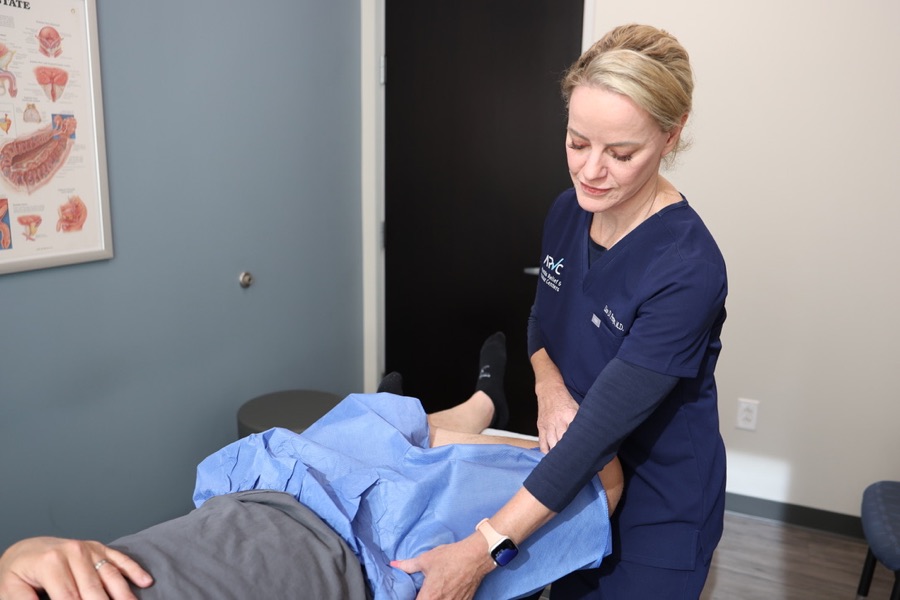
First, we find the real driver Dr. Lisa Persyn examining a patient’s hip in our clinic. Arthritis in the joint, bursitis on the outside, or pain borrowed from your back — the exam and imaging tell us which.
Hip arthritis and greater trochanteric bursitis don’t just wear parts down —
they keep the joint, and the tissue around it, inflamed. At ARVC we treat that
inflammation directly: precision image-guided injections as the first step, and
hip embolization — a non-surgical, same-day procedure
through a pinhole in the groin — when injections stop holding. No implants. No
months of rehab. Covered by most insurance plans, including Medicare.
Covered by most insurance, including Medicare No referral needed for your initial consultation
Does this sound familiar?
The bed lost. You’re in the recliner most nights now, because lying on that side is out and lying on the other side pulls at it. The worst of it lands somewhere between 2 and 4 a.m. Four hours of sleep is a good night.
Socks and shoes have become a project — you’ve gone to slip-ons. Getting out of the car takes a hand on the door frame. Stairs are one at a time. And you’ve started skipping things — not because you can’t, but because you already know what they’ll cost you tomorrow.
Maybe the X-ray said arthritis. Maybe someone said “bursitis,” or “it’s muscular,” and handed you a cortisone shot that helped for six weeks. Maybe you’ve heard the word “replacement” — or the opposite: that you’re too young for one, or it’s not bad enough yet, so come back when it’s worse.
“Come back when it’s worse” is not a plan. Here’s what’s actually going on in there — and the rungs nobody’s walked you through.
Why it hurts
Two kinds of hip pain. One thing they share.
Hip pain usually comes from one of two places — and it’s worth knowing which,
because they feel different and they’re treated a little differently.
Hip osteoarthritis lives in the joint itself. The pain sits in the groin
or the front of the hip, sometimes running down the thigh toward the knee. It’s
stiff after sitting, stiff first thing in the morning, and it’s the reason the
socks won’t go on.
Greater trochanteric bursitis — doctors now call it greater
trochanteric pain syndrome, because the gluteal tendons are usually as involved as the
bursa — lives on the outside of the hip, over the bony point you can feel
through your skin. It’s tender to press. It’s the one that won’t let
you lie on that side, and it flares on stairs and standing on one leg. Plenty of people
have some of both.
What they share is the part the X-ray doesn’t show. When a joint or a tendon stays
irritated long enough, the body grows abnormal new blood vessels into the area —
and new pain nerves grow right along with them. The inflammation feeds the vessels, the
vessels feed the inflammation, and the loop runs day and night. That’s why the ache
is deep and constant, why it wakes you when you’re lying still, and why it can be
so much worse than the X-ray “looks.” On an angiogram, that overgrown blood
supply shows up around an arthritic hip joint and around an inflamed trochanter alike.
It’s the same mechanism we treat in knees every week — and it’s
treatable in hips too.
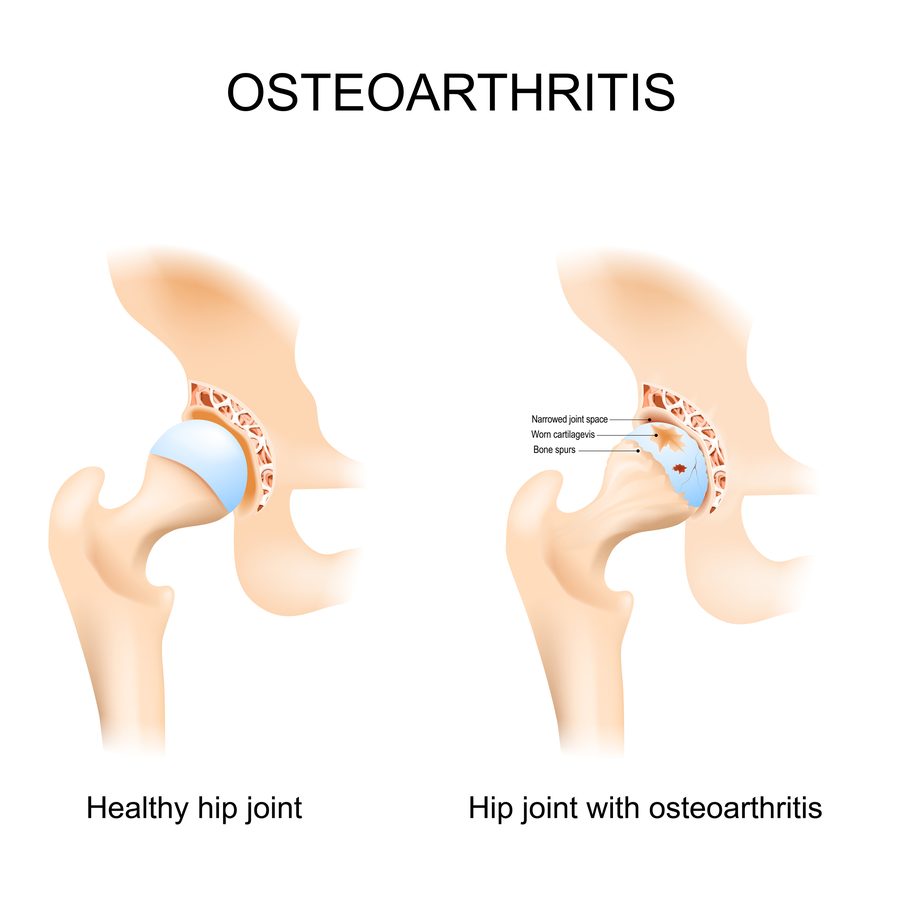
What the X-ray shows — and what it doesn’t
Worn cartilage and bone spurs show up on X-ray. The inflammation that wakes you at 3 a.m. doesn’t.
Your options, in honest order
A ladder — not a leap to surgery.
Rest, anti-inflammatories, PT
Where everyone starts — and for bursitis especially, a well-run program of
gluteal strengthening is worth doing. But when the joint or the tendon itself stays
inflamed, rest and exercises alone often can’t quiet it. If they were going to be
enough, they’d have worked by now.
Precision image-guided injections — our first rung
Steroid to calm the inflammation — in the joint for arthritis, at the bursa and
tendon for bursitis. Hyaluronic acid (gel) to cushion and lubricate an arthritic joint.
PRP where it genuinely fits. What makes ours different is the word precision:
the hip joint sits deep under muscle, and there is no reliable way to reach it by feel.
Every injection at ARVC is guided by imaging, so the medication lands exactly
where it should — not near it. That’s the difference between
“we tried an injection” and “we treated the hip.”
Through a pinhole in the groin, an interventional radiologist guides a tiny catheter to
the arteries feeding the inflamed tissue and blocks the abnormal vessels with a temporary
slurry of microcrystals that dissolves into the bloodstream within the hour —
nothing permanent stays behind. The inflammation loop loses its supply line; pain eases
over the following weeks. It treats the source of the inflammation
— not the symptom schedule. It’s an option for arthritis in the joint, and
especially for the severe, stubborn bursitis that keeps coming back after every shot.
No incision, no implants, home the same day.
Here’s the honest part: total hip replacement is one of the most successful
operations in medicine. If your arthritis is advanced, you’re a good surgical
candidate, and you’re ready — that is usually the right answer, and
we’ll say so. This ladder is for everyone who isn’t there: because the
arthritis isn’t advanced enough yet, because surgery isn’t safe for you right
now, or because you’re not ready and need something real in the meantime. And
bursitis was never a replacement problem in the first place.
When injections aren’t enough
The next rung is hip embolization — what the studies say, and what we see.
Two of the published papers on hip embolization — including the six-month series cited below. The hip literature is younger and smaller than the knee’s, and we say so plainly.
To be clear about what this section describes: hip embolization
— the rung above. When precision injections stop holding, it goes after the abnormal
blood vessels feeding the inflamed joint or bursa rather than the pain they cause.
The procedure we’ve done the most, and the one with the most research behind
it, is genicular artery embolization for knee
arthritis. The knee has been studied the longest and most widely, and the finding is
consistent: block the abnormal blood vessels feeding an inflamed joint, and the pain settles.
Doctors then asked whether the same approach would help other joints — and the results
in shoulders, hips, and even the plantar fascia in the foot follow the same pattern as the
knee.
That matches what we see in our own practice. We’ve performed more than
700 knee embolizations, along with shoulders, hips, and feet, and in our experience all of
them are highly effective — most of the patients we treat get real, meaningful
relief. The hip research is newer and smaller than the knee’s, and we’ll
always tell you that. Here’s what it shows.
7.8 → 4.0
Average pain out of 10, before and 12 months after hip embolization, in the largest
study of the procedure — 49 patients with hip arthritis or bursitis. About 3 in 4
of those followed for the full year had at least a 50% improvement in pain or
function.¹
21 of 38
Hips with stubborn trochanteric bursitis that reached mild pain (0–3 out of 10)
at last follow-up in a 31-patient series — with 7 more improved to moderate, and 9
that didn’t improve. Worth knowing going in.²
Zero
Serious complications reported across the published hip series. The side effects
were groin bruises, a temporary patch of thigh numbness, and a brief patch of skin
discoloration — all cleared on their own.¹ ² ³ ⁴ ⁵
The bursitis finding matters to us, because we see a lot of it. In the 12-month
study, patients whose problem was purely trochanteric bursitis did just as well as the
arthritis patients.¹ In an earlier six-month series — 13 patients, 10 of them with
bursitis — the standard hip pain-and-function score fell from 77 to 27.³
That’s why we offer embolization for severe, recurring bursitis rather than sending you
back for a fourth cortisone shot.
One study looked only at people who couldn’t have a hip
replacement — 18 patients over 60, each with a medical reason surgery wasn’t safe
— and saw pain fall from 7.8 to 4.3 out of 10 at 12 weeks, with no complications. Its
authors called embolization a bridge between conservative care and surgery. That’s how
we think of it too.⁴
And the newest series — 41 patients in Berlin, every one with confirmed
hip arthritis, most of it moderate to severe on X-ray — shows the same shape: pain
7 to 4 out of 10 at six months, holding at twelve; about 2 in 3 with a
meaningful pain improvement and roughly 9 in 10 with a meaningful gain in daily function; no
serious complications and no damage to the ball of the hip joint. The two patients who
didn’t respond went on to hip replacement afterward — embolization didn’t
close that door.⁵
We do a complimentary benefits check before any procedure. No
surprises.
Sources: 1. Cavalheiro et al., HipE Study,
Cardiovasc Intervent Radiol 2026;49(7):1295–1305 — prospective single-arm, single-center;
49 treated, 37 completed 12 months (31 hip OA, 6 pure trochanteric pain syndrome);
imipenem/cilastatin; VAS 7.84→3.97, WOMAC 54→24; clinical success (≥50%
reduction in WOMAC or VAS) 73% of completers; two grade 1a groin hematomas; no
significant difference between the OA and pure-GTPS subgroups. 2. Giordani et al., Latino-Hip
cohort, Cardiovasc Intervent Radiol 2025;48(4):538–542 — single-center registry
(retrospective analysis of a prospective cohort), 31 patients / 38 joints with
trochanteric pain syndrome refractory to conservative care; at last follow-up 21 joints VAS
0–3, 7 joints VAS 4–6, 9 joints unimproved (VAS 7–10); one lost to
follow-up; two minor complications (posterior thigh numbness, resolved within 30 days).
3. Correa et al., Cardiovasc Intervent Radiol 2022 — 13 patients (10 GTPS,
3 hip OA), 6 months: WOMAC 77→27, VAS 10→2; two transient numbness. 4. Feier et al.,
Cureus 2025 — 18 patients ≥60 with a contraindication to hip replacement,
Tönnis grade I–II: VAS 7.8→4.3 and Harris Hip Score 45.5→62.1 at 12
weeks; no adverse events. 5. Fleckenstein et al., Cardiovasc Intervent Radiol 2026;49:1352–1361
— retrospective single-center, 41 patients with radiographic hip OA (KL III 68%, KL IV 27%),
≥3 months failed conservative care; technical success 40/41; median NRS pain 7→4 at 6 and 12
months; MCID reached by 64% (pain) and 85–92% (HOOS domains) at 12 months; 12-month follow-up in
28/41; no major or moderate adverse events, 3 transient skin discolorations; two KL IV non-responders
proceeded to hip replacement at 7 and 9 months. Sources 1–2 abstract-verified, 3–5 full
text — full texts before any print or ad use.
What hip embolization is like
In our office. Home the same day.
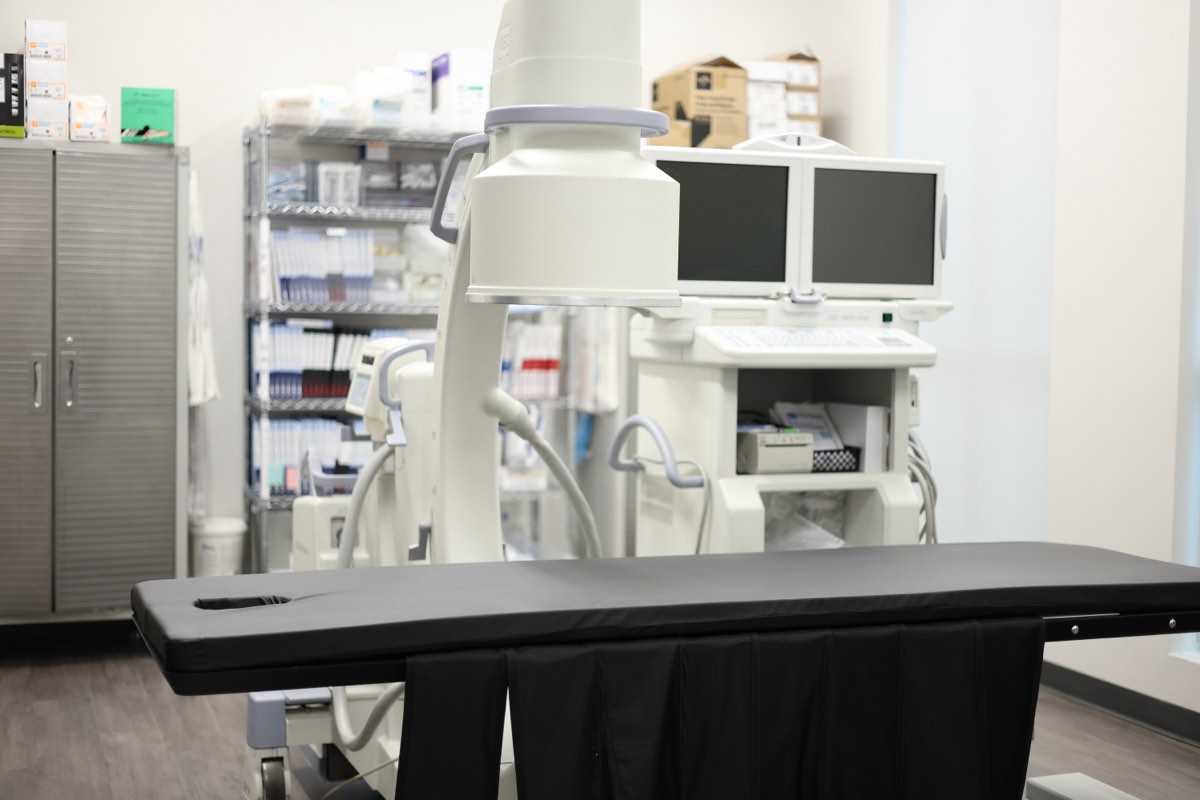
Hip embolization is done in our own IR suite, in our office — not a
hospital. Twilight (IV) sedation with a dedicated nurse. A numbed pinhole in the groin
— no incision, no stitches; a brief pinch is the only thing you should feel,
because blood vessels themselves have no pain nerves. The blocking agent is temporary: an
antibiotic (imipenem/cilastatin) mixed with X-ray dye, which forms microcrystals smaller
than a grain of sand that quiet the abnormal vessels, then dissolve into the bloodstream
within the hour — the same agent used in the published hip studies. Forty-five to ninety minutes on the table, about an
hour in a recliner, and someone drives you home. Plan on three to four hours all told.
Light walking the same day; nothing strenuous for 48 hours; easy on the hip for
a week or two. Relief isn’t instant — it builds over the following
weeks as the inflammation settles, and a brief flare in the first few days is normal.
Most patients manage the first day with over-the-counter pain relievers.
Our IR suite — in the office
Hip embolization is done here. Not a hospital. Home the same day.
Candidacy
Who this is for — and who it isn’t.
You may be a candidate if:
Hip arthritis or trochanteric bursitis pain has lasted months despite conservative care — therapy, anti-inflammatories, injections
Injections helped but keep wearing off — or you want them guided precisely this time
You’ve been told you’re “too young” for a replacement, or “not bad enough yet” — and offered nothing in the meantime
Surgery isn’t safe for you right now, or you’re not ready — and you need something real in between
Bursitis that keeps coming back after every cortisone shot
You’re probably not a candidate if:
Your arthritis is so advanced that replacement is honestly the better road — some are, and we’ll say so
Your pain is coming from your spine, not your hip (we look before we treat)
Something structural is the real driver — a fracture, dead bone (avascular necrosis), or a torn labrum that needs a surgeon. Imaging tells us, and we’ll tell you
We turn away patients who aren’t candidates for what we do.
Routinely.
Your care team
One team, under one roof.
Your workup and your first rung start with our physical medicine team:
Lisa D. Persyn, M.D., board-certified in physical medicine and
rehabilitation, performs your image-guided injections — she has more than
100,000 joint injections behind her — and nurse practitioner Meredith
Reynolds handles your exams and care through the visits. When embolization is
the right rung, you’re handed to our Board Certified Vascular and Interventional
Radiologists. The ladder isn’t a referral chain. It’s a hallway.
When you go home, you take the on-call doctor’s cell phone number with you.
Not an answering service — the doctor.
And you don’t have to wonder whether to bother us: we call you the next day
to check in. Every patient, every procedure.
Before you leave, you’ll get this card
Your procedure:
On-call doctor:
Cell phone: written by hand, before you walk out
Call me if anything worries you.
Straight answers
Questions patients actually ask.
“Is this the same procedure you do for knees?”
Same idea, different address. Genicular artery embolization (GAE) treats the abnormal vessels around an arthritic knee; hip embolization does the same for the hip. The knee version has the most research behind it; the hip uses the identical technique, the same temporary blocking agent, and the same team — and in our experience the results track. Knee Pain & Arthritis →
“Is it arthritis or bursitis? How do you tell?”
Where it hurts, what makes it worse, and what we find when we press. Pain in the groin or the front of the hip — stiff after sitting, worse putting on socks — is usually the joint. Pain on the outside of the hip that’s tender to the touch and won’t let you lie on that side is usually trochanteric bursitis. Pain in the buttock that runs down the leg may be your back, not your hip at all. Then imaging confirms it — X-ray, and sometimes MRI or ultrasound. Often it’s some of both, which is one reason a hip that’s been “treated for bursitis” three times can still hurt.
“I’ve had cortisone in the bursa three times. It keeps coming back. Now what?”
That pattern is the signal. Cortisone quiets the inflammation without touching what’s feeding it — the abnormal vessels are still there when the medication fades, so the loop restarts, usually a little sooner each time. For bursitis that’s severe and keeps returning, hip embolization goes after the supply line itself — and patients exactly like that are who the published bursitis series were built on. Bring your history; we’ll tell you if you’re there.
“Why do you insist on imaging for hip injections?”
Because the hip joint sits deep, under muscle, and there is no reliable way to reach it by feel. Guidance means the medication lands in the joint — or precisely at the bursa and tendon — instead of somewhere near it. It also tells us something: if numbing the joint takes the pain away, the joint was the source. If it doesn’t, we keep looking rather than treating the wrong thing.
“Should I just get the replacement?”
Maybe — and if that’s the honest answer, you’ll hear it from us. Total hip replacement is one of the most successful operations in medicine. If your arthritis is advanced, you’re a good surgical candidate, and you’re ready, that’s usually the right road. What we treat is everyone who isn’t there yet: not advanced enough, not safe for surgery right now, or not ready — and everyone whose problem is bursitis, which a replacement was never going to fix. And embolization doesn’t burn the bridge: in the published series, the few patients who didn’t respond went on to have a replacement afterward.
“Am I too old for this? Too young?”
The published hip studies were mostly patients in their 60s and 70s — and one was built entirely on patients over 60 whose health ruled surgery out. Age matters less than what’s driving the pain. “Too young for a replacement” is precisely the situation this ladder exists for — the years between “come back when it’s worse” and surgery don’t have to be endured untreated.
“I already had a hip replacement and it still hurts. Can you help?”
Sometimes. Step one is always the implant: it has to be confirmed sound — not loose, not infected, not out of position — before we would consider treating inflammation around it. That’s your surgeon’s call and it comes first. If the implant is fine and the pain is inflammatory, it’s something we evaluate. We do the same for knees →
“Is it covered by insurance?”
Injections are broadly covered. (PRP is the exception — it’s typically cash-pay, and we will tell you plainly when it’s worth considering and when it’s not.) Hip embolization is covered by most plans too, including Medicare. And the standing promise still holds: we do a complimentary benefits check before any procedure. No surprises.
Free patient guide
Not ready to call? Start with the hip guide.
Our physicians wrote a plain-English guide to hip pain: what’s actually driving it
— arthritis in the joint or bursitis on the outside — what each treatment can
and can’t do, from guided injections to embolization to replacement, and how to tell
which rung of the ladder fits your hip. No appointment required, and no follow-up phone
call unless you ask for one.
We’ll email your guide plus occasional patient education.
Unsubscribe anytime. Privacy policy.
Bring your imaging if you have it. You’ll leave knowing what’s actually driving the pain.
X-ray, MRI, whatever exists — bring it. You’ll leave knowing which rung of the ladder fits your hip, and whether we can help — including a plain “we can’t, and here’s who can” if that’s the truth. Call us directly, or send this form and we’ll call you to schedule. We do a complimentary benefits check before any procedure. No surprises.