You keep your uterus
UFE is uterine-sparing. It treats the fibroids and leaves your uterus exactly where it is — nothing is removed, and all of your fibroids are treated in one procedure.
For women in San Antonio who want a highly effective, non-surgical fibroid treatment that spares the uterus
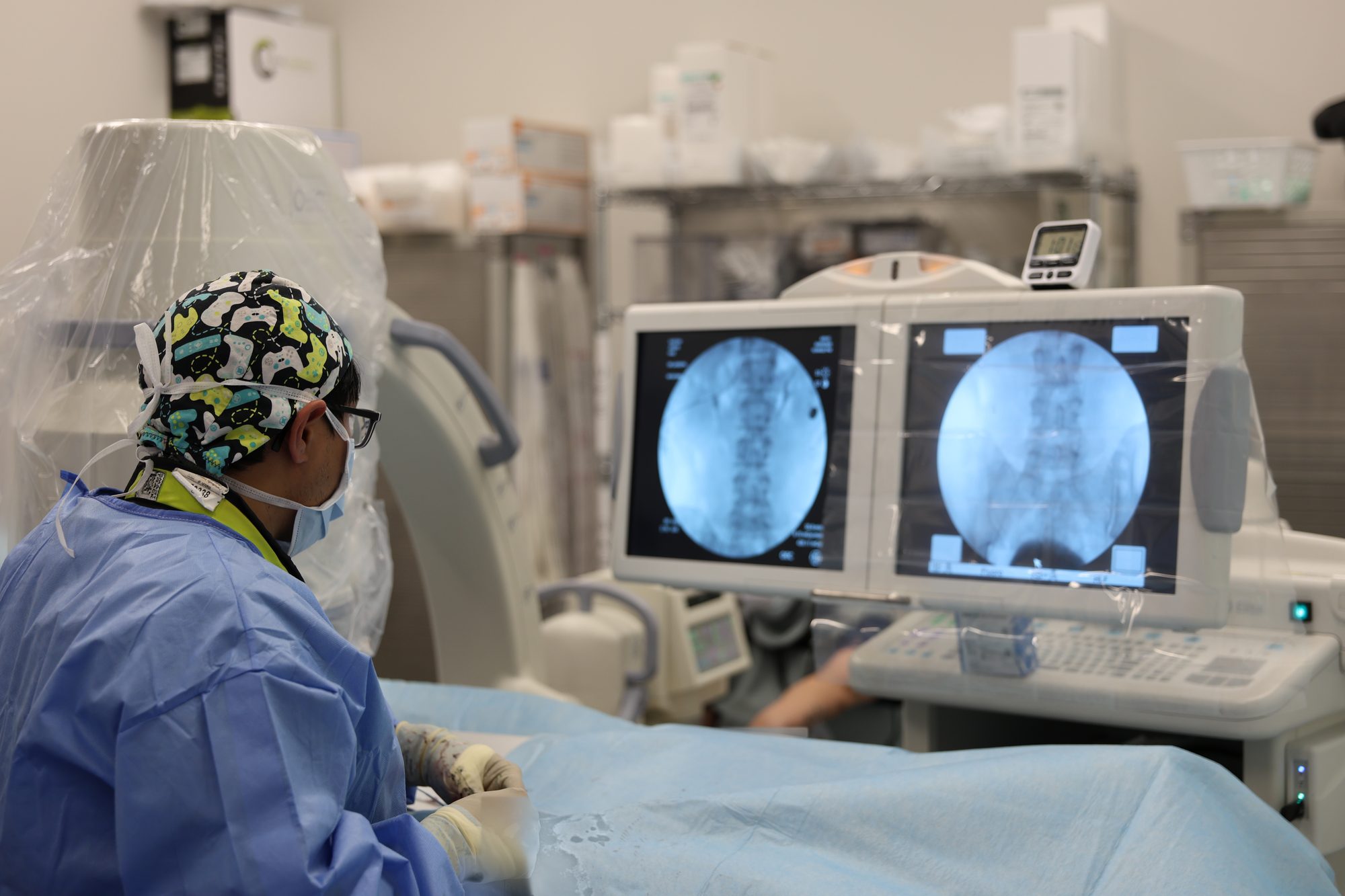
Arthur Joseph, D.O., MPH · Vascular & Interventional Radiology
Dr. Joseph performing a uterine fibroid embolization here in our office.
Uterine fibroid embolization is a same-day, non-surgical procedure. Through a pinhole in the groin, an interventional radiologist blocks the arteries feeding your fibroids. Starved, they soften and shrink. No incision, nothing removed — your uterus stays exactly where it is. Done in our own IR suite, in our office, and covered by most insurance plans, including Medicare and Medicaid.
Covered by most insurance, including Medicare & Medicaid No referral needed for your initial consultation Every patient goes home the same day More than 300 UFE procedures performed here
Maybe you came here from our uterine fibroids page, where UFE is the option nobody offered you — and before you take it seriously, you want to know what “a procedure” actually means.
Maybe your OB/GYN finally mentioned it, or a friend had it done — or you found the letters U-F-E at 2 a.m. in a fibroid forum and thought: this sounds too good. What’s the catch?
This page is the full walkthrough: what happens on procedure day, what goes into your body, how we keep you comfortable the first night — and a documentary of a real UFE performed here, following one of our patients through her whole treatment. Judge it with your own eyes.
The procedure
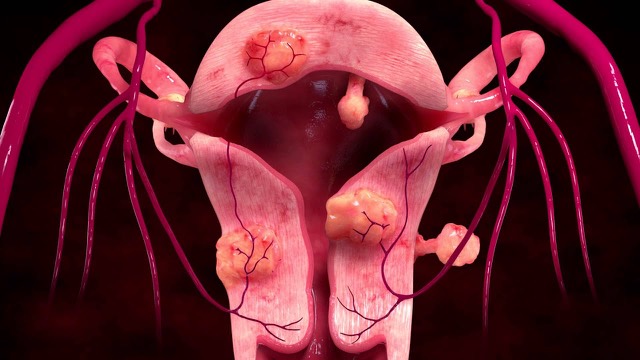
Fibroids are muscle tumors — almost never cancer — and they behave like any growing tissue: they live on blood supply. Give a fibroid blood and it grows. Take the blood away and it shrinks. That’s not a metaphor. It’s the entire procedure.
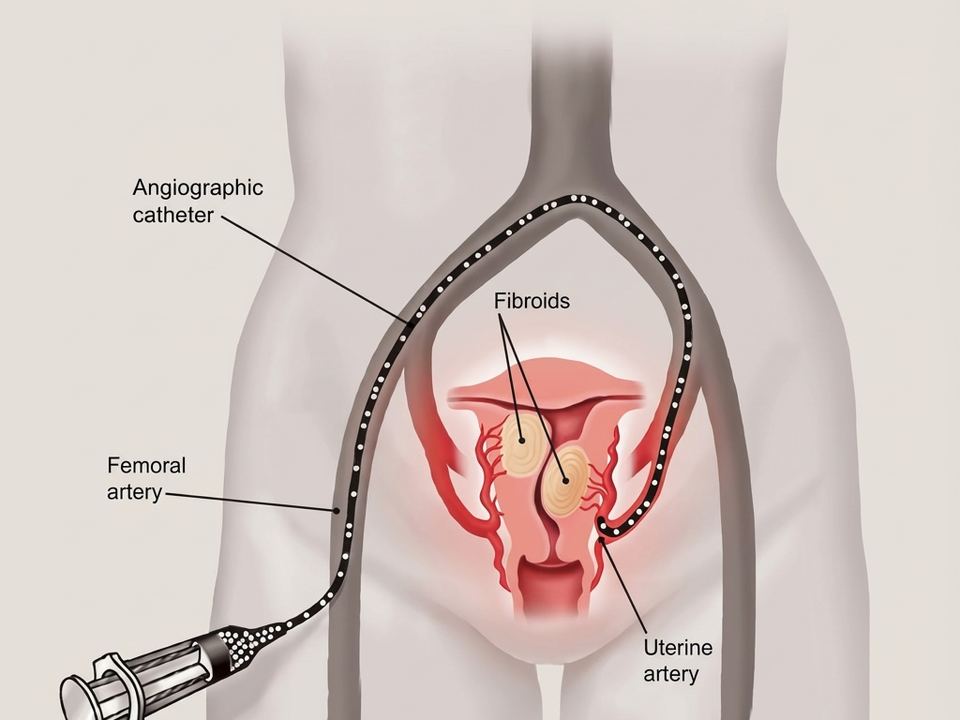
Through a pinhole in the groin, an interventional radiologist guides a catheter thinner than a phone-charger cord into the uterine arteries — the supply line — and releases microscopic particles into the branches feeding each fibroid. The particles lodge there and block the flow. Starved, the fibroids soften and shrink over the following weeks and months. The bleeding eases. The pressure lets up.
Notice what UFE is not: it’s not surgery. Nothing is cut and nothing is removed. A hysterectomy solves fibroids by taking out the organ that has them. UFE solves them by unplugging them — all of your fibroids, in one procedure — and your uterus stays exactly where it is.
 3-D animation
How embolization starves a fibroid — a 3-D animation Watch on YouTube →
3-D animation
How embolization starves a fibroid — a 3-D animation Watch on YouTube →
Animation courtesy of Merit Medical, the manufacturer of the embolic microspheres we primarily use.
Why women choose UFE
UFE is uterine-sparing. It treats the fibroids and leaves your uterus exactly where it is — nothing is removed, and all of your fibroids are treated in one procedure.
UFE is an outpatient procedure. You go home the same day and sleep in your own bed that night — no hospital stay.
Recovery takes three to five days. After the first 24 hours you can do any activity you feel up to — the one rule is no heavy lifting over 50 pounds for at least three days. In less than a week you’re back to full physical activity, with no restrictions.
You’re under IV sedation — relaxed and drowsy, breathing on your own. You’re never put under.
UFE goes through a pinhole in the groin. Nothing is cut through the abdomen, so there’s nothing to stitch and nothing to scar — no abdominal muscle recovery, and no vaginal soreness.
UFE relieves the bleeding, the pain and the pressure, and the risk of regrowth is very low. It’s a long-term solution.
The relief you came for, without the surgery. Now watch it actually happen.
See the procedure
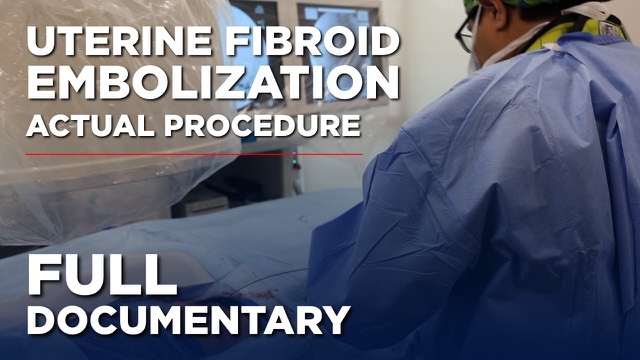 Full documentary
Watch a real UFE, start to finish — one patient’s complete journey Watch on YouTube →
Full documentary
Watch a real UFE, start to finish — one patient’s complete journey Watch on YouTube →
 UFE explained
What UFE is — and why you’ve never heard of it — explained by our team Watch on YouTube →
UFE explained
What UFE is — and why you’ve never heard of it — explained by our team Watch on YouTube →
 Patient story
Lindsey’s life-changing non-surgical fibroid treatment Watch on YouTube →
Patient story
Lindsey’s life-changing non-surgical fibroid treatment Watch on YouTube →
 Patient story
“How I beat fibroids without surgery” Watch on YouTube →
Patient story
“How I beat fibroids without surgery” Watch on YouTube →
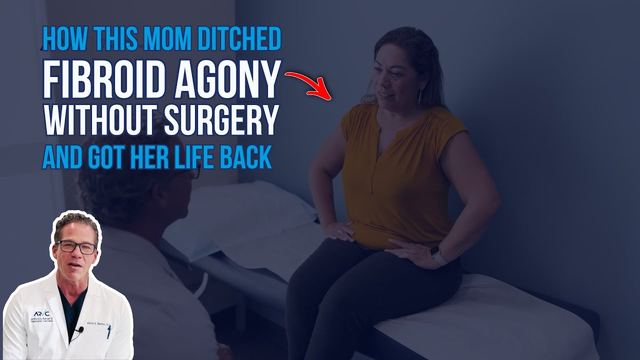 Patient story
A busy mom’s secret to feeling normal again Watch on YouTube →
Patient story
A busy mom’s secret to feeling normal again Watch on YouTube →
Every patient’s story is their own. Results vary. These are real ARV Centers patients, sharing their experiences with their permission. Prefer reading? Everything in the videos is covered on this page — and in more detail.
Procedure day
You get comfortable. An IV delivers sedation — you’re relaxed and drowsy, breathing on your own. Not general anesthesia. The procedure itself doesn’t hurt; discomfort during it is rare.
The pinhole. The doctor numbs a spot at the top of your thigh and makes a pinhole opening in the artery. No incision, no stitches — a small bandage covers it afterward.
The map. A catheter travels to the uterine arteries. X-ray dye flows, and the arteries feeding your fibroids light up — the same map you can watch the doctor navigate in the documentary above.
The treatment. Microscopic particles go into the branches feeding the fibroids — both sides, all of your fibroids in one procedure — while the healthy arteries around them keep flowing.
Sealed and resting. The catheter comes out, the pinhole is sealed, and you recover with us for about an hour.
Home the same day. Your driver takes you home — no driving the rest of the day; it’s the sedation, not the procedure. You leave with our advanced pain-management regimen, an hour-by-hour schedule that keeps you comfortable, and the on-call doctor’s cell number. We call you the next morning to check on you.
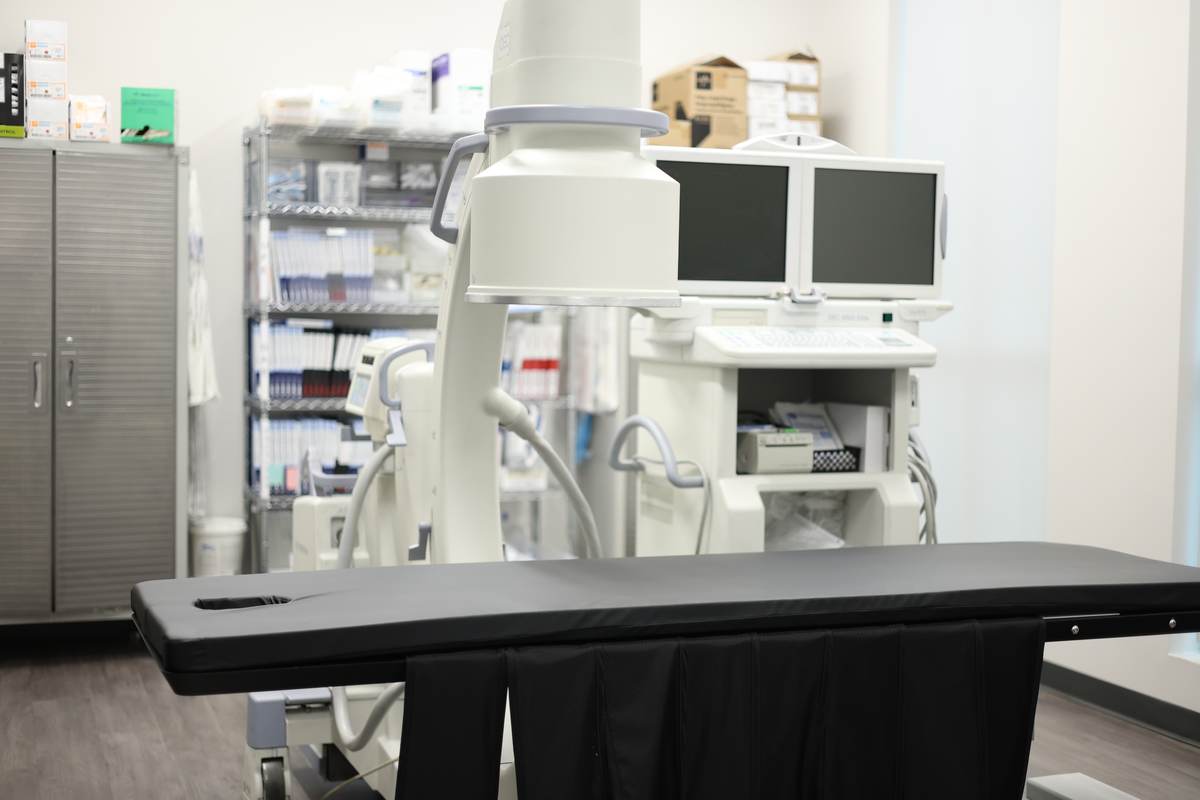
Every UFE here happens in our own IR suite — not a hospital. Every patient goes home the same day, after about an hour of recovery. In the randomized trial against surgery, embolization patients spent one day in the hospital instead of five³ — in our office, there’s no hospital at all. Plan on being with us three to four hours all told — you’ll fast for the eight hours before (clear liquids and black coffee are fine up to two hours ahead), and you’ll bring a driver.
You may have heard about the cramps after UFE. Our patients stay comfortable. Every patient goes home on our advanced pain-management protocol, which now includes Journavx — a non-narcotic medication, approved by the FDA in 2025, that blocks the pain signal in the nerve itself, before it reaches the brain.
Added to the rest of the regimen, it is the biggest advance in pain control after the procedure we have ever used: our patients feel a fraction of the pain women had on the older medications alone, and they are doing extremely well. You go home with the medication, an hour-by-hour schedule, and the doctor’s cell number. See how the pain plan works →
Don’t take our word for any of this: the exact instruction sheets our patients take home are right here. Read them before you ever book anything — pre-procedure instructions (PDF) and post-procedure instructions (PDF) — down to the hour-by-hour pain-medication schedule and the heating-pad advice for the first night.
What goes in — and what stays
The particles are soft, biocompatible medical microspheres smaller than a grain of sand, delivered sterile. They’ve been FDA-cleared since 2000 — and cleared specifically for uterine fibroid embolization since November 2002, on the strength of a prospective clinical study.⁶ They lodge in the arteries feeding the fibroids and stay there, so the supply line stays closed — while the healthy arteries around them keep flowing.
“And the fibroid itself — doesn’t the dead tissue just stay in there?” Fair question — most women ask it. The fibroid doesn’t rot or float loose. Your body does what it does with any tissue it no longer feeds: it breaks it down and scars it in, the way a bruise resolves. In some cases, small fibroid fragments pass naturally. Location matters, and your doctor will tell you what to expect for your specific fibroids — we don’t sugarcoat it.
The pictures from the procedure
Three runs from a uterine fibroid embolization performed here, in the order they were taken. This is the same live X-ray your doctor watches — which is why nobody has to wait and wonder whether the treatment reached the fibroid. It’s confirmed before the catheter comes out.
Angiograms from a uterine fibroid embolization performed at ARV Centers, San Antonio. Patient identifying information removed. One patient’s images; individual results vary — the study numbers below are the fairer way to set expectations.
The published evidence
9 in 10
women who have uterine fibroid embolization get significant improvement, or their symptoms go away completely — the figure the Society of Interventional Radiology gives patients.⁸
96%
had their heavy bleeding improve — in 1,285 women treated in an office-based outpatient setting, the same way we do it here.⁷
94%
had their pelvic pain improve — and 94% their bulk symptoms, the pressure and swelling. Fatigue improved in 94%, urinary frequency in 92%.⁷
2,112
women in the largest study ever done — 27 practices across the U.S. Symptom and quality-of-life scores improved by more than 40 points, into the normal range, holding at three years.⁴
2 in 3
never needed a hysterectomy — in the only randomized trial that followed women for ten full years. Their quality of life matched the women who’d had one.²
Zero days
in the hospital — against a five-day stay for surgery in the randomized trial, and a faster return to work.³ UFE happens in our own IR suite, and every patient goes home the same day, after about an hour of recovery.
78%
of embolization patients said — ten years later — that they were satisfied with their choice.²
Level A
the highest grade of evidence ACOG gives. The OB/GYNs’ own professional college recommends UFE at that level for women who want to keep their uterus — the same tier it gives hysterectomy.⁵
And these aren’t one clinic’s numbers. The symptom-relief figures line up across two decades of independent series — 200 patients at Georgetown, 538 women in the Ontario UFE trial — landing in the same 80–90% range for bleeding, bulk, urinary urgency and period pain.⁹
The strongest endorsement isn’t ours: ACOG — the American College of Obstetricians and Gynecologists, the OB/GYNs’ own professional college — recommends uterine artery embolization at its highest evidence level for women with fibroids who want to keep their uterus.⁵
And it lasts: the risk of fibroid regrowth after UFE is very low. Fibroids grow on estrogen over time, so the risk depends on your age — the younger you are, the more years before menopause — and it is still very low. In the 2,112-woman registry, fewer than 1 in 10 women had gone on to a hysterectomy three years after the procedure, and fewer than 1 in 50 chose a repeat embolization.⁴ UFE is a long-term solution.
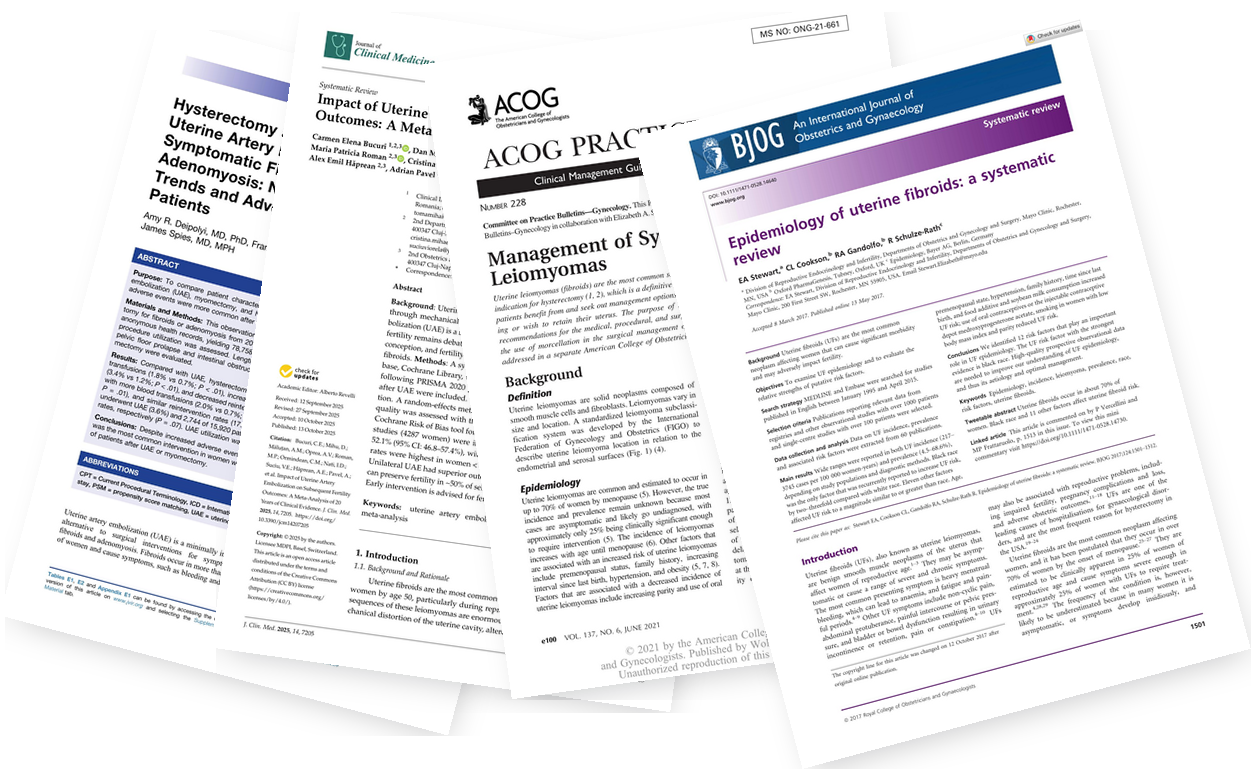
Sources: 1. Ravina et al., Lancet 1995. 2. de Bruijn et al. (EMMY 10-year randomized trial vs hysterectomy), Am J Obstet Gynecol 2016. 3. Edwards et al. (REST randomized trial), N Engl J Med 2007. 4. Goodwin et al. (FIBROID Registry, 2,112 patients), Obstet Gynecol 2008. 5. ACOG Practice Bulletin, Management of Symptomatic Uterine Leiomyomas, 2021 (Level A recommendation). 6. FDA 510(k) K021397, Embosphere Microspheres for uterine fibroid embolization, cleared Nov 22, 2002. 7. Geschwind, Afsari, Nezami et al., Diagnostics (Basel) 2025;15(6):739 — 1,285 women treated with UAE in an ambulatory (office-based) setting: bleeding improved in 96%, pelvic pain in 94%, bulk-related symptoms in 94%, fatigue in 94%, urinary frequency in 92%. 8. Society of Interventional Radiology, patient information on uterine fibroids and UFE — “approximately nine out of 10 women who undergo uterine fibroid embolization will experience significant improvement, or their symptoms will go away completely.” 9. Corroborating series: Spies et al., Obstet Gynecol 2001;98(1):29–34 (200 patients — heavy bleeding improved 90%, bulk symptoms 91% at one year); Pron et al. (Ontario UFE Trial), Fertil Steril 2003;79(1):120–127 (538 women — menorrhagia 83%, bulk/size 84%, urinary urgency 86%, dysmenorrhea 77%).
Candidacy
We turn away patients who aren’t candidates for what we do. Routinely.
Planning a pregnancy someday? That doesn’t rule you out — it changes the conversation, and we’d rather have it honestly than around it. Tell us first. The full fertility discussion — the real numbers, by age — is on our uterine fibroids page, and it continues in person, with your imaging in front of us.
Your care team
Uterine fibroid embolization at ARV Centers is performed by our Board Certified Vascular and Interventional Radiologists, in our own angiography suite. One number worth asking any doctor before any procedure: how many times have you done this? Here’s ours: more than 300 uterine fibroid embolizations. You’ll meet the doctor performing your procedure at your consultation — and we’re glad to coordinate with your OB/GYN before and after.
After your procedure
When you go home, you take the on-call doctor’s cell phone number with you. Not an answering service — the doctor.
And you don’t have to wonder whether to bother us: we call you the next morning to check in. Every patient, every procedure.
Before you leave, you’ll get this card
Your procedure:
On-call doctor:
Cell phone: written by hand, before you walk out
Call me if anything worries you.
Straight answers
You’re under IV sedation — relaxed and drowsy, breathing on your own. Not general anesthesia. The procedure itself doesn’t hurt — discomfort during it is rare. Afterward, expect one night of cramps much like your period — and our pain-management protocol keeps you comfortable through it. The plan we send you home with is covered above.
UFE is an outpatient procedure in our own IR suite — not a hospital. Plan on being at our office three to four hours all told, prep included. After the procedure you recover with us for about an hour, and every patient goes home the same day. Bring a driver: the sedation means no driving until the next day, no exceptions.
We use the groin. Both are genuine routes to the same arteries, and some centers prefer the wrist — so if you’ve read about wrist access, that’s why. Either way it’s a pinhole: no incision, no stitches.
You won’t be guessing alone at 2 a.m. You go home with the on-call doctor’s cell number, real pain medication, and a plan we built with you before the procedure — and we call you the next morning. In our practice, nine out of ten women are off narcotic pain medication by that call.
Most of our patients are fully back to their normal routine in less than a week. The first night brings cramps much like your menstrual cycle, or the pain you’ve already been having — and with our medication plan, usually less. By week two, most women have forgotten they went through treatment at all.
Bleeding usually improves within the first cycles. Most women notice significant change in the first four to six weeks — if you could feel the fibroid before, you’ll often feel it soften and shrink. The most substantial shrinking happens between six and twelve months.
The risk of regrowth after UFE is very low, and UFE is a long-term solution. It depends on your age: fibroids grow on estrogen over time, so the closer you are to menopause, the lower the risk — and for younger women it is still very low. In the 2,112-woman registry, fewer than 1 in 10 women had gone on to a hysterectomy three years after the procedure, and fewer than 1 in 50 chose a repeat embolization.⁴ And yes, UFE can be repeated: if a fibroid does grow back, a second treatment is an option.
No — but tell us first, because it changes the conversation. The honest, number-by-number fertility discussion — including what the largest analysis to date shows by age — lives on our uterine fibroids page, and we’ll have it with you in person, with your imaging in front of us.
More than 300. That’s exactly the right question, by the way — we’d encourage you to ask it of any doctor recommending any procedure. We’ll never be offended by it.
No. The technique was pioneered in Paris in the 1970s to stop life-threatening bleeding after childbirth, and first used for fibroids in the early 1990s, with results published in The Lancet in 1995.¹ The microspheres have been FDA-cleared since 2000 — for uterine fibroids specifically since 2002.⁶ It has been tested against both hysterectomy and myomectomy in randomized trials published in the New England Journal of Medicine, with ten-year follow-up data² ³ — and ACOG, the OB/GYNs’ own college, recommends it at its highest evidence level for women who want to keep their uterus.⁵
Yes — most plans cover UFE, including Medicare and Medicaid, and we’re in-network with most insurance plans. We do a complimentary benefits check before any procedure. No surprises.
Free patient guide
Our free fibroid guide explains what fibroids are, every treatment option — from watchful waiting to hysterectomy, including the ones nobody mentioned — and the questions worth asking any doctor, including us. Written by our physicians. No appointment required, and no follow-up phone call unless you ask for one.
We’ll email your guide plus occasional patient education. Unsubscribe anytime. Privacy policy.
You’ll sit with a physician — not a salesperson. Bring your imaging if you have it, and every question you’ve been saving. You’ll leave knowing whether UFE fits your fibroids — and what we’d do if you were family. Call us directly, or send this form and we’ll call you to schedule. We do a complimentary benefits check before any procedure. No surprises.
210-405-1335Closed on major holidays.
3212 Napier Park, San Antonio, TX 78231
Stand-in image (Map © OpenStreetMap) — the live site embeds the interactive Google map here
No referral needed for your initial consultation.
Rather book by phone? Call (210) 405-1335.