
Uterine fibroid embolization has no incision, no general anesthesia and no hospital stay. You go home the same day, about an hour after the procedure ends. Most of our patients are fully back to their normal routine in less than a week.
The part of recovery women ask us about most is the first night. As the fibroids lose their blood supply, the uterus cramps — much like your menstrual cycle, or the pain you have already been living with. On our pain plan, most women feel even less than that. This article walks through that plan, and then through the rest of recovery, day by day.
The short version
The cramping lasts about 18 to 24 hours for most women. We treat it with three kinds of medication that work in three different ways, on a schedule where something is due every three hours. On this plan, our patients report much lower pain levels than they did on narcotics alone — and nine out of ten are off narcotic pain medication by the time we call the next morning.
Why the first night cramps
UFE works by closing off the small arteries that feed the fibroids. Without blood, the fibroids begin to shrink. That is the treatment working.
The uterus is a muscle, and it reacts to that change the way it reacts during a heavy period: it cramps. The cramping starts within a few hours, peaks the first night, and for most women is over in 18 to 24 hours. It feels like menstrual cramps, or like the fibroid pain you already know — and with the medication, usually less.
The cramps come from the fibroids losing their blood supply. They are a sign the treatment reached its target.
Our pain plan: three medications, three ways of working
For years, the standard answer to cramping after UFE was a narcotic. Narcotics help, but one medication doing all the work means higher doses, more nausea and more grogginess.
We use a combination instead. Each medication stops pain at a different point, so together they cover more than any one of them can alone.
| Medication | What it is | What it does |
|---|---|---|
| Oxycodone + Tylenol | A narcotic pain reliever, taken together with acetaminophen | Turns down how strongly the brain and spinal cord register pain. |
| Naproxen | An anti-inflammatory — the same family as the medicine many women take for period cramps | Lowers the chemicals in the uterus that cause it to cramp. |
| Journavx | A non-narcotic pain medication, approved by the FDA in 2025 | Blocks the pain signal in the nerve itself, before it reaches the spinal cord or the brain. |
The alternating schedule
The oxycodone and the naproxen take turns, three hours apart. That way a dose is always due soon, and the pain never has a long gap to build in.
| When | What you take |
|---|---|
| Start | Oxycodone + Tylenol |
| 3 hours later | Naproxen |
| 3 hours after that | Oxycodone + Tylenol again |
| 3 hours after that | Naproxen again |
You keep that pattern going for 24 to 48 hours. Most women need the first 24 and little beyond it.
The Journavx runs alongside on its own clock: two 50 mg tablets to start, one more tablet 12 hours later, and one more 12 hours after that.
Journavx: what changed the first night for our patients
Journavx (the generic name is suzetrigine) is the first of a new class of pain medication in more than twenty years. It is not a narcotic and it is not an opioid.
Pain travels from the body to the brain along nerves, and those nerves use tiny gates called sodium channels to pass the signal along. Journavx blocks one of those gates — one found on pain-sensing nerves, outside the brain. The signal is stopped on its way in.
Because it works out in the nerves and not in the brain, it doesn’t act on the brain the way a narcotic does. And because it works differently from both oxycodone and naproxen, it adds relief on top of them.
Since we added it to our UFE plan, it has been the biggest single change in how our patients get through the first night. It treats the cramps very well.
What else goes home with you
- Anti-nausea medication, to take while you are on the oxycodone.
- A stool softener, because narcotics slow the bowel.
- A written schedule with your doses laid out by the hour. That sheet is the one to follow — your provider sets the plan for you, including if you can’t take one of these medications.
- The on-call doctor’s cell number. If something feels off at 2 a.m., you call a doctor, not an answering service.
One thing to do before you come in: have a heating pad ready at home. Heat on the lower belly helps with cramping, and you’ll want it within reach when you get back.
Recovery, step by step
The day of the procedure
You’re under IV sedation for the procedure — relaxed and drowsy, breathing on your own. Afterward you rest with us for about an hour, then your driver takes you home. Plan on no driving for the rest of the day.
Start the medication schedule on time and stay on it, even if you feel fine at first. Staying ahead of the cramps is easier than catching up to them. Drink plenty of fluids, use the heating pad, and rest.
The next morning
We call you. For most women the cramping is already fading by then, and nine out of ten of our patients have stopped the narcotic by that call. From here it is usually Tylenol and naproxen only, as needed.
Days 2 through 7
Expect period-like cramps that taper off, and expect to feel tired. Fatigue for five to seven days is normal — your body is doing its healing on the inside. A small bruise at the pinhole in the upper thigh is also common.
- Showers are fine. Skip baths, pools and hot tubs for 48 hours.
- After the first 24 hours, do whatever you feel up to. The one rule: no heavy lifting — nothing over 50 pounds — for at least three days.
- Don’t drive while you are still taking oxycodone.
- Take your regular daily medications as usual unless we tell you otherwise.
Weeks 1 and 2
Most of our patients are fully back to work and their normal routine in less than a week. There is no incision to protect and no stitches to come out.
By week two, most have forgotten they went through treatment at all — except that they may already be starting to see the first signs of improvement.
Weeks 4 through 12
This is when the results show up. As the fibroids shrink, the heavy bleeding, the pressure and the bloating ease over the next one to three months. We see you for a follow-up visit to check how you are healing and how your symptoms are responding.
How this compares with surgery
| UFE | Hysterectomy | |
|---|---|---|
| How it’s done | A pinhole in the upper thigh | An operation to remove the uterus |
| Anesthesia | IV sedation | General anesthesia |
| Where you sleep that night | Your own bed | Often the hospital |
| What recovery involves | One night of period-like cramps, kept comfortable with medication | A surgical wound that heals over weeks |
| Back to normal life | Less than 1 week | 12+ weeks |
| Your uterus | Stays | Removed |
That is the trade UFE offers: one night of period-like cramps, kept comfortable with medication, in place of months of surgical recovery.
When to call us
Call the number on your instruction sheet if you can’t keep fluids down, if your pain isn’t controlled on the schedule, or if the bruise at the pinhole is getting bigger or a firm lump forms there. We would always rather hear from you early.
The next step
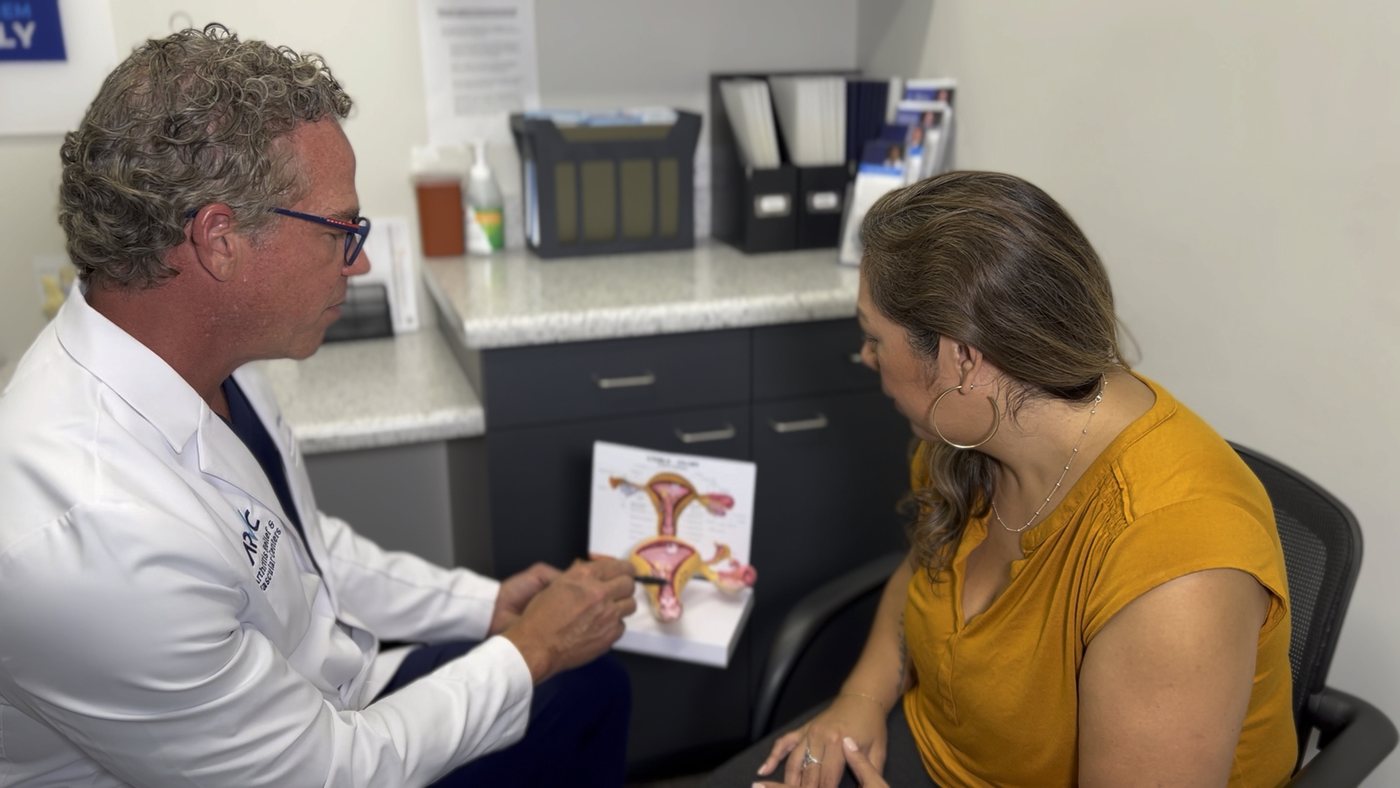
How recovery goes for you depends on your fibroids and your health history, and that is what a consultation is for. You’ll sit down with a provider, go over your imaging, and walk through the procedure and the pain plan before you decide anything. No referral is needed, and we do a complimentary benefits check when you come in.
The full UFE page shows the procedure step by step, or you can book a consultation on our calendar below.
Written and reviewed by the physicians of Arthritis Relief & Vascular Centers. This article is general health education, not medical advice, and reading it does not create a doctor–patient relationship. Every case is different — talk with a physician who has seen your imaging and examined you before making a treatment decision. If you are having a medical emergency, call 911.