
“Free consultation” has been used to mean “free sales pitch” often enough that the phrase has stopped meaning much. Fair enough. So rather than reassure you, this article just describes the visit — what happens, in what order, who you see, and what you walk out with.
Before you come in
You don’t need a referral. Your initial consultation doesn’t require one from another doctor. You can call (210) 405-1335 or book online, and the online calendar books you directly — usually right away, not “someone will call you back to find a time.”
Bring your imaging. Any X-rays, MRIs, ultrasounds or reports you already have. If you don’t have them or don’t know how to get them, tell us and we’ll help — that’s a normal part of the process, not an imposition.
Bring your questions written down. Nearly everyone forgets at least one, and the ones people forget are usually the ones they’ve been chewing on for months.
What to bring, in list form
- Your insurance card and photo ID
- Imaging discs or reports — or the name of the facility that has them
- A list of your medications, including blood thinners
- Your questions
What happens in the room
1. A provider takes your history
Not a coordinator, not a video, not a slide deck. A provider — one of our physicians or our nurse practitioner — asks what your problem actually does to your life. How long it has gone on. What you’ve already tried, and how each of those went.
That last question matters more than people expect. “I tried injections and they didn’t work” and “I had one injection placed by feel three years ago” are very different facts, and only one of them closes a door.
2. You get examined
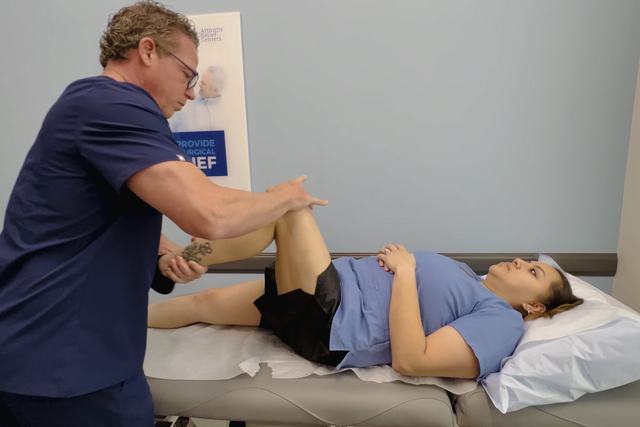
A physical exam, appropriate to what brought you in. It takes minutes, and it is the part that most often changes the plan — because the exam sometimes says the pain is coming from somewhere other than the thing on your scan.
3. Your imaging gets read with you
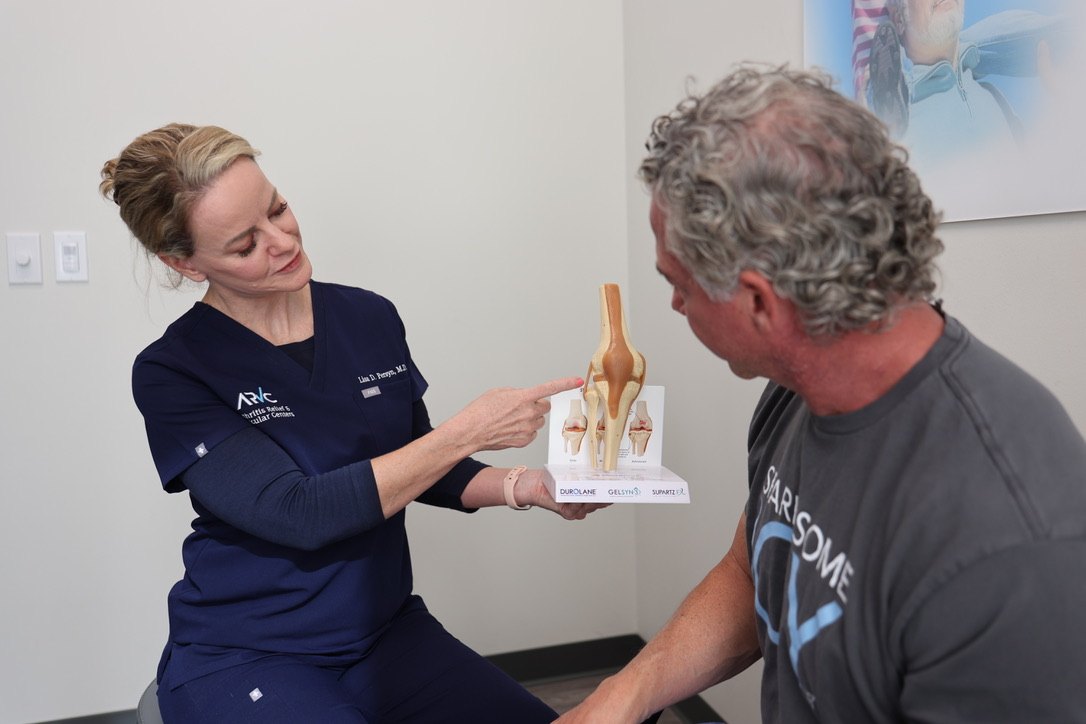
Your scans are put up and explained in plain language, including the parts that argue against treating you here.
The order matters: your story and the exam come first, and the imaging is read against them. Many people who are “bone on bone” have no pain at all — an X-ray shows what a joint looks like, not how it feels. If nobody has ever walked you through your own scan, this is often the most useful twenty minutes of the visit.
4. You get an answer — including “no”
You’ll be told whether one of our procedures can help you or whether it can’t, what it would involve, and where your insurance stands — usually the same day.
We turn away patients who aren’t candidates for what we do. Routinely. If surgery is genuinely your best option, we’ll say so.
That isn’t modesty. A practice that treats everybody who walks in produces bad results, and bad results are the only thing that actually ends a practice like this one.
5. If it’s an injection, you may well start today
This surprises people, so it’s worth saying plainly: most of our injection patients are treated the same day.
If an image-guided injection is the right next step and your plan doesn’t require a prior authorization or a referral first, there is usually no reason to send you home and bring you back. The injection itself takes about five minutes. You’re already here, already examined, and your imaging has already been reviewed — so most people would rather get started than make a second trip.
Everything else takes one more step, and should. The endovascular procedures — embolization of the knee, fibroids, adenomyosis, hemorrhoids, a shoulder — are planned, not improvised. Depending on what imaging you already have, that usually means a pre-planning study or additional imaging before a date is set. Sometimes it means a referral to another specialist so your condition is co-managed properly rather than treated in isolation.
None of that is us being slow. It’s the difference between a five-minute injection and a procedure that deserves a map first. And to be clear about the direction of the pressure: same-day treatment is offered because it’s convenient for you, never because a decision needs making today.
The money conversation
We run a complimentary benefits check when you come in — not at booking — so the answer is based on your actual plan rather than a guess. We’re in network with most insurance plans, and the procedures we perform are covered benefits under most of them, including Medicare.
Any out-of-pocket cost is discussed with you before any procedure is performed. And there is no same-day pressure: nothing about the price changes if you go home and think about it.
How long it takes
Plan on about 30 to 45 minutes for the consultation itself, plus paperwork. If you decide to go ahead with an injection the same day, allow a little extra — the injection itself takes about five minutes.
It is one visit, not a series of them. You should leave knowing what’s wrong, what your options are, and what you want to do next.
What we won’t do
- We won’t criticize your other doctors. If your OB/GYN or orthopedic surgeon didn’t mention what we do, that’s usually a gap between specialties, not a failing. We’d rather coordinate with them than work around them.
- We won’t promise you a result. Nobody honest can. We’ll show you the published numbers, including the ones that don’t flatter us, and tell you where your case sits relative to them.
- We won’t treat over a problem that needs a surgeon. If your imaging shows something that belongs in an operating room, that’s what we’ll tell you — before you spend a dollar.
Questions worth asking us
Since you’re making a list anyway, here are four we think you should ask any practice, including this one:
- How many of these procedures have you personally done?
- What are the options you don’t perform, and why isn’t one of those better for me?
- What does the published evidence say — including the parts that don’t support this?
- What happens if this doesn’t work?
If a practice gets uncomfortable at any of those, that itself is the answer.
And if we’re not the right fit
You leave better informed either way. You’ll know what your imaging shows, what’s driving your symptoms, which treatments exist for it, and which ones we think fit you best — even when that’s an operation we don’t perform.
That’s the whole visit. Book a consultation, or call (210) 405-1335 if you’d rather just ask someone a question first.
Written and reviewed by the physicians of Arthritis Relief & Vascular Centers. This article is general health education, not medical advice, and reading it does not create a doctor–patient relationship. Every case is different — talk with a physician who has seen your imaging and examined you before making a treatment decision. If you are having a medical emergency, call 911.