
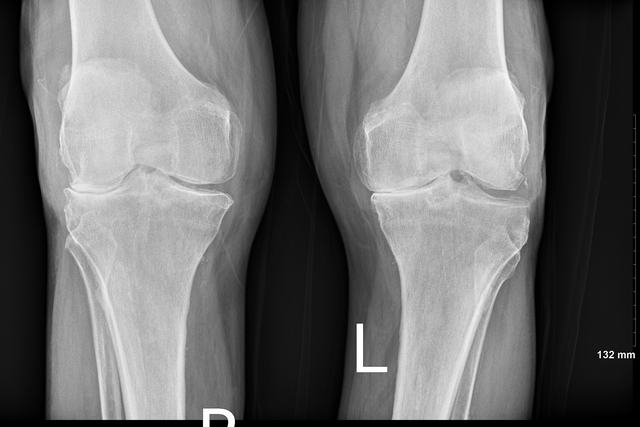
Three words end more conversations in an orthopedic office than any others: bone on bone. A doctor turns the monitor toward you, points at a narrow gap between two grey shapes, and says it. And whatever else gets said in the next ten minutes, most people stop hearing after that.
It sounds like a verdict. It sounds like the cartilage is gone, the knee is finished, and the only thing left to discuss is when to schedule the replacement.
It isn’t a verdict. It’s a description of an X-ray — and an X-ray is a photograph of a knee, not a report on how that knee feels or what can still be done for it.
What “bone on bone” actually describes
A healthy knee is built to glide. The ends of the thigh bone and shin bone are capped with articular cartilage — a smooth, slippery layer that lets bone move against bone without friction. Between them sit two C-shaped cushions, the menisci, that spread the load. Wrapping the whole joint is a thin lining called the synovium, which makes the fluid that keeps everything slick.
In osteoarthritis that system wears down. The cartilage thins, cracks, and in places wears through. The meniscus frays. The bone underneath thickens and grows bony ridges at the edges — bone spurs.
Here is the part that matters: cartilage doesn’t show up on an X-ray. Bone does. So a radiologist infers how much cartilage is left by measuring the gap between the bones. When that gap closes, the report says “bone on bone.” It’s a reasonable shorthand for advanced wear. It is not a measurement of your pain, and it never was.
The picture and the pain disagree more often than you’d think
This is the single most useful thing to know about knee arthritis, and almost nobody is told it: imaging severity and symptom severity are only loosely related.
Plenty of people walk around with knees that look terrible on film and feel fine. In published data, most people over 60 with arthritis visible on their X-rays don’t report bothersome symptoms. And it cuts the other way too — some of the most painful knees we see look unremarkable on the report.
An X-ray can show what a knee looks like. It can’t show how a knee feels.
If pain were simply a function of cartilage loss, that discordance couldn’t happen. So something else has to be generating a large share of the pain.
Where a lot of the pain is actually coming from
Much of knee arthritis pain doesn’t come from bone rubbing on bone. It comes from the inflamed lining of the joint.
Irritated by years of debris and wear, the synovium becomes chronically inflamed and thickened. Inflamed tissue does something specific: it grows a web of tiny, abnormal new blood vessels to feed itself — and new pain nerve endings grow alongside them. That tissue swells, aches, and keeps sending pain signals whether or not the cartilage underneath changed this month.
It explains the things that don’t fit the “worn-out hinge” story: why the knee is worse on some weeks than others, why it swells, why it throbs at night when you aren’t loading it at all, and why your pain doesn’t track your X-ray.
It also explains why there is something to treat. Cartilage doesn’t grow back — no honest doctor will tell you otherwise. But inflammation is a live, treatable process.
The list you were given was probably shorter than the real one
Most patients arrive having been offered two things: take an anti-inflammatory, or replace the knee. Between those two ends of the list sits a lot of genuinely useful treatment. Some of it we do; some of it we don’t and will tell you about anyway.
The things worth doing that cost almost nothing
- Topical anti-inflammatories are the most underused item on this whole list. Applied to the knee, they give short-term relief comparable to the pills with far less exposure for your stomach, kidneys and heart. They’re available over the counter, and most patients have never been told to try them.
- Movement is recommended at every stage of arthritis, including alongside everything else here. The benefit is real, and it fades when the program stops — which is why “I did physical therapy and it came back” is a description of how exercise works, not a personal failure.
- Weight, honestly. Each pound of body weight lost takes roughly four pounds of load off the knee with every step. Ten pounds is forty pounds a step.
About “lose weight first”
Being told to lose weight before a surgeon will operate — while the knee pain itself is what makes exercise impossible — is one of the cruellest loops in medicine. The arithmetic above is real. So is the trap. Treating the pain enough to let you move is often the thing that makes the rest of it possible, not a reward for having done it already.
Injections — and why yours may have failed for a fixable reason
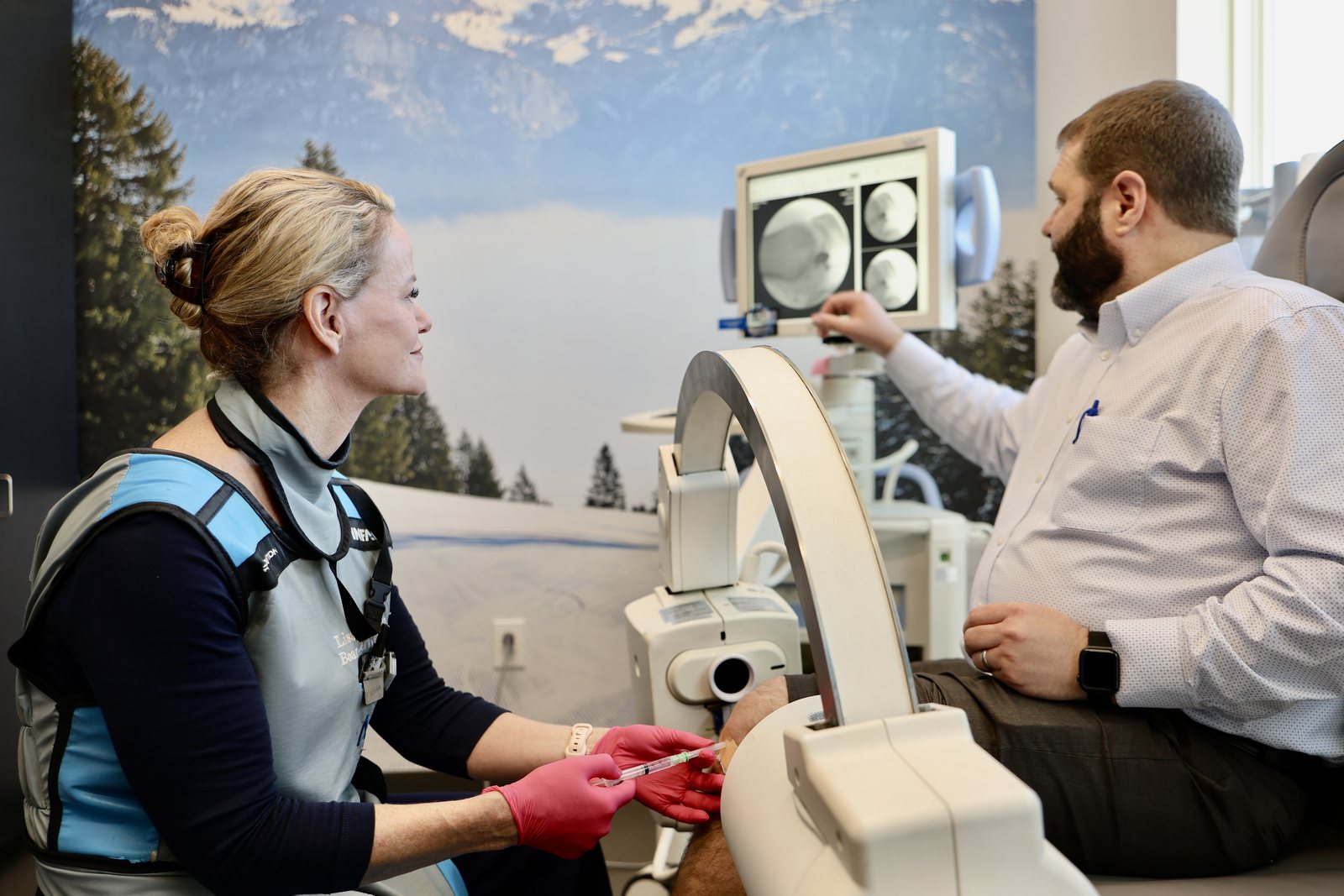
Cortisone and gel injections have a poor reputation with a lot of patients, often because of how they were done rather than what was in the syringe. Placed by feel — what doctors call a blind injection — a shot can miss the joint space entirely. Research published in the Journal of Bone and Joint Surgery found that up to 30% of them do. And the miss rate is worst in exactly the knees that hurt most, where the joint space has narrowed and bone spurs have moved the landmarks.
That matters more than it sounds, because gel injections have to be delivered inside the joint capsule to work at all — the medicine can’t cross the synovial membrane from outside. An injection that missed didn’t give you a weaker dose. It gave you none. We wrote a separate piece on why that happens and what changes with live imaging.
Treating the inflamed lining directly
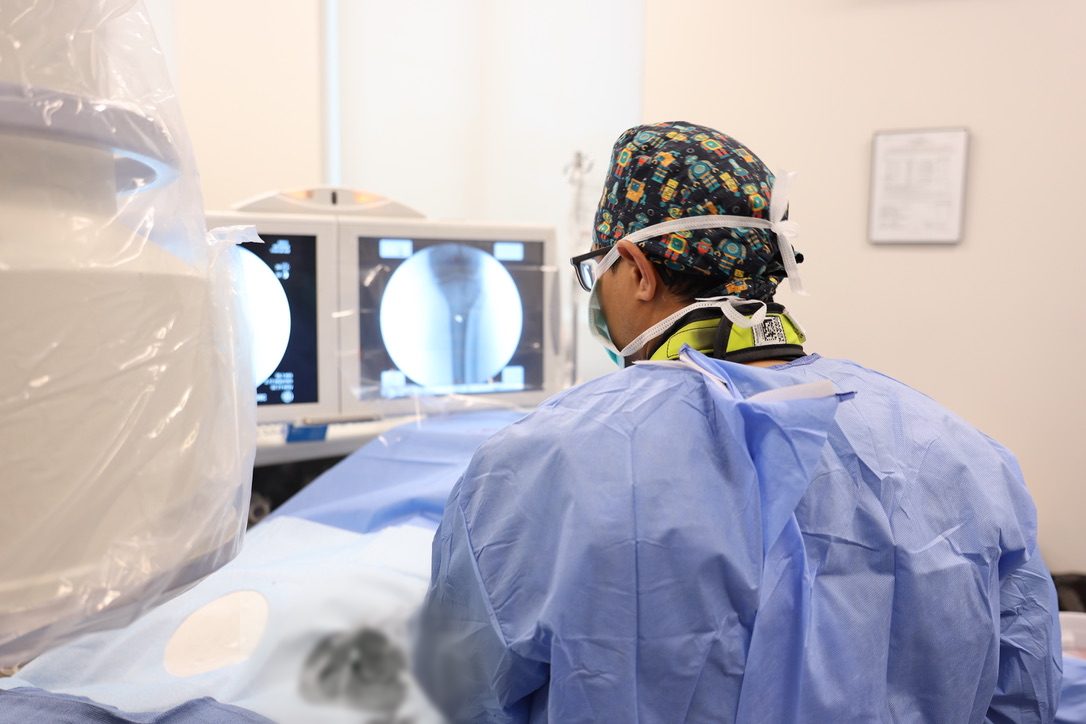
Genicular artery embolization (GAE) targets the abnormal blood supply feeding that inflamed lining. Through a pinhole in the upper thigh, a catheter is guided to the small arteries around the knee and blocks the abnormal ones, leaving the healthy vessels alone. No incision, no general anesthesia, home the same day. The plain-English explanation is here.
What a knee replacement is genuinely good at
Nobody here will tell you surgery is wrong. Some knees need it, and we say so when it’s true. It deserves an honest account rather than a straw man:
- It works, for the right knee. For a great many people a replacement is exactly what it promises — pain down, function up, life back.
- It lasts. Pooled registry data covering nearly 300,000 replacements found about 82% still in place at 25 years.
- It carries substantial risk. This is major surgery. Infection, blood clots, stiffness, persistent pain, and one of the hardest recoveries of any joint are all real possibilities, and none of them are rare enough to wave away.
- 1 in 5 aren’t satisfied. Roughly 20% of patients are not happy with the result — they still have pain, or the knee never quite feels like theirs.
Sit with that last number, because the scale of it is the part nobody says out loud. About a million knee replacements are performed in the United States every year. One in five means roughly 200,000 people a year walk away from a knee replacement without the result they were promised.
That is not an argument against the operation. It is an argument about who should be having it.
Patient selection is the single most important thing in knee replacement surgery.
The right knee, with the right problem, causing the right amount of pain — in a patient whose overall health makes the operation and the recovery a sensible thing to take on. Get that selection right and it is a superb operation. Get it wrong and a patient has taken on all of the risk of major surgery for a problem it was never going to fix.
So the question worth arguing about is almost never whether knee replacement works. It’s whether it’s the right operation for you, and whether it’s the right step right now.
Questions worth asking before anyone schedules one
Take these to whoever is recommending surgery. A good surgeon will answer them without flinching.
- How much of my pain do you think is coming from the cartilage loss, and how much from inflammation? The answer tells you how much a resurfacing operation can realistically fix.
- Were my previous injections image-guided? If they were done by feel and didn’t work, that’s not a closed experiment.
- What happens if I wait six months? Ask specifically whether waiting makes the eventual surgery harder or riskier — and whether that’s true for your knee.
- What is your revision rate, and how do you measure satisfaction? Ask how they define a good outcome.
- What are the non-surgical options you don’t perform? The answer to this one is the most revealing question on the list.
The short version
“Bone on bone” means an X-ray shows advanced wear. It does not mean your pain has one cause, that nothing else can be done, or that the calendar has started. Between an ibuprofen and a new knee there is a whole range of real treatment — and you’re entitled to hear the full list before you choose from the short one.
If you’ve been told you’re bone on bone and you want a second look at what’s driving the pain, that’s a 30-minute conversation. Bring your imaging. Read more about how we treat knee arthritis, or book a consultation.
Written and reviewed by the physicians of Arthritis Relief & Vascular Centers. This article is general health education, not medical advice, and reading it does not create a doctor–patient relationship. Every case is different — talk with a physician who has seen your imaging and examined you before making a treatment decision. If you are having a medical emergency, call 911.