
It doesn’t regrow cartilage
GAE treats the inflamed lining that drives much of the pain — not the structure of the joint. Your X-ray will look the same afterward. Anyone promising regrown cartilage is selling something.
For people who’ve just heard of genicular artery embolization — and want to know what it actually does
Samy A. Al-Bayati, M.D. · Vascular & Interventional Radiology
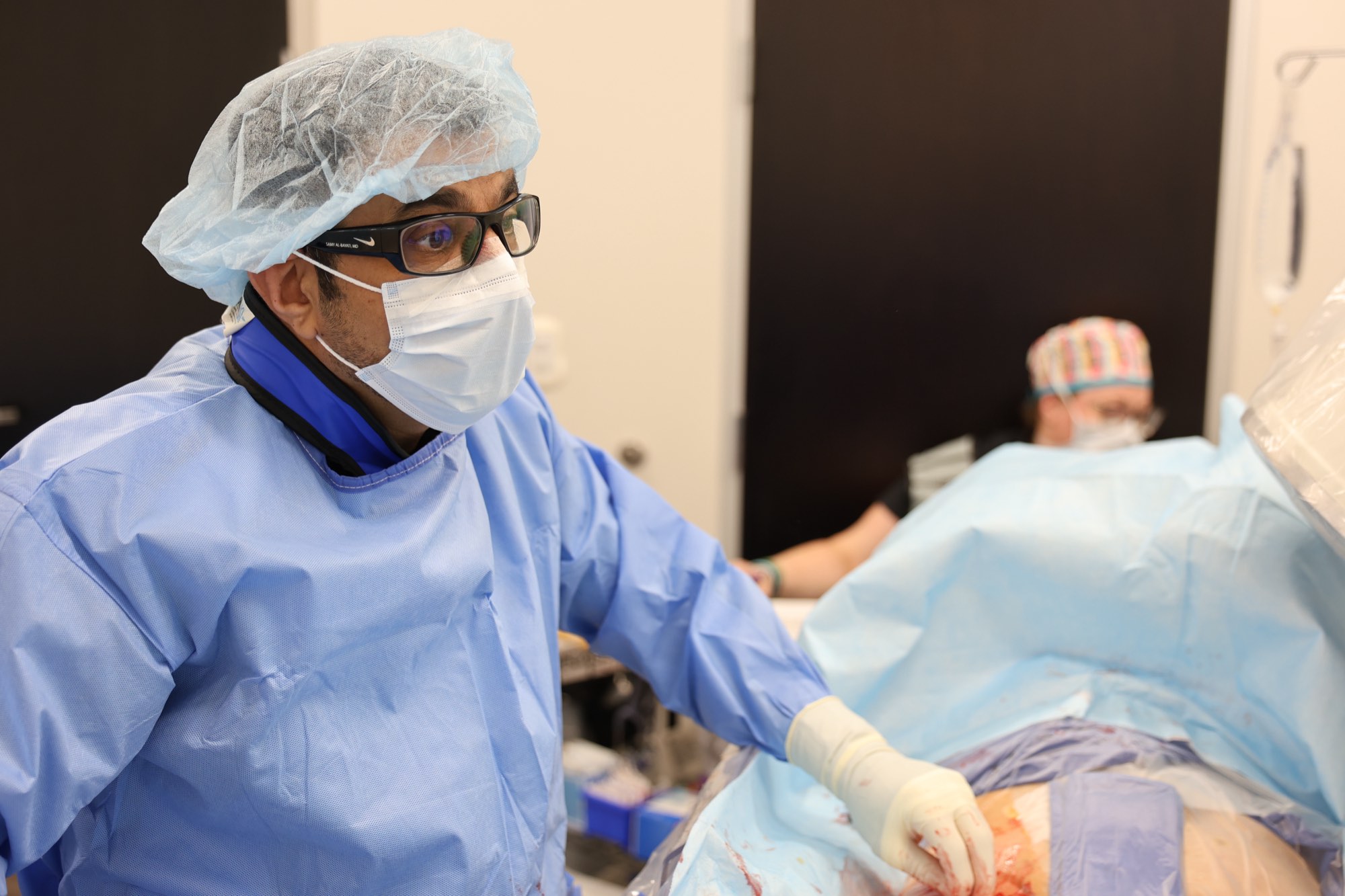
Dr. Al-Bayati performing an embolization in our own angiography suite, in our office, not a hospital.
Genicular artery embolization — GAE for short — is a same-day, non-surgical procedure for knee arthritis pain. Through a pinhole in the upper thigh, an interventional radiologist blocks the abnormal blood vessels that keep the lining of your knee inflamed and hurting. IV sedation, about 45 minutes on the table, home the same day — no incision, no implant, and nothing injected into the joint.
Covered by most insurance, including Medicare No referral needed for your initial consultation More than 700 GAE procedures performed here
Maybe you came here from our knee arthritis page, where GAE is step two of the treatment ladder — and you want the full picture before you take it seriously.
Maybe a doctor said the words, or a friend had it done and couldn’t quite remember what it was called. That’s normal — almost nobody can say “genicular artery embolization” twice.
Or maybe you’re just out of patience — with shots that quit working, with “come back when it’s worse” — and you want to see the option nobody offered you.
Forget the name. This page shows you what it does — including live before-and-after angiograms most practices never show. Judge it with your own eyes.
The procedure
Much of knee arthritis pain doesn’t come from bone rubbing on bone. It comes from the inflamed lining of the joint — tissue that grows a web of abnormal new blood vessels, with new pain nerves alongside them. Those vessels are the supply line that keeps the inflammation — and the pain — alive. It’s why your knee can hurt far more than your X-ray suggests.
GAE goes at that supply line directly. Through a pinhole in your upper thigh, a catheter thinner than a phone-charger cord travels to the small arteries feeding the knee’s lining. There, a slurry of microscopic particles blocks the abnormal vessels while the healthy arteries around them stay open. Starved of their supply line, the inflamed tissue and its extra pain wiring quiet down. And this isn’t a theory about what should happen: in two published trials, MRI scans taken one and two years later showed the inflammation itself — not just the pain — had measurably decreased.⁴ ⁵
Notice what GAE is not: it’s not an injection into the joint at all. Gel shots and cortisone put something into the joint space and hope the joint can use it. GAE works on the blood supply around the joint — which is why it can help knees that injections have given up on.
 Knee · GAE explained
“Can GAE really stop your knee pain for good?” — the procedure, explained by our team Watch on YouTube →
Knee · GAE explained
“Can GAE really stop your knee pain for good?” — the procedure, explained by our team Watch on YouTube →
Our team walks through the whole picture: what the procedure is and how it works, who it’s for, the outcomes you can reasonably expect, the risks, and what the day is actually like as the patient.
What GAE is not
GAE treats the inflamed lining that drives much of the pain — not the structure of the joint. Your X-ray will look the same afterward. Anyone promising regrown cartilage is selling something.
In the published trials, roughly one patient in five didn’t get meaningful relief.¹ If we think your knee makes you a poor candidate, we’ll tell you before you spend a dollar.
Most responders hold their improvement through two years of follow-up — some longer — and some choose a repeat treatment. The full numbers are below, uncropped.
Limits first, results second — that’s the order you deserve. Now the results.
See it for yourself — in motion
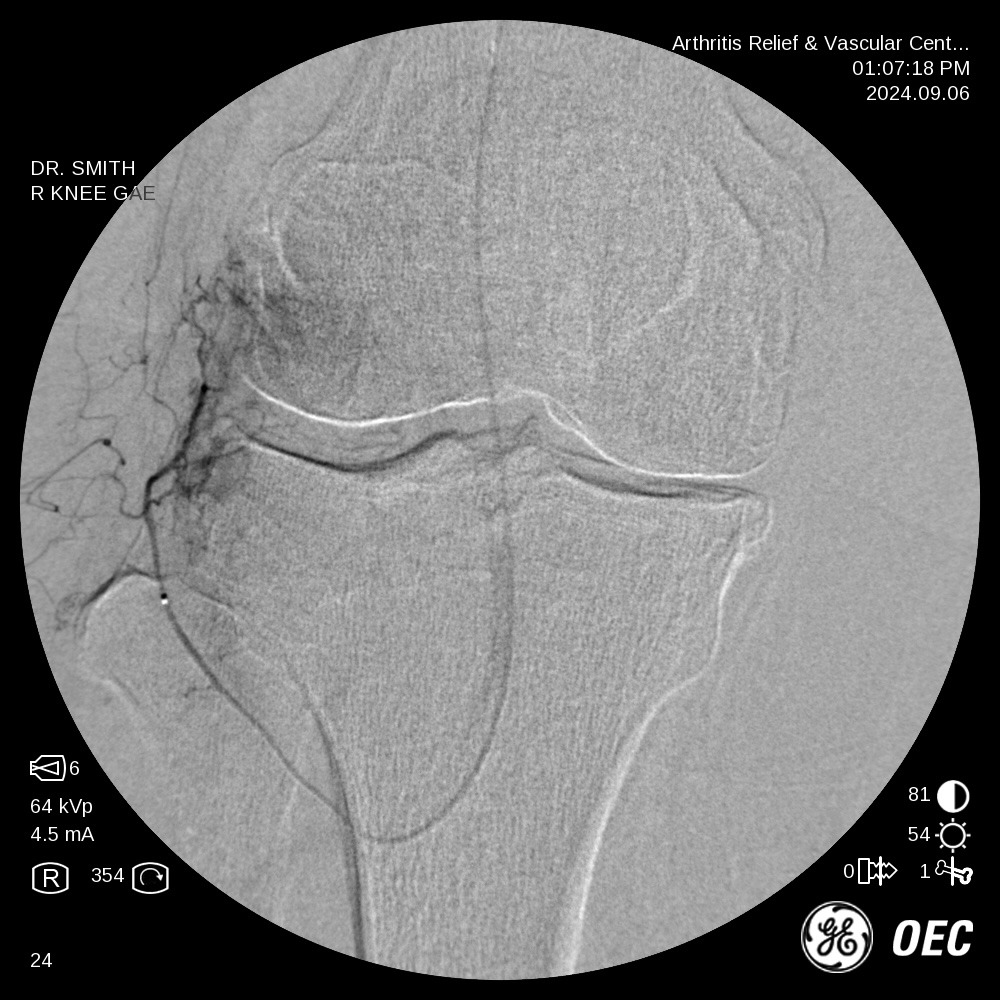
These are angiograms — X-ray pictures taken while dye flows through the arteries — from genicular artery embolizations performed here at ARVC. In the looping video, the dark blush at the knee (arrow) is the tangle of abnormal vessels feeding the inflamed lining, flooding in with the dye. In the after loop, minutes after embolization: the blush is gone, and the healthy arteries are still open.
Before
After
Before
After
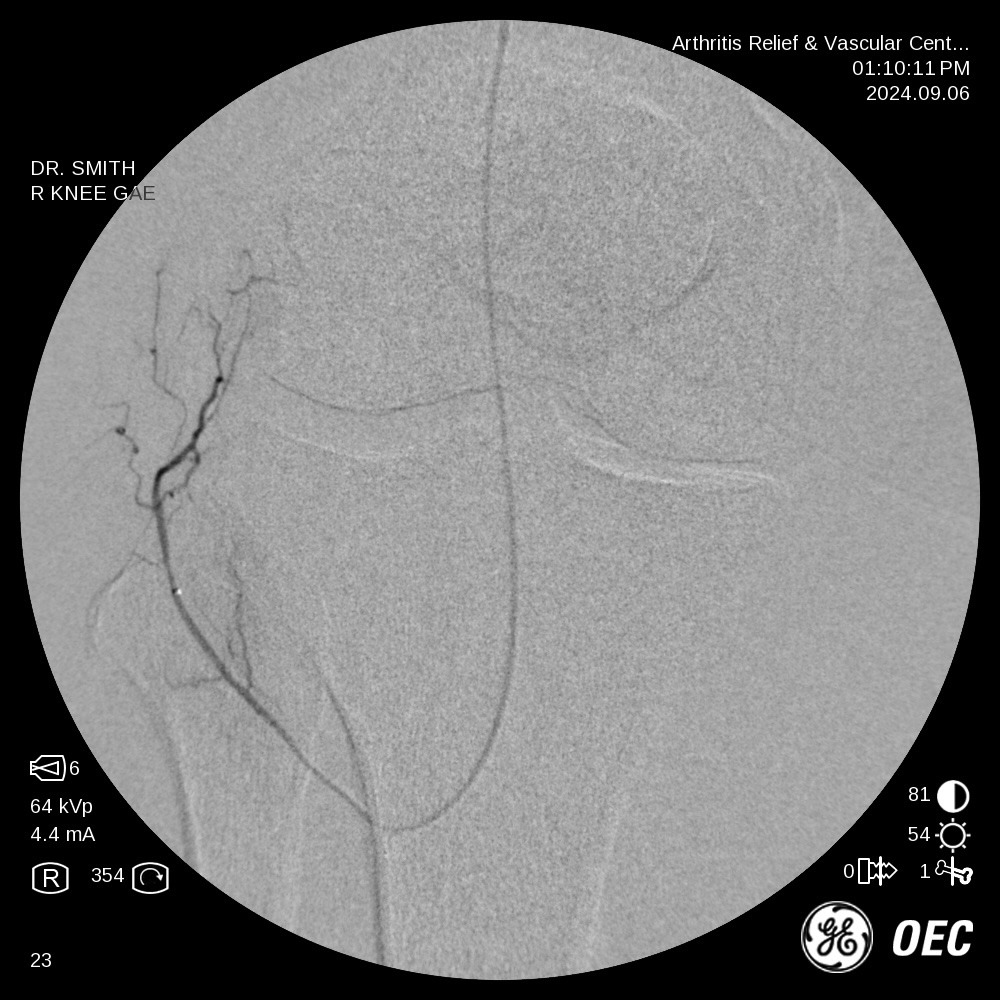
Angiograms from genicular artery embolization procedures performed at ARV Centers, San Antonio. Patient identifying information removed. Individual results vary — the study data below is the fairer way to set expectations.
Procedure day
You get comfortable. An IV delivers sedation — an anti-anxiety medicine plus pain medicine. You’re relaxed and drowsy, breathing on your own. Not general anesthesia.
The pinhole. The doctor numbs a spot on your upper thigh and makes a pinhole opening in the artery. No incision, no stitches.
The map. A catheter travels to your knee, dye flows, and the X-ray reveals the abnormal vessels — the same loops you watched above.
The treatment. The temporary blocking slurry goes into each abnormal cluster. Some patients feel an ache like their arthritis right then — oddly reassuring: it often means the right vessels are being treated.⁵ You’re usually on the table about 45 minutes.
Sealed and resting. The catheter comes out, the pinhole is sealed, and you rest with us for 30 to 45 minutes — purely for observation. The sedation itself is light: most patients say it feels like a strong margarita, and it wears off fast.
Home. Your driver takes you — no driving for the rest of the day. You can get back to your normal daily activities, to tolerance, right away — just no lifting over 50 pounds for at least 48 hours. Expect the knee to ache for a day or two; ordinary Tylenol and ibuprofen, alternated, handle it. We call you the next day to check in.
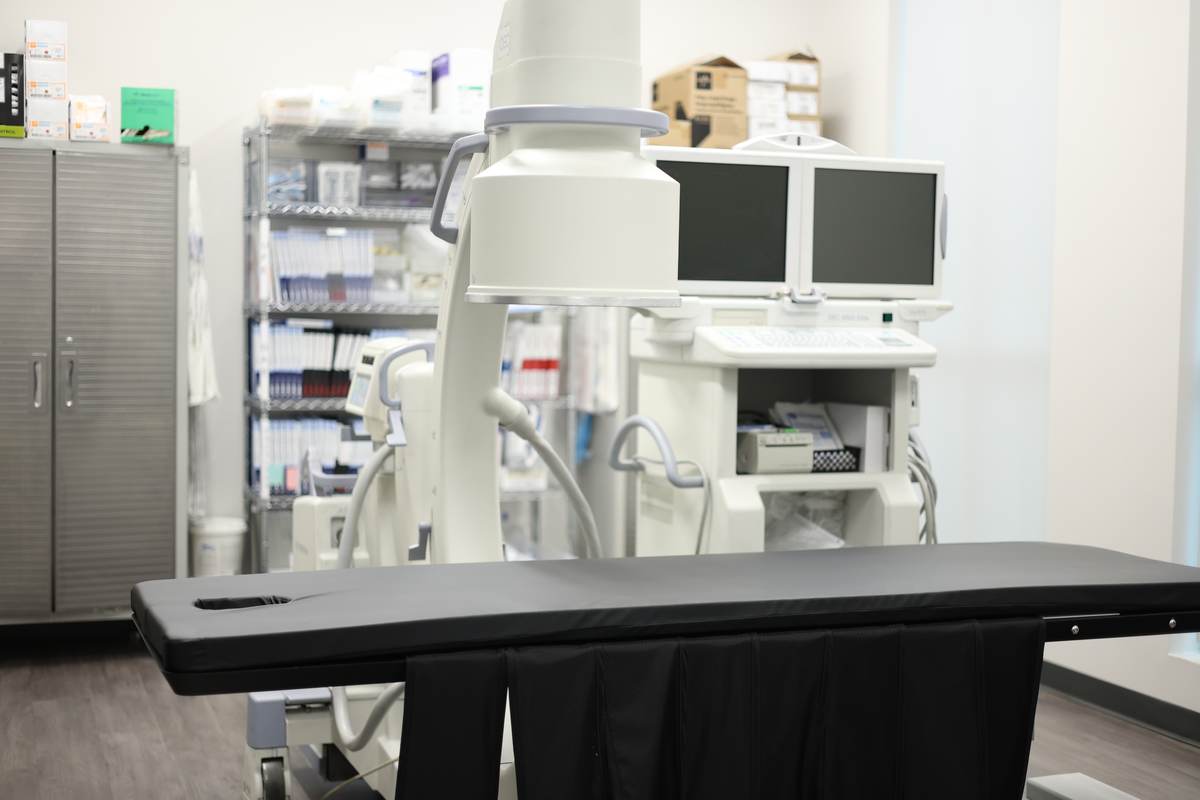
Plan on three to four hours with us all told — prep, procedure, and recovery. You’ll fast for the eight hours before (clear liquids and black coffee are fine up to two hours ahead), and you’ll bring a driver. No exceptions — it’s the sedation, not the knee.
Don’t take our word for any of this: the exact instruction sheets our patients take home are right here. Read them before you ever book anything — pre-procedure instructions (PDF) and post-procedure instructions (PDF).
Patient stories
 Patient story
“Can this fix knee pain without surgery?” — a real ARVC patient’s story Watch on YouTube →
Patient story
“Can this fix knee pain without surgery?” — a real ARVC patient’s story Watch on YouTube →
 Patient story
How Dolores fixed her knee pain — after 10 years Watch on YouTube →
Patient story
How Dolores fixed her knee pain — after 10 years Watch on YouTube →
 Patient story
“The procedure that’s replacing knee replacements” Watch on YouTube →
Patient story
“The procedure that’s replacing knee replacements” Watch on YouTube →
 Patient story
“I had 23 knee surgeries before 60” — what happened next Watch on YouTube →
Patient story
“I had 23 knee surgeries before 60” — what happened next Watch on YouTube →
 Patient story
“Knee replacement gone wrong?” — what finally helped Watch on YouTube →
Patient story
“Knee replacement gone wrong?” — what finally helped Watch on YouTube →
Every patient’s story is their own. Results vary. These are real ARV Centers patients, sharing their experiences with their permission. Prefer reading? Everything in the videos is covered on this page — and in more detail.
What goes in — and what doesn’t stay
The blocking agent we use is a slurry of a medication (imipenem/cilastatin) mixed with X-ray dye. Mixed together, they form microcrystals smaller than a grain of sand. The crystals block the abnormal vessels — and the pain nerves they feed — just long enough to quiet them, then dissolve into the bloodstream within 30 to 45 minutes. Nothing permanent stays in your body.
If you’re wondering how a temporary blockage gives lasting relief: the crystals stay long enough to shut down the abnormal vessels and calm the inflammation they feed. In the study that compared temporary crystals head-to-head against permanent beads in knees, relief at two years was just as good.⁹ It’s the same dissolving agent we use for shoulder embolization — one agent, one philosophy: block the problem, leave nothing behind.
The published evidence
0 of 7
sham-procedure patients meaningfully improved in the randomized U.S. trial — against about 4 in 5 who got the real procedure at one month.¹
78%
of 270 patients across nine pooled studies had meaningful pain relief one year after GAE — and about nine in ten met the improvement bar for overall symptoms.²
7 in 10
responders were still holding at least half their improvement at two years — and only about 1 patient in 20 went on to a knee replacement within two years.² ³
79.8%
clinical success at three years in the longest follow-up published — about 8 in 10 still had at least half their pain gone.⁴
Start with the placebo question: in the randomized U.S. sham trial, not one patient who received the fake procedure meaningfully improved — and when the study was unblinded, every one of them chose to cross over and have the real treatment.¹ Nobody votes with their knees like a sham-group patient.
The testing hasn’t stopped: the largest sham-controlled trial of GAE ever run — GENESIS 2, up to 110 patients, half receiving a placebo procedure — is underway right now.⁶ We’ll share its results here when they publish, whatever they show. That’s how real treatments behave.
The transparent half: about 3 in 10 responders slip back somewhere between years one and two,³ and about 1 in 12 patients choose a repeat treatment within two years.² Severe arthritis deserves extra candor: a UCLA trial that included many knees surgeons called “bone on bone” still saw two-thirds cut their pain and symptom scores in half at one year⁷ — but the most advanced knees held their gains less often at two years.³ We’ll tell you which group your knee is in. One more thing worth knowing: the “50% improvement” bar these studies use is a stricter test than most pain treatments are ever held to.⁸
What we won’t claim: a cure, regrown cartilage, or permanence. And one encouraging nuance from the pooled data: the patients with the worst baseline pain got the biggest improvements.² This is not a treatment that only helps the easy cases. If you ever do choose a replacement later, GAE won’t make that surgery harder — in the British trial, every patient who went on to a knee replacement had a normal surgery.⁵
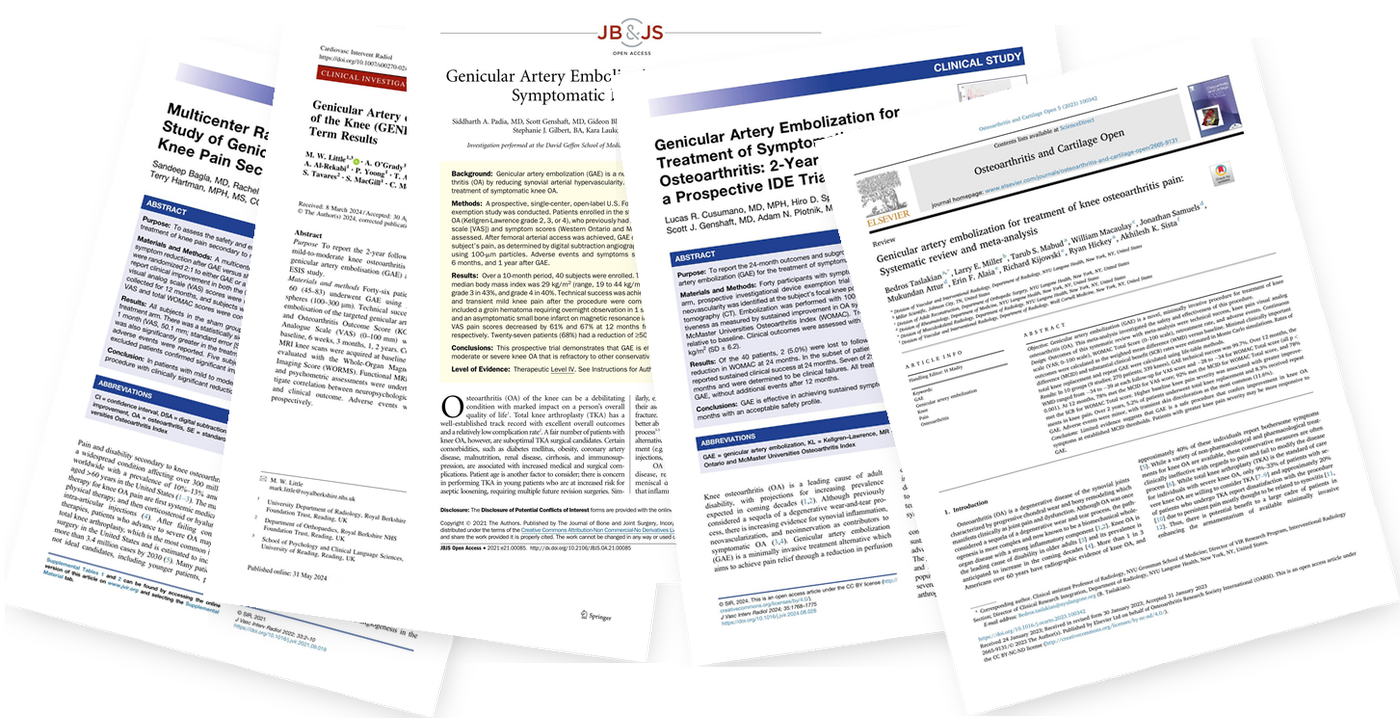
Sources: 1. Bagla et al., J Vasc Interv Radiol 2022 — multicenter randomized sham-controlled trial, 21 patients: 0 of 7 sham patients responded at 1 month vs 11 of 14 (79%) treated; pain reduction beat sham by 50 points of 100; all 7 sham patients subsequently crossed over to the real procedure (crossover reported in Tyagi et al., Semin Intervent Radiol 2022). 2. Taslakian et al., Osteoarthr Cartil Open 2023 — systematic review & meta-analysis: 9 studies, 270 patients; 78% met the clinically-important pain threshold and 92% the overall-symptom threshold at 12 months; technical success 99.7%; 5.2% knee replacement and 8.3% repeat GAE within 2 years; greater baseline pain predicted greater improvement; most common side effect temporary skin discoloration (11.6%), hospitalization 0.3%, no deaths, no bone damage. 3. Cusumano et al., J Vasc Interv Radiol 2024 — 2-year follow-up of the UCLA trial: 72% of 12-month responders held ≥50% symptom reduction at 24 months; lower sustained-success rate in grade-4 knees. 4. Okuno et al., J Vasc Interv Radiol 2017 — 72 patients / 95 knees: clinical success 86.3% at 6 months, 79.8% at 3 years; 2-year MRI showed improved synovitis, no bone complications. 5. Little et al. (GENESIS), Cardiovasc Intervent Radiol 2024 — 40 treated patients through 24 months: significant improvement at every timepoint; 1-year MRI showed reduced synovitis; 67% felt an arthritis-like ache during embolization; patient-satisfaction responses 77% positive; all 9 later knee replacements proceeded with no added surgical difficulty. 6. Little et al., GENESIS 2 protocol, Cardiovasc Intervent Radiol 2023 — double-blind, randomized, sham-controlled, up to 110 patients; results pending. 7. Padia et al., JB JS Open Access 2021 — 40 patients, 40% grade 4: 68% achieved ≥50% reduction in pain and symptom scores at 12 months. 8. Epelboym, J Vasc Interv Radiol 2024 — invited commentary. 9. Bhatia et al., The Knee 2023 — Embosphere microspheres vs imipenem/cilastatin: 2-year clinical success 72% vs 78%, no significant difference; no major adverse events in either group.
Candidacy
We turn away patients who aren’t candidates for what we do. Routinely.
Your care team
GAE at ARVC is performed by our Board Certified Vascular and Interventional Radiologists, in our own angiography suite. One number worth asking any doctor before any procedure: how many times have you done this? Here’s ours: more than 700 genicular artery embolizations.
After your procedure
When you go home, you take the on-call doctor’s cell phone number with you. Not an answering service — the doctor.
And you don’t have to wonder whether to bother us: we call you the next day to check in. Every patient, every procedure.
A follow-up appointment is scheduled to check your recovery and your response to the treatment — part of the procedure here, not an extra.
Before you leave, you’ll get this card
Your procedure:
On-call doctor:
Cell phone: written by hand, before you walk out
Call me if anything worries you.
Straight answers
No. GAE has been studied for more than a decade, including randomized sham-controlled testing — the same placebo standard used for medications¹ — with results published in the major radiology and orthopedic journals.² And it passes the test skeptics rightly apply to new procedures: it’s covered by most insurance, including Medicare. Insurers don’t cover marketing hype.
You’re under IV sedation — an anti-anxiety medicine plus pain medicine — relaxed and drowsy, breathing on your own. Not general anesthesia: it’s light, and most patients say it feels like a strong margarita and wears off fast. Most patients describe pressure rather than pain. Some feel an ache like their arthritis while the vessels are treated — often a sign the right ones are being blocked.⁵ In the British trial, patients rated their anxiety and pain during the procedure as low, and said they’d be open to having it again.⁵
The procedure itself typically takes about 45 minutes, and you rest with us for 30 to 45 minutes afterward — purely for observation. Plan on being at our office three to four hours all told, prep included — then home, the same day. A morning, not a hospital stay.
You’ll walk the same day — we get you moving early on purpose. You can get back to your normal daily activities, to tolerance, right away — just no lifting over 50 pounds for at least 48 hours. Driving waits until the next day: the sedation means you’ll need a driver to take you home, no exceptions.
Not beads, and nothing permanent. We use a slurry of temporary microscopic crystals — a medication mixed with X-ray dye — that blocks the abnormal vessels and then dissolves into the bloodstream within 30 to 45 minutes. In the study that compared temporary crystals head-to-head against permanent beads in knees, relief at two years was just as good.⁹ The full story is in the section above.
Relief builds over weeks, not minutes. Improvement comes gradually over the first four to six weeks, with the full effect, in the trials, by about three months. That’s not a numbing agent wearing off — it’s inflamed tissue, cut off from its supply line, calming down.
The transparent answer: of patients who responded at one year, about seven in ten still held at least half their improvement at two years³ — and in the longest study, about eight in ten responders were still doing well at three.⁴ Only about 1 patient in 20 went on to a knee replacement within two years.² Some patients choose a repeat treatment when appropriate. Nobody can promise your knee a number — we can promise you the real ones before you decide.
Yes — in the pooled studies about 1 patient in 12 chose a repeat within two years,² and a repeat can be considered when appropriate. And if you instead choose a knee replacement later, GAE won’t have made that surgery harder — in the British trial, every later replacement went normally.⁵
GAE is done by interventional radiologists — a different specialty with a different referral network. Nobody hid it from you; it just lives outside the surgical world you’ve been seeing. The research is published in journals surgeons and radiologists both read, and we’ll gladly share it with your doctor.
Possibly. About 1 in 5 knee replacement patients report dissatisfaction afterward, most often from persistent pain tied to inflammation of the joint lining — the same inflamed tissue GAE targets.² The first step is making sure the implant itself is stable; that’s a question for your surgeon and imaging, and we won’t treat over an implant problem. If the implant is solid and the lining is inflamed, embolization may be an option worth discussing — early published studies in patients with pain after a knee replacement report meaningful improvement. We built a full page for exactly this situation: GAE after knee replacement.
More than 700. That’s exactly the right question, by the way — patient communities researching GAE tell each other to ask it, and we’d encourage you to ask it of any doctor recommending any procedure. We’ll never be offended by it.
Yes — GAE is covered by most insurance plans, including Medicare. And we still do a complimentary benefits check before any procedure, so there are no surprises: you’ll know exactly where you stand before you decide anything.
Free patient guide
Our free knee arthritis guide explains what’s actually causing your pain, every treatment option — surgical and non-surgical — and the questions worth asking any doctor, including us. Written by our physicians. No appointment required, and no follow-up phone call unless you ask for one.
We’ll email your guide plus occasional patient education. Unsubscribe anytime. Privacy policy.
You’ll sit with a physician — not a salesperson. You’ll hear every option, including the ones we don’t offer, and get a straight answer about whether GAE fits your knee. Call us directly, or send this form and we’ll call you to schedule. We do a complimentary benefits check before any procedure. No surprises.
210-405-1335Closed on major holidays.
3212 Napier Park, San Antonio, TX 78231
Stand-in image (Map © OpenStreetMap) — the live site embeds the interactive Google map here
No referral needed for your initial consultation.
Rather book by phone? Call (210) 405-1335.