For people with a fresh, painful compression fracture who’ve heard the word “kyphoplasty” — and want to know exactly what it is

A compression fracture moves with every breath. Kyphoplasty holds it still.

Balloon kyphoplasty is a same-day, non-surgical procedure for a painful, recent compression fracture of the spine. Through two punctures in the back about the width of a pencil — no incision — an interventional radiologist guides a needle into the broken vertebra under live X-ray, opens a space in the collapsed bone with a small balloon, and fills it with medical bone cement that hardens in minutes. Moderate sedation, about 60 to 90 minutes, done in our own IR suite, home the same day.

Covered by insurance No referral needed for your initial consultation No incision, no stitches, no hospital stay

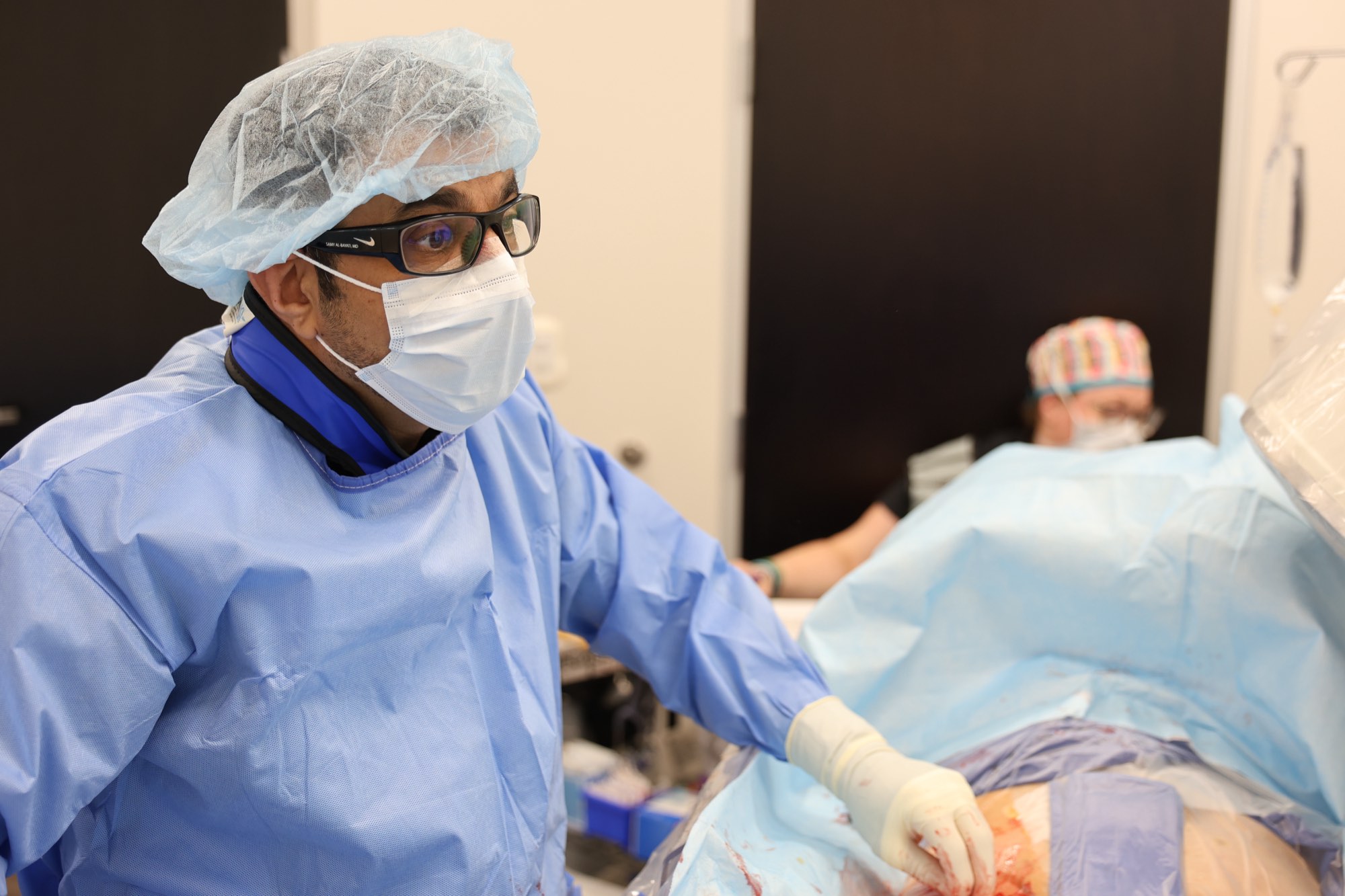
Dr. Samy Al-Bayati, in surgical cap and mask, performs an image-guided procedure in the ARVC interventional radiology suite
Performed by the physician, start to finish Dr. Samy Al-Bayati in ARVC’s IR suite — in our office, not a hospital.

If you were handed a brace and told to come back in six weeks

Maybe you came here from our spinal compression fractures page, where kyphoplasty is the option most patients are never told about in time — and you want the full picture before you take it seriously.

Maybe an emergency room or your family doctor found the fracture, said “rest, a brace, pain medicine, come back in six weeks,” and the pain hasn’t budged — or the pills are causing more trouble than the pain.

Or maybe you’re reading this for a parent, at an hour when nobody is answering the phone, trying to work out what “kyphoplasty” actually involves before you bring it up with her doctor — or with her.

Whatever brought you here: this page walks through what kyphoplasty does, step by step, what the trials found — the results and the limits — and who it is and isn’t for. Read it, then decide whether it’s worth one conversation.

The procedure

What kyphoplasty actually does.

A compression fracture is a bone in the spine — a vertebra — that has caved in, usually because osteoporosis thinned it. The spine is a stack of blocks; when one of them can’t carry an ordinary load, the front of the block crushes down into a wedge. And here is why it hurts the way it does: you can’t put a cast on a spine. The broken bone shifts a little with every breath, every turn, every attempt to stand — so it keeps hurting for as long as it stays unhealed. Lying flat takes the load off. Standing puts it back on.

Kyphoplasty is a cast on the inside. Through a puncture in the back about the width of a pencil — usually one on each side — an interventional radiologist guides a narrow needle into the broken vertebra under live X-ray. A small balloon is inflated inside the collapsed bone to open a space; the balloon comes out, and medical bone cement fills the space and hardens within minutes. The fracture stops moving. That is the whole idea: it doesn’t numb the pain, it removes the reason for it — a bone that shifts every time you breathe — and it lets you get up.

And there is a clock running inside the bone. A fractured vertebra starts to heal and scar almost at once. In the first few weeks the crushed bone is still soft enough that the balloon can re-open it before the cement goes in. Past about six weeks, the bone has begun to knit and harden into its collapsed shape — the balloon has little left to open, so re-expanding the vertebra becomes unlikely, and by then the pain is usually easing on its own anyway. That is why we say sooner — and why “come back in six weeks” is the wrong plan for a fresh, severe fracture.

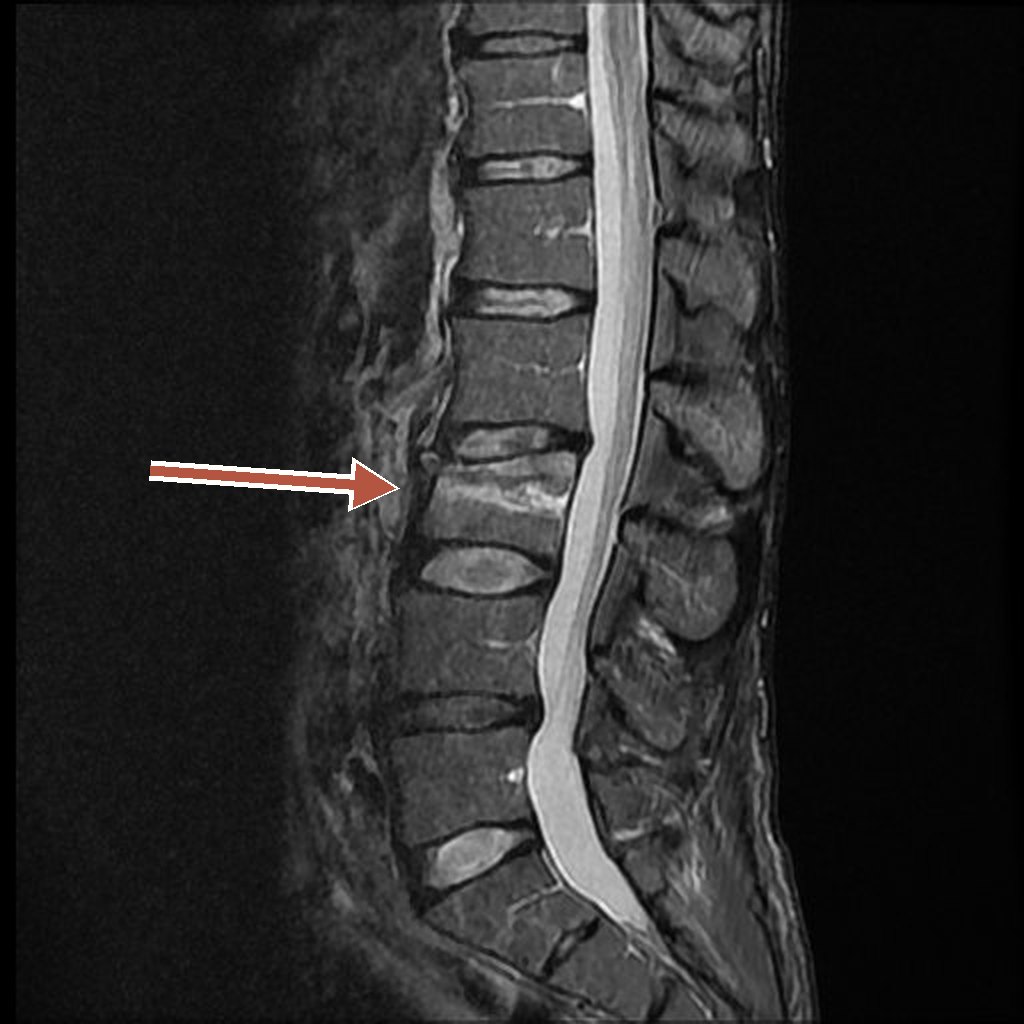
Side-view MRI of the lower spine (STIR sequence) with an arrow marking the L3 vertebra, which glows bright inside — swelling from a fresh, active fracture
The picture that decides it An MRI that makes fluid glow: the arrow marks a vertebra lit up bright in its middle — swelling inside the bone — which tells us the fracture is fresh and still active. An old, healed fracture stays dark. Case courtesy of Joshua Wells, Radiopaedia.org, rID: 190385

What kyphoplasty is not

Three limits, stated before any results.

It’s for fresh fractures

The trials and the bone itself both favour the first six weeks. Past that, the vertebra has hardened into its collapsed shape, the balloon has little to open, and the pain is usually easing anyway — the evidence is weakest there.¹ ³ If your fracture is months old and the MRI shows it has healed, we’ll say so rather than treat a picture.

It doesn’t treat the osteoporosis

Cement stabilizes one bone; it does nothing for the rest of them, and people who fracture once tend to fracture again — about one in five within a year, treated or not.⁵ A DEXA scan, a T-score and a bone medicine belong in every plan, procedure or not — and we co-manage that with a rheumatologist or your primary care physician.

It isn’t a guarantee

In the best blinded trial, treated patients were more than twice as likely to reach mild pain at two weeks — 44% versus 21% after a placebo procedure.¹ More than twice as likely, and still fewer than half. The full numbers are below, uncropped.

Limits first, results second — that’s the order you deserve. Now the pictures, then the numbers.

See it for yourself

A needle, a balloon, and cement that sets in minutes.

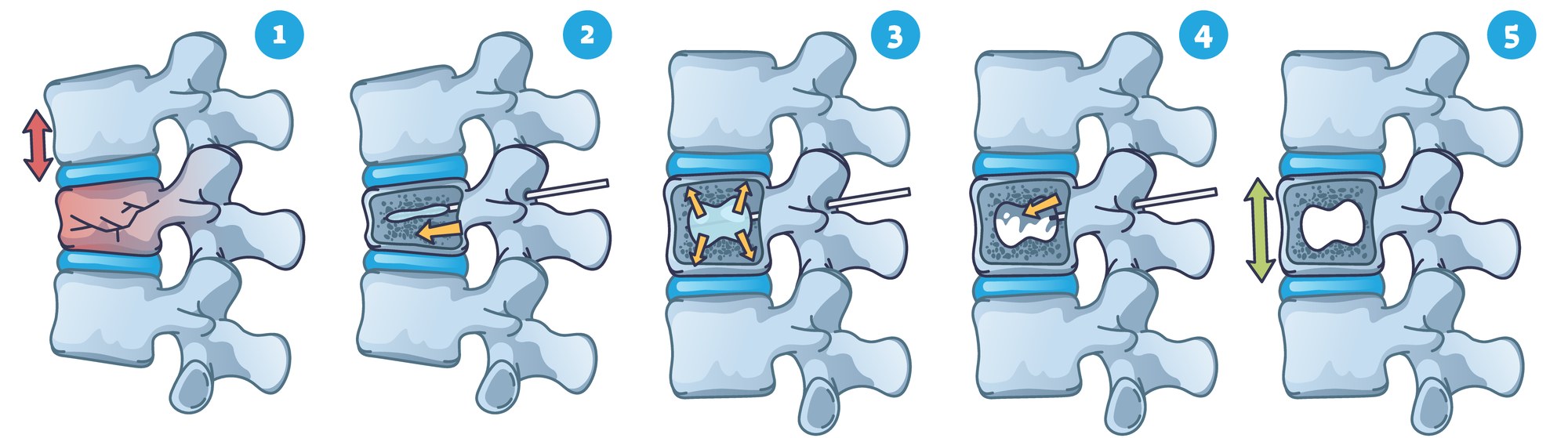
Here is the procedure in five frames, then what it looks like on the screen while it is happening. The X-ray pictures are taken live during the procedure — the interventional radiologist watches the needle, the balloon and the cement at every step, which is what makes a procedure done through a needle safe. Nothing in these pictures involves an incision.

Five-panel illustration of balloon kyphoplasty: a compressed vertebra; a needle and balloon placed inside it; the balloon inflated to open a space; the balloon removed and cement placed; the cement hardened, holding the vertebra stable
Kyphoplasty, in five frames1 The collapsed vertebra. 2 A needle carries a small balloon inside it. 3 The balloon inflates and opens a space in the soft, fractured bone. 4 The balloon comes out; bone cement goes in. 5 The cement hardens in minutes — the fracture is stable and stops moving.

On the screen

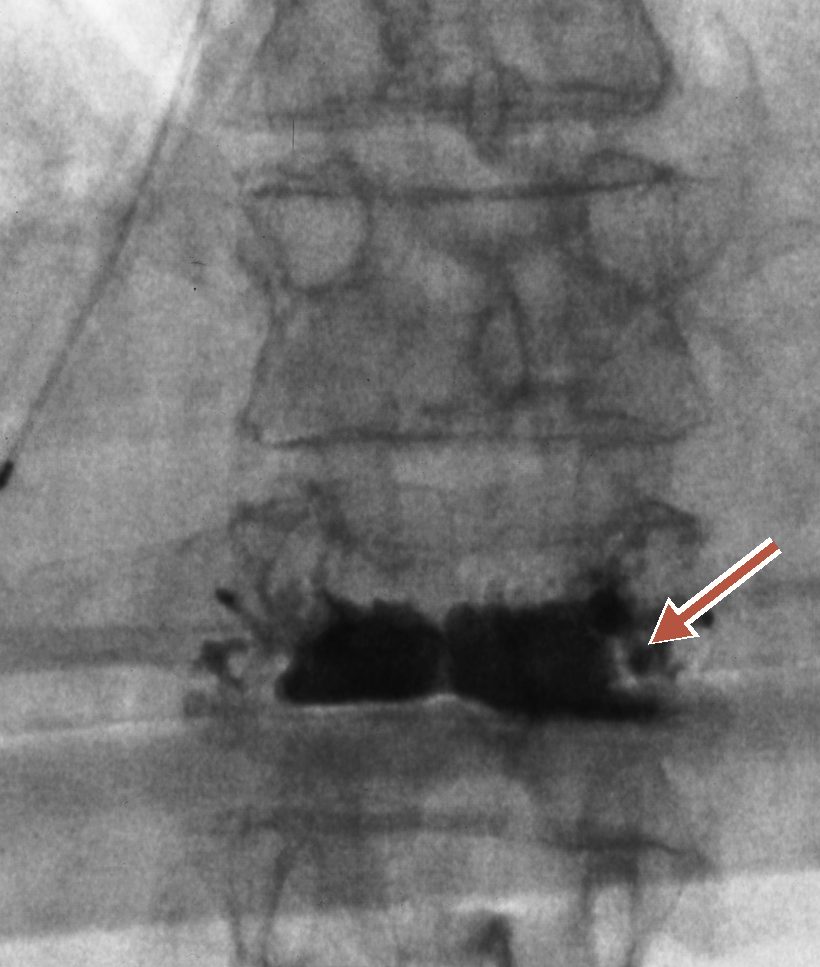
Front-view live X-ray during a kyphoplasty, with an arrow marking the cement — two dark shapes — inside the fractured vertebra
During a kyphoplasty — front view: the live X-ray the doctor watches. The arrow marks the cement — the two dark shapes — sitting inside the fractured vertebra, one fill from each side, holding it stable.

Illustration and live X-ray frame shown for explanation. Individual results vary — the study data below is the fairer way to set expectations.

Procedure day

What happens, step by step.

  1. Before. An MRI (or a bone scan) confirms the fracture is still active, and we review it with you. You’ll fast for a few hours beforehand, and you’ll need someone to drive you home.

  2. Getting comfortable. You lie face down on the table, covered. A nurse starts an IV, and it delivers moderate sedation — relaxed and comfortable, breathing on your own, no general anesthesia — and the skin over the fracture is numbed. Most people remember very little of the procedure.

  3. The needle. Under live X-ray, the interventional radiologist passes a narrow needle through a puncture about the width of a pencil into the broken vertebra — usually one on each side. The X-ray shows the needle’s position at every step; that’s what makes it safe.

  4. The balloon. A small balloon is inflated inside the collapsed bone to open a space, then withdrawn.

  5. The cement. Medical bone cement fills the space and hardens within minutes. The fracture is now stable — it no longer moves when you breathe or turn. The procedure itself usually takes about 60 to 90 minutes.

  6. Home. About an hour in recovery, then you walk before you leave — someone drives you home. Take it easy for the rest of the day. Many people notice a difference within the first day or two; the trials measured the improvement at two weeks and one month.¹ ² You’ll get written instructions to take home, we call you the next day, and a follow-up visit is on the calendar before you go.

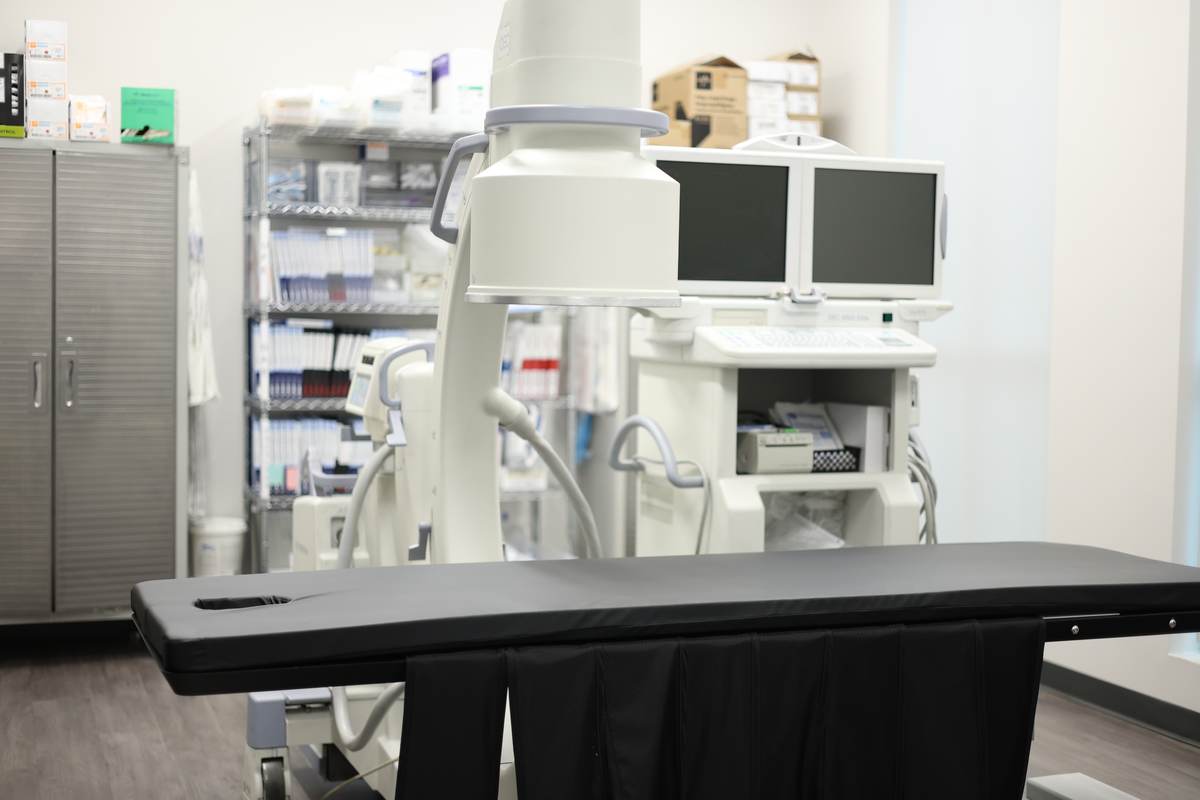
The interventional radiology suite at ARV Centers: imaging equipment and procedure table
Where it happens Our own IR suite, in our office — not a hospital operating room.

Plan on a few hours with us all told — prep, procedure, and about an hour of recovery. You’ll fast beforehand, and you’ll bring a driver. No exceptions — it’s the sedation, not the procedure.

If you take a blood thinner, we’ll coordinate a short pause with your prescribing doctor beforehand — being on one doesn’t rule you out. You’ll get written pre- and post-procedure instructions at your consultation, so nothing on the day is a surprise.

What goes in — and what it does

About a teaspoon and a half of bone cement. Set in minutes.

The cement is polymethylmethacrylate — PMMA — an acrylic bone cement that surgeons have used to anchor hip and knee replacements for decades. It goes in as a thick paste and hardens within minutes; in the trials, the average amount was about a teaspoon and a half per vertebra.⁵ Because kyphoplasty’s balloon has already opened a space for it, the cement goes in gently, at low pressure, and stays where it is put — which is why kyphoplasty has fewer cement leaks than the older technique, vertebroplasty, in which the cement is pushed straight into the bone.⁵

If you’re wondering about the cement leaking — the most-discussed risk — here is the honest version. Small leaks outside the bone are common when you go looking for them on a CT scan, and almost never cause symptoms. Across the randomized trials, a leak needing surgery happened in one patient, and major complications of any kind occurred in fewer than 1% of patients, with no procedure-related deaths.⁵ Nothing is removed from your body, and nothing is left to dissolve: the cement is permanent, and so is the stability it gives the fracture.

The published evidence

What the studies show — and what each one selected for.

44% vs 21%

Patients who reached mild pain two weeks after treatment, versus after a placebo procedure, in VAPOUR — the double-blind, placebo-controlled trial that enrolled only fresh (under six weeks) and severe (7 out of 10 or worse) fractures. More than twice as likely, and the advantage held at six months.¹

60 days

Extra days free of bed rest and restricted activity gained by balloon-kyphoplasty patients in the FREE trial — 300 patients, 21 centres, the largest randomized test of kyphoplasty itself. Physical function was significantly better at one month and held through six.² ⁵

Under 4 weeks

In a 2025 meta-analysis, kyphoplasty done within four weeks of the fracture gave significantly better pain relief and better correction of the wedge angle than kyphoplasty done later. “Sooner” is not a sales pitch on this page. It’s the finding.³

Under 1%

Major complications across the randomized trials, with no procedure-related deaths — and fewer cement leaks with kyphoplasty’s balloon than with the older technique.⁵

Start with what the evidence is: vertebral augmentation — kyphoplasty and its older cousin, vertebroplasty — has been studied for more than thirty years, and the research has sharpened over time toward one conclusion: the people who benefit most are the ones with severe pain from a recent fracture, treated within about six weeks. That is who the strongest trials enrolled, and it is who we treat. It is why national bodies and the medical societies — NICE in the UK, the American College of Radiology, the neurosurgical societies, the American Academy of Family Physicians and the interventional radiology societies among them — advise vertebral augmentation for painful osteoporotic compression fractures.⁵ ⁶ ⁷ You may read that some older studies found no benefit; those studies mixed fresh fractures with months-old, already-healing ones. The newer, better-selected trials came out the other way.⁵

The transparent half: in VAPOUR, fewer than half of the treated patients had reached mild pain at two weeks — more than twice the placebo group, but not everyone.¹ FREE compared kyphoplasty with usual care rather than with a placebo procedure, so we lean on VAPOUR’s blinded numbers for the headline and on FREE for what it measured best — function, days out of bed, and the shape of the bone at two years.² And the evidence fades for older fractures that have already begun to heal — which is why it is the first limit on this page.

And the other side of the ledger — what waiting costs. In VAPOUR, nearly half of the untreated fractures had lost more height by six months, and hospitalized patients who were treated went home about five and a half days sooner.¹ ⁵ In another trial, every treated patient was up and walking within 24 hours, against 2% of those managed with rest and medication.⁵ And bed rest is not free: as little as two days of it starts measurable bone loss, and ten days costs about 15% of an older adult’s strength and stamina — roughly what ten years of ageing takes.⁵

What we won’t claim: a 90% number, a change you’ll see in the mirror, or that a procedure on one bone treats the osteoporosis in the rest. What we will say: for a fresh, severe compression fracture, kyphoplasty is a real option with real evidence, a clean safety record across the trials, and it takes nothing off the table — the bone-health plan, and time itself, remain exactly as available afterward.

Sources: 1. Clark et al., VAPOUR, Lancet 2016 — multicentre, randomised, double-blind, placebo-controlled; 120 patients with 1–2 osteoporotic fractures <6 weeks old and pain ≥7/10; primary outcome pain <4/10 at 14 days: 24/61 (44%) vs 12/59 (21%), p=0.011, durable to 6 months; median admission shortened 5.5 days; 30% greater vertebral height preservation vs sham; mean cement volume 7.5 mL. 2. Wardlaw et al., FREE, Lancet 2009 — 300 patients, 21 sites, 1–3 acute fractures, balloon kyphoplasty vs non-surgical care; SF-36 Physical Component Summary difference 5.2 points at 1 month (95% CI 2.9–7.4, p<0.001), durable to 6 months; 60 days gained without restricted activity/bed rest; adverse-event frequency did not differ; 2-year follow-up (Boonen et al. 2011): durable back-pain reduction; 27% anterior height restoration and 3.3° kyphosis correction maintained. 3. Time to balloon kyphoplasty, systematic review with meta-analysis, N Am Spine Soc J 2025 — <4 weeks vs >4 weeks: better pain scores and kyphotic-angle correction. 4. Network meta-analysis of 23 RCTs / 2,838 patients, Eur Radiol 2024 — adjacent-level fracture, kyphoplasty vs natural history RR 1.35 (95% CI 0.78–2.34), p=0.23. 5. Chandra RV, Maingard J, Asadi H, et al. Vertebroplasty and kyphoplasty for osteoporotic vertebral fractures: what are the latest data? AJNR Am J Neuroradiol 2018;39:798–806 — review of the randomized trials, claims data and society positions; source for: bed-rest costs (bone loss from 2 days; 15% aerobic capacity/strength lost after 10 days ≈ 10 years of ageing), VAPOUR height preservation, admission and cement-volume data, FREE 2-year anatomic outcomes, Farrokhi 2011 (100% vs 2% ambulatory at 24 h), major complications <1% with no procedural mortality across the RCTs (one symptomatic leak requiring surgery), lower cement-leak rate and greater kyphosis correction with kyphoplasty (2,838-patient meta-analysis), sham-arm height loss in ~50% by 6 months, and the NICE / 2014 society / CIRSE positions. 6. Barr JD, Jensen ME, Hirsch JA, et al. Position statement on percutaneous vertebral augmentation — SIR, AANS/CNS, ACR, ASNR, ASSR, CIRA, SNIS. J Vasc Interv Radiol 2014;25:171–181. 7. NICE Technology Appraisal TA279 (2013): percutaneous vertebroplasty and percutaneous balloon kyphoplasty for treating osteoporotic vertebral compression fractures. Sources 1, 2, 5 full text or abstract verified; 3, 4, 6, 7 via secondary summaries — full texts before any print or ad use.

Candidacy

Who this is for — and who it isn’t.

You may be a candidate if:

  • Your compression fracture is recent — ideally within the first six weeks — and an MRI shows it’s still active
  • The pain is severe — it keeps you from standing, walking or sleeping — and it isn’t easing with rest, a brace and medication
  • Pain medication is causing more trouble than it solves — confusion, constipation, falls, no appetite
  • Weeks in a chair or a bed would be dangerous for you — and getting upright sooner matters
  • The bone was weakened by osteoporosis or by cancer

You’re probably not a candidate if:

  • The fracture is months old and the MRI shows it has already healed — the evidence is weakest here, and we’ll say so
  • Your pain is already improving week to week — then time is doing its job
  • The pain isn’t coming from the fracture — the imaging and the exam don’t match (we look before we treat)
  • The fracture presses on the spinal cord or nerves, the spine is unstable, or there’s an infection — that’s a spine surgeon’s job, and you’ll get the referral
  • The fracture was found by accident on a scan and doesn’t hurt — we don’t treat pictures

If it’s been months, we’ll tell you that honestly. We turn away patients who aren’t candidates for what we do. Routinely.

Your care team

The doctors who perform kyphoplasty here.

Kyphoplasty at ARVC is performed by our Board Certified Vascular and Interventional Radiologists — physicians whose entire specialty is doing precise work through a needle, guided by imaging, without an incision. They read your MRI themselves, they tell you whether the fracture is fresh, and if kyphoplasty honestly isn’t the answer, they’re the ones who say so.

Meet the whole team →

After your procedure

You go home with a doctor’s cell number.

When you leave, you take a doctor’s cell phone number with you for the day of your recovery. Not an answering service — the doctor. If anything worries you that evening, you call it.

And you don’t have to wonder whether to bother us: we call you the next day to check in, your follow-up visit is on the calendar before you leave, and if you’re a son or daughter managing this for a parent, we’ll talk with you too.

Straight answers

Questions patients — and their families — actually ask.

“Is kyphoplasty the same thing as vertebroplasty?”

Close cousins. Both put medical cement into a broken vertebra through a needle. Vertebroplasty injects the cement directly. Kyphoplasty first inflates a small balloon inside the collapsed bone to open a space, then fills that space — which lets the cement go in gently, under lower pressure. Head to head, the two relieve pain about equally; in a 2,838-patient comparison, kyphoplasty had fewer cement leaks and corrected the wedge angle better.⁵ We perform balloon kyphoplasty.

“Will I be awake? Does it hurt?”

You’re given moderate sedation through an IV — relaxed and comfortable, breathing on your own, no general anesthesia — and the skin over the fracture is numbed before anything else happens. You lie face down, covered, for the procedure. Most people remember very little of it. Afterward, some soreness where the needles went in is normal for a day or two; the fracture pain itself is what most people notice easing first.

“How long does the whole thing take?”

The procedure itself usually takes about 60 to 90 minutes. Afterward you spend about an hour in recovery, you walk before you leave, and someone drives you home. Plan on a few hours with us all told — prep, procedure and recovery — then home the same day. It’s done in our own IR suite, in our office; there is no hospital stay.

“How soon do I need to decide?”

Sooner than most people are told — and there’s a physical reason, not just a statistical one. A broken vertebra starts healing and scarring right away; within about six weeks it has begun to harden into its collapsed shape, and the balloon can no longer re-open it. Past that point kyphoplasty is unlikely to change the shape of the bone, and the pain is usually easing on its own anyway. The trials line up with that: VAPOUR enrolled only fractures under six weeks old, and a 2025 meta-analysis found better pain relief when kyphoplasty was done within four weeks.¹ ³ That doesn’t mean panic. It means: don’t let a fresh, severe fracture drift for months on a “come back in six weeks” plan without at least asking. If your pain is already improving week to week, waiting is reasonable. If it isn’t, call — this week, not next month.

“How soon will I feel a difference?”

Often quickly. The fracture stops moving the moment the cement sets, and many people notice a difference within the first day or two. In one randomized trial, every treated patient was up and walking within 24 hours, against 2% of those managed with rest and medication.⁵ The trials measured the improvement formally at two weeks and at one month — in VAPOUR, 44% of treated patients had reached mild pain at two weeks, against 21% after a placebo procedure — and the advantage held at six months.¹ ² Not everyone gets there, and we’ll be honest about that at the consultation.

“What exactly goes into my spine? Does it stay?”

Medical bone cement — PMMA, an acrylic cement that has been used to anchor hip and knee replacements for decades. It goes in as a thick paste and hardens within minutes; in the trials the average amount was about a teaspoon and a half per vertebra.⁵ Yes, it stays. It sets inside the bone and holds the fracture the way a cast holds a wrist — from the inside, permanently. Unlike our embolization procedures, nothing here dissolves; that’s the point.

“What about the cement leaking? Is that dangerous?”

It’s the most-discussed risk, so here is the honest version. Small leaks of cement outside the bone are common when you go looking for them on a CT scan and almost never cause symptoms. Across the randomized trials, a leak needing surgery happened in one patient, and major complications of any kind occurred in fewer than 1% of patients, with no procedure-related deaths.⁵ Kyphoplasty’s balloon opens a space first, so the cement goes in at lower pressure — which is why kyphoplasty has fewer leaks than the older technique. Location matters too: some levels are technically harder to reach, which is exactly what the imaging review is for. If a level isn’t safe to treat, we’ll say so rather than treat it.

“Will kyphoplasty cause a fracture at the next level?”

Studies have not found a higher risk. A 2024 analysis of 23 randomized trials found no difference in next-level fractures after kyphoplasty compared with letting the fracture heal on its own.⁴ What is true is that people who fracture once tend to fracture again — because of the osteoporosis, not the cement. That’s why treating the bone is part of every plan we make, procedure or not.

“Will it straighten my back or give my height back?”

It can — if it’s done early. While the crushed bone is still soft, the balloon re-opens the collapsed vertebra, and the cement holds it there: in the FREE trial, kyphoplasty patients regained 27% of the vertebra’s front height and 3.3 degrees of the wedge angle, and were still holding it two years later. In VAPOUR, treated patients kept 30% more height than untreated ones — nearly half of whom lost more height over the following six months.¹ ² ⁵ Once the bone has hardened, usually by about six weeks, that chance is largely gone. What that means for how you stand depends on how many levels are involved and how early we treat, so we won’t promise you a number in the mirror — but restoring the broken bone’s shape, not just numbing it, is part of the point.

“Can more than one vertebra be treated?”

Often, yes. The trials enrolled people with one to three fresh fractures — VAPOUR one or two, FREE up to three.¹ ² Whether yours are treated in one session or more than one depends on how many levels are involved, where they are, and how you’re doing — a decision we make with you from the MRI, not a rule.

“My fracture is from cancer, not osteoporosis. Does any of this apply?”

Yes. Compression fractures caused by cancer weakening the bone — myeloma, or a tumor that has spread to the spine — can also be stabilized with kyphoplasty; the multi-society position statement on vertebral augmentation covers both osteoporotic and cancer-related fractures.⁶ We coordinate with your oncology team, and the goal is the same: pain relief and getting you moving. Bring your reports.

“What are the risks? I read it’s dangerous at certain levels.”

Every procedure carries risk, and we’ll go through yours specifically. Across the randomized trials, major complications occurred in fewer than 1% of patients, with no procedure-related deaths.⁵ The most-discussed risk is cement leaking outside the bone — covered above; small leaks are common on a CT scan and almost never cause symptoms. Infection and bleeding are uncommon. Location does matter — some levels are technically harder to reach — which is exactly what the imaging review is for. And rest isn’t risk-free either: weeks in bed at this age cost bone, muscle and lung function.⁵

“Do I still need osteoporosis treatment afterward?”

Yes. Cement stabilizes one bone; it does nothing for the rest of them. A DEXA scan, a T-score and a bone medicine that fits you belong in the plan whether or not you have kyphoplasty. If nobody has raised it, we will — and we co-manage your osteoporosis with a rheumatologist or your primary care physician, so it actually gets treated.

“Is kyphoplasty covered by Medicare and insurance?”

Yes — kyphoplasty is covered by insurance. Plans generally want to see a fracture confirmed on imaging and significant pain that hasn’t settled with conservative care; we handle that paperwork. And here’s the standing promise: we do a complimentary benefits check before any procedure. No surprises. How insurance and costs work here →

“I read online that the pain is reduced by 90%. Is that true?”

We’ve seen that number too, and we won’t repeat it. In the best blinded trial, 44% of treated patients reached mild pain at two weeks, versus 21% after a placebo procedure.¹ That’s more than twice as likely — and it is not 90%. Kyphoplasty is a real option with real evidence for the right patient. It is not a guarantee, and anyone who tells you otherwise is selling.

Free patient guide

Not ready to call? Start with the compression fracture guide.

A plain-English guide our physicians wrote for patients and families: what a compression fracture is, how to tell a fresh one from an old one, what rest and bracing can and can’t do, what the kyphoplasty trials actually found, why the first six weeks matter, and the questions to ask about your bone health before the next fracture. No appointment required, and no follow-up phone call unless you ask for one.

We’ll email your guide plus occasional patient education. Unsubscribe anytime. Privacy policy.

Bring whatever imaging you have. One conversation tells you whether your fracture is one kyphoplasty can help.

You’ll sit with a provider in a private room and go through your imaging — an X-ray shows the fracture; only an MRI with a STIR sequence shows whether it’s fresh, and if you don’t have one, we’ll order it — and get a straight answer about whether kyphoplasty fits your situation. If you’re calling for a parent, say so — we’ll talk with both of you. And you’ll get a plain “we can’t help, and here’s who can” if that’s the truth. We do a complimentary benefits check before any procedure.

210-405-1335

Consultation hours

  • Monday–Thursday8:00–5:00
  • Morning · last consult11:30 AM
  • Afternoon · last consult4:30 PM
  • FridayProcedures only

Closed on major holidays.

3212 Napier Park, San Antonio, TX 78231

Get directions

Stand-in image (Map © OpenStreetMap) — the live site embeds the interactive Google map here

Schedule a spine consultation

No referral needed for your initial consultation. Family members welcome to call on a patient’s behalf.

Rather book by phone? Call (210) 405-1335.