
For women in San Antonio who’ve been told a hysterectomy is the only real fix
You can keep your uterus and still end heavy menstrual bleeding, clots, and cramps.
ARV Centers, San Antonio
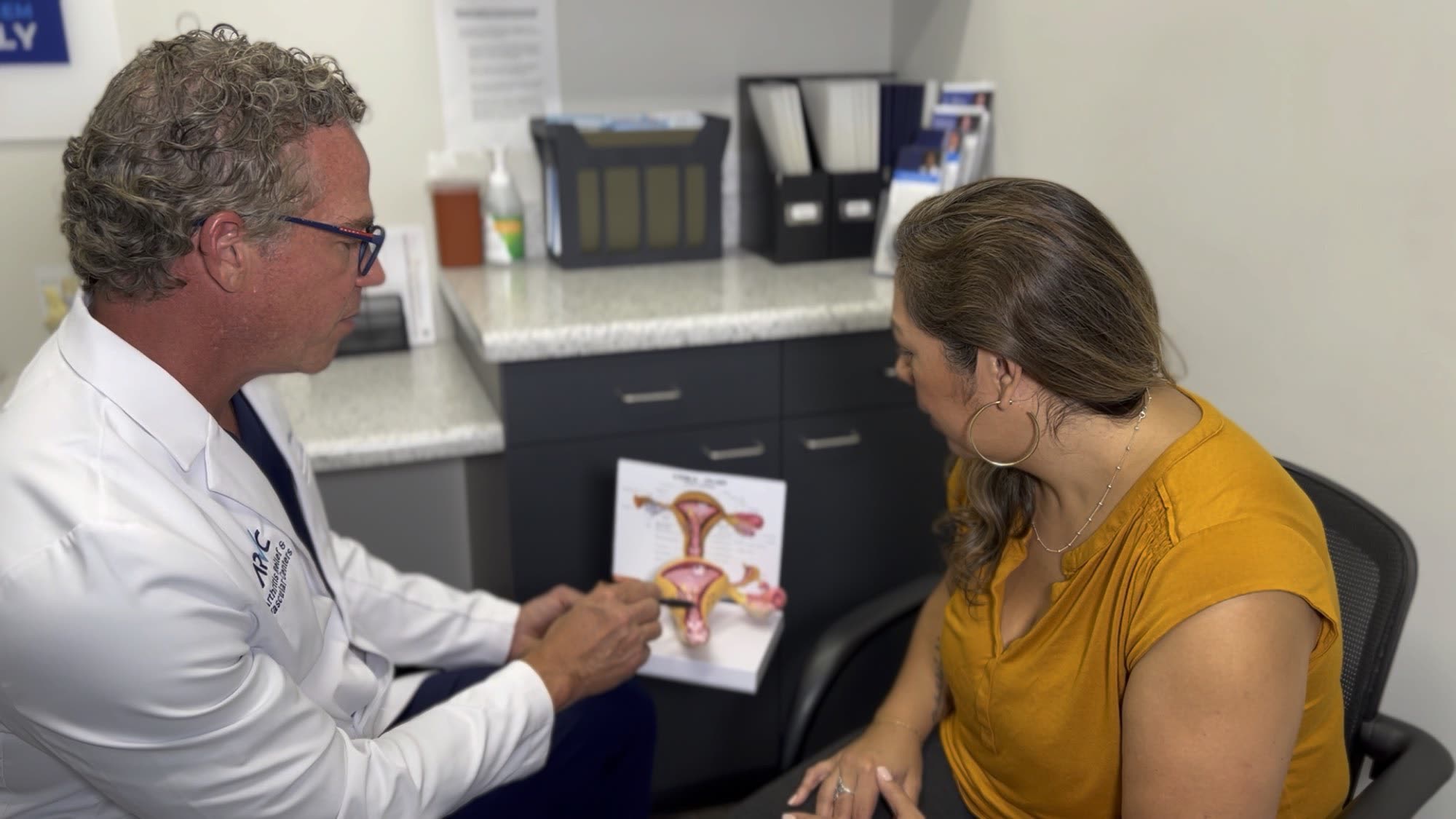
A fibroid consultation in our clinic — every option, explained.
Uterine fibroid embolization (UFE) shrinks fibroids by blocking their blood supply — no surgery, no hysterectomy, no weeks of recovery. Covered by most insurance plans, including Medicare and Medicaid — and we’re in-network with most plans. No referral needed for your initial consultation.
Covered by most insurance, including Medicare & Medicaid No referral needed for your initial consultation
Does this sound familiar?
You plan your life around your period now. You know which week is the bad one. You’ve bled through at work. You’ve slept on a towel. You keep pads in every bag you own.
You’re tired in a way sleep doesn’t fix — and maybe your labs finally explained why.
And when you asked for help, somebody told you heavy bleeding is “normal.” Take some ibuprofen. Try another birth control. Wait and see.
And when waiting didn’t work, your OB/GYN said: “We should talk about a hysterectomy.”
Let’s be clear about two things. This was never normal. And a hysterectomy is not your only option.
What fibroids are
Benign muscle growths — common, and not cancer.
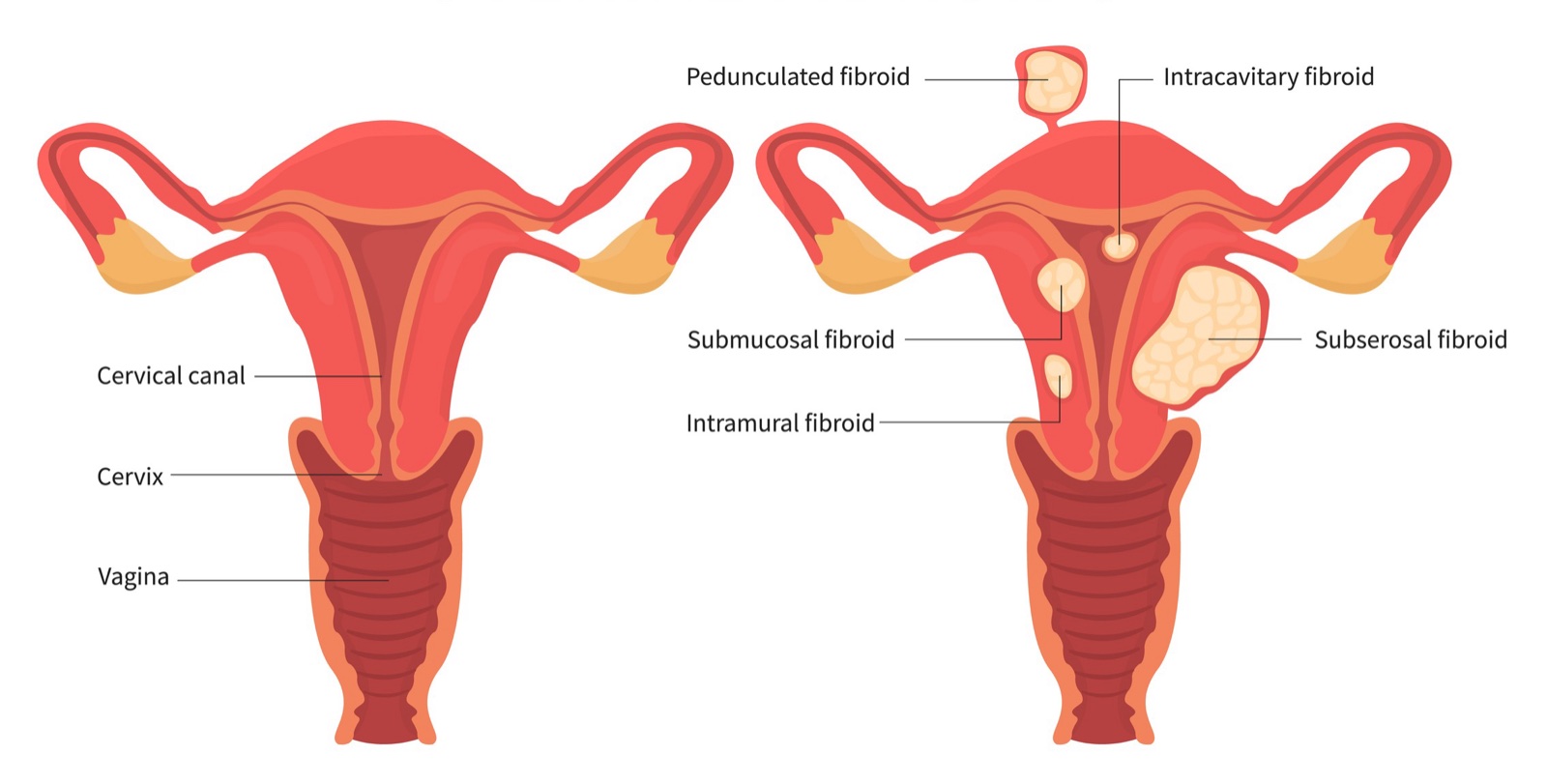
A fibroid is a growth of the muscle tissue your uterus is already made of. They range in size from the size of a seed to the size of a watermelon, and a uterus can hold one or dozens. They are not cancer, and having them does not raise your risk of it.
They are also ordinary. Fibroids occur in 70% to 80% of women by menopause, but many cause no symptoms and are never diagnosed, and only about 1 in 4 are significant enough to need any treatment at all.⁷
Where they sit matters more than how many you have. The ones that bulge into the cavity — submucosal and intracavitary — drive the heaviest bleeding and most of the fertility effect. The ones in the wall (intramural) or on the outside (subserosal, pedunculated) drive the pressure, the bloating, and the bladder symptoms. It’s the first thing we look at on your imaging, because it changes which treatments are realistic.
If your fibroids aren’t bothering you, the right treatment is usually none. This page is for the women whose fibroids are bothering them — and who’ve been told the only fix is surgery.
Why fibroids form
The risk factors — separated into the ones you can’t change and the ones you can.
Most women are told fibroids “just happen.” The research says otherwise. Nearly every documented risk factor traces back to the same two engines: estrogen exposure and chronic inflammation. That is the thread running through all of it — and it’s why fibroids are almost exclusively a premenopausal problem. Premenopausal women carry a three to five times higher risk of symptomatic fibroids than postmenopausal women; once estrogen drops after menopause, fibroids typically shrink or stop growing.₀
 Fibroids · Risk factors
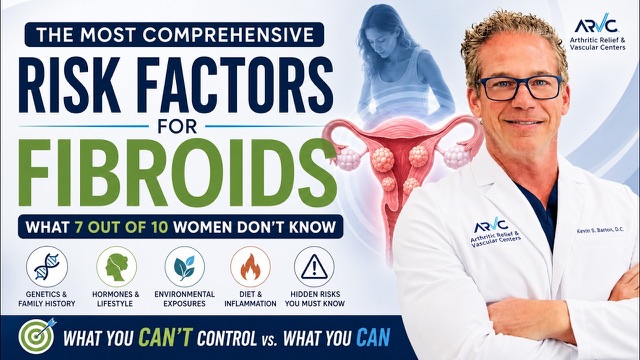
“Do you have these risk factors?” — the full deep dive, on video Watch on YouTube →
Fibroids · Risk factors
“Do you have these risk factors?” — the full deep dive, on video Watch on YouTube →
Everything in this section, walked through in detail — including why so many of these factors connect back to the same two things.
Part one — what you were born with
Family history — over 3×
If your mother, sister, or aunt had fibroids, your risk is more than three times higher. That points to genetics: some women carry variants that make uterine tissue more sensitive to estrogen, or more prone to the abnormal muscle growth that forms fibroids.₀
Race — 2 to 3×
Black women have two to three times the risk, consistent across four major registry studies — and tend to develop fibroids earlier, with more severe symptoms and larger tumors at diagnosis. The disparity persists after accounting for income, access, and lifestyle.₀⁷
Age — up to 10×
The largest-magnitude factor in the systematic review. Women in their 40s and 50s were up to ten times more likely to have fibroids than women in their 20s — the estrogen bill, accumulated over reproductive years.₀
An early first period
Starting your period early — particularly before age 10 or 11 — meaningfully raises risk. Earlier start means more years of cumulative estrogen exposure. Worth knowing as a mother watching a daughter.₀
Never having given birth
Women who had given birth three or more times had less than one-fifth the risk of women who had never given birth. Pregnancy appears to remodel the uterus protectively and interrupts continuous cycling.₀
Years since your last birth
Women whose last birth was more than five years ago had two to three times the risk of women who gave birth more recently — found in both the Nurses’ Health Study II and the Black Women’s Health Study.₀
Part two — what you can influence
High blood pressure — nearly 5×
This one stops people in their tracks. Women with hypertension had a nearly fivefold increased risk of fibroids — putting it among the highest-magnitude factors identified, alongside race and age. Unlike those, blood pressure can be managed.₀
Weight and metabolic health
Body fat converts androgens into estrogen through aromatization, so more adipose tissue can mean more estrogen produced outside the ovaries — in an already pro-inflammatory state. PCOS, diabetes, and metabolic syndrome share the same inflammatory, hormonally dysregulated profile.₀
Vitamin D deficiency
Fibroid cells carry vitamin D receptors, and vitamin D appears to have an anti-proliferative effect on fibroid tissue. Low levels are associated with higher risk — and deficiency is more common in Black women, which may be one contributor to the disparity above. Getting your level checked is a simple, actionable step.₀
Red meat and inflammatory diet
High beef and red meat consumption is linked to elevated fibroid risk, and the mechanism is layered: red meat raises circulating estrogen, elevates IGF-1 — a growth factor that directly stimulates fibroid tissue — and is fundamentally pro-inflammatory. It’s the same mechanism that makes it hard on your heart.₀
Processed food and additives
Food-additive consumption — processed, sweetened, and preserved foods — was associated with more than three times the fibroid risk in a large hospital-based study. By contrast, diets rich in fruit, vegetables, and fiber are associated with lower risk.₀
Alcohol
Alcohol raises circulating estrogen by interfering with how the liver clears it, and elevates growth factors that may promote fibroid development. Even moderate regular drinking can meaningfully raise estrogen in premenopausal women.₀
Part three — what your food comes in
Beyond what’s in the food, there’s what the food touches. Many everyday exposures contain xenoestrogens — chemicals that mimic estrogen in the body, known collectively as endocrine-disrupting chemicals (EDCs). When they enter the body they can bind to estrogen receptors and trigger the same estrogenic signaling that drives fibroid growth; research has shown EDC exposure can directly promote fibroid tissue proliferation.₀
The most studied are BPA (plastic food containers, can linings, receipt paper), phthalates (food packaging, plastic wrap, and many personal care products), and PFAS — the “forever chemicals” used in non-stick cookware, stain-resistant fabrics, and fast-food packaging.
One more from the same review: soy milk consumption was associated with 2.5 times greater fibroid risk, likely through phytoestrogens — plant compounds that act on estrogen receptors. The science there is still evolving, but it underlines the point: what you eat and drink shapes your hormonal environment.₀

Practical steps
- Reduce processed and packaged foods; choose fresh whole foods where you can.
- Never heat food in plastic containers.
- Switch to cookware without PFAS coatings.
- Ask for a vitamin D level at your next visit.
- Get your blood pressure and metabolic numbers under control — the same work that protects your heart.
Having fibroids is not your fault. Half of this list was written into your biology before you were born. But the other half is where your leverage is — and nobody tends to tell you that either.
Sources for this section: Stewart EA, Cookson CL, Gandolfo RA, Schulze-Rath R. Epidemiology of uterine fibroids: a systematic review. BJOG 2017;124(10):1501–1512 — the systematic review behind the magnitudes above; and ACOG Practice Bulletin 228, Management of Symptomatic Uterine Leiomyomas, Obstet Gynecol 2021;137(6) — prevalence, racial disparity, and the risk factors ACOG lists. Individual figures come from the primary studies pooled in that review; effect sizes vary by population and study design, and association is not the same as cause. Bring this list to your consultation — we’ll go through which ones actually apply to you.
What they do to you
The symptoms, grouped the way patients actually describe them.
Bleeding
Heavy or long periods. Clots. Bleeding between periods. Periods that soak through protection in under an hour.
Bulk and pressure
Pelvic pressure or fullness. A belly that looks pregnant. Back pain. Leg pain.
Bladder and bowel
Going constantly. Trouble emptying your bladder. Constipation. Bloating.
Everything else it costs
Exhaustion that sleep doesn’t fix. Low iron. Hair loss. Pain with sex. Missed work. Missed plans. Clothes you can’t wear.
Fertility and pregnancy
Trouble conceiving, or miscarriage — mostly driven by fibroids that bulge into the cavity. Most women with fibroids can still conceive.
What “heavy” actually means
Soaking a pad or tampon every hour for several hours. Needing double protection. Waking at night to change. Clots the size of a quarter or bigger. Periods longer than seven days.
If you said yes to any of those, ask for a ferritin and a CBC — not just a hemoglobin.
Doctors ask “are your periods heavy?” and most women say “I don’t know — compared to what?” That’s the comparison.
Why nobody offered you this
UFE isn’t new. It just lives in a different specialty.
The technique was pioneered in Paris in the 1970s, where doctors used it to stop life-threatening bleeding after childbirth. In the early 1990s — in the same city — it was first used to treat fibroids, with results published in The Lancet in 1995. The embolic microspheres used today have been FDA-cleared since 2000 — and cleared specifically for uterine fibroids since 2002.¹⁰ And it has gone head-to-head against hysterectomy in randomized trials — including one that followed women for ten full years.¹ ² ⁵
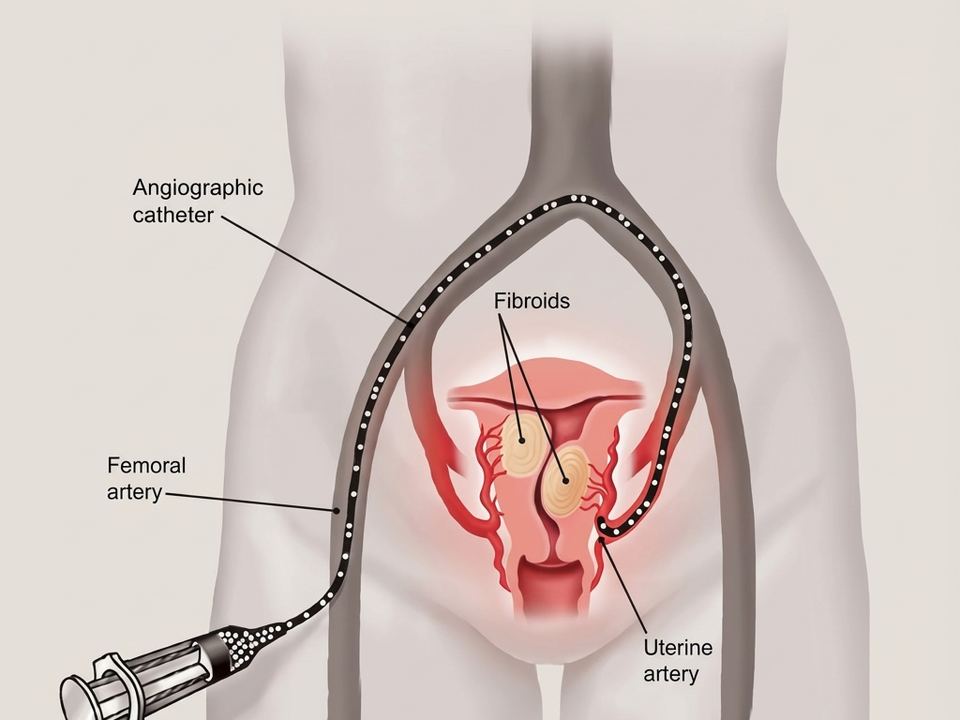
Fibroids are benign muscle tumors — not cancer — that live on blood supply. Give a fibroid blood and it grows. Take the blood away and it shrinks. Through a pinhole in the groin, an interventional radiologist guides a tiny tube to the arteries feeding your fibroids and releases small particles that block them. The bleeding eases. The pressure lets up. Your uterus stays exactly where it is.
So why did you hear “hysterectomy” first? Because UFE is performed by interventional radiologists — a different specialty from your OB/GYN, with a different training path and a different referral network. Most women who find UFE find it the way you may have found this page: by refusing the first answer and looking for themselves.
The numbers behind that gap are real. When OB/GYNs across 33 states were surveyed, nearly all said they start with medication — the standard first step. But asked which treatment they most frequently recommend beyond that, the answers were hysterectomy, then myomectomy. Not one of the 104 OB/GYNs named UFE — and nearly two out of three said they refer patients for UFE “not very often.”⁴ Meanwhile, 1 in 5 women believed hysterectomy was their only option.⁴
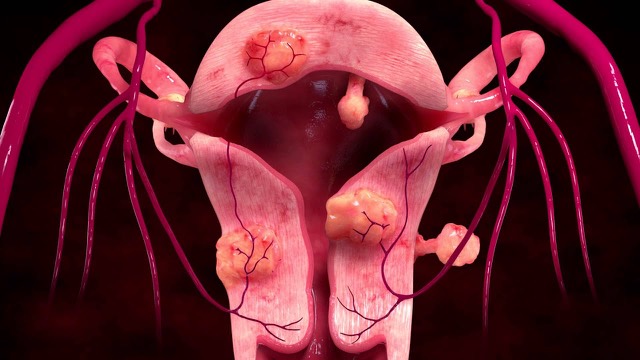 3-D animation
How embolization starves a fibroid — a 3-D animation Watch on YouTube →
3-D animation
How embolization starves a fibroid — a 3-D animation Watch on YouTube →
The questions everyone actually wants to ask
Asked out loud, answered straight.
“But doesn’t the dead tissue just… stay in there?”
Fair question — most women ask it. The fibroid doesn’t rot or float loose. Your body does what it does with any tissue it no longer feeds: it breaks it down and scars it in, the way a bruise resolves. In some cases, small fibroid fragments pass naturally. Your doctor will tell you what to expect for your specific fibroids, based on where they are.
“And the particles — they just stay in me?”
They’re smaller than a grain of sand — soft, biocompatible medical spheres, FDA-cleared specifically for uterine fibroid embolization since 2002, delivered sterile, and they stay put in the treated vessels.¹⁰ They’ve been used in millions of procedures worldwide.
Before, during, and after
What to expect from the procedure.
The procedure itself doesn’t hurt. You’re sedated and comfortable, and discomfort during the procedure is rare. We do UFE in our own IR suite, in our office — not a hospital. Every patient goes home the same day, usually after about an hour of recovery.
The first night brings cramps much like your period. As the fibroids lose their blood supply, the uterus cramps — much like your menstrual cycle, or the pain you’ve already been having. Every patient goes home on our advanced pain-management protocol, which now includes Journavx, a non-narcotic medication that blocks the pain signal in the nerve itself. It is the biggest advance in pain control after the procedure we have ever used, and with it most women feel even less than their usual cramps. We call you the next morning to check on you.
Back to your routine in less than a week. After the first 24 hours you can do whatever you feel up to — the one rule is no heavy lifting over 50 pounds for at least three days. Most of our patients are fully back to their normal routine in less than a week, and you go home with the doctor’s cell number.
Can fibroids come back? The risk of regrowth after UFE is very low. Fibroids grow on estrogen over time, so your age matters: the closer you are to menopause, the lower the risk — for many of our patients, less than a 10% chance over a decade. UFE treats all of your fibroids in one procedure, and it is a long-term solution.
And fertility? If future pregnancy matters to you, tell us first — it changes the conversation. Here’s what the largest analysis to date shows — 33 studies, 4,287 women: the biggest predictor of fertility after UFE is the same as before it. Your age. About half of the women who wanted to become pregnant after the procedure did — two out of three under age 30.⁸ By age group, fertility after UFE looked similar to women the same age with fibroids who never had the procedure — with pregnancy and miscarriage rates comparable to the age-matched population.⁸ ⁹ And when researchers pooled all six randomized trials comparing embolization head-to-head with myomectomy, they found no statistical difference in successful pregnancy between the two — though they note more data is still needed.¹¹
One more thing your fertility conversation should always include: where your fibroids are. Location matters more than size or number. Fibroids on the outer wall generally don’t affect fertility at all. Fibroids in the muscle wall can have a moderate effect. Fibroids that bulge into the uterine cavity — where an embryo needs to implant — are the real problem, cutting ongoing pregnancy rates roughly in half.¹² That’s why the first question is never “which procedure?” It’s “where exactly are your fibroids?” — and that’s an imaging conversation we’ll have with you directly.
Who isn’t a candidate? Women whose symptoms come from something other than fibroids, and women with very large fibroids — we don’t treat fibroids larger than 17 centimeters, because at that size only a myomectomy or hysterectomy can resolve the bulk, and we’ll refer you for exactly that. We turn away patients who aren’t candidates for what we do — routinely.
What it looks like in numbers
More long-term evidence than any “alternative” you’ll be offered.
96%
had their heavy bleeding improve — in 1,285 women treated in an office-based outpatient setting, the same way we do it here.¹³
94%
had their pelvic pain improve — and 94% their bulk symptoms, the pressure and swelling. Fatigue improved in 94%, urinary frequency in 92%.¹³
9 in 10
women who have UFE get significant improvement, or their symptoms go away completely — the figure the Society of Interventional Radiology gives patients.¹⁴
2,112
women in the largest study ever done — 27 practices across the U.S. Symptom and quality-of-life scores improved by more than 40 points, into the normal range, holding at three years.⁶
Zero days
in the hospital. UFE happens in our own IR suite, in our office, and every patient goes home the same day — against a five-day hospital stay for surgery in the randomized trial.⁵
Level A
the highest grade of evidence ACOG gives. The OB/GYNs’ own professional college recommends UFE at that level for women who want to keep their uterus — the same tier it gives hysterectomy.⁷
2 in 3
never needed a hysterectomy — in the only randomized trial that followed women for ten full years. Their quality of life matched the women who’d had one.²
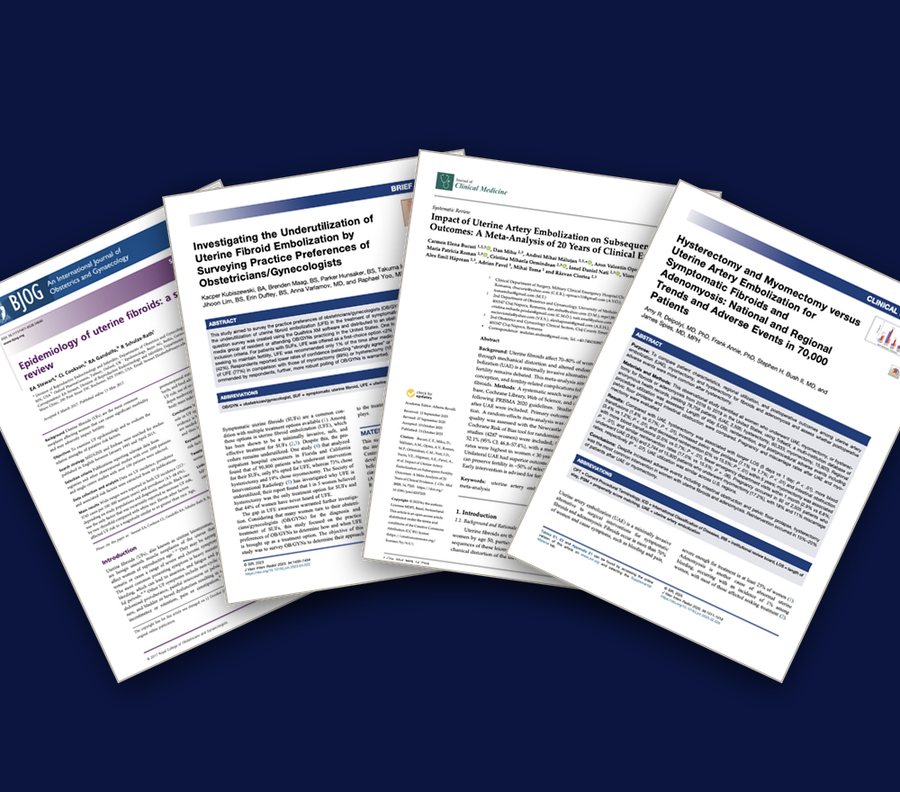
These aren’t claims. They’re published papers.
Randomized trials against hysterectomy and myomectomy, a 70,000-patient national comparison, twenty years of fertility data, and the survey that measured how rarely OB/GYNs mention UFE at all. Every number on this page traces back to one of them, and the full citations are below.
And the OB/GYNs’ own college agrees. ACOG’s practice bulletin on symptomatic fibroids recommends uterine artery embolization at Level A — its highest grade, based on good and consistent scientific evidence — for women who want to keep their uterus.⁷
Sources: 1. Ravina et al., Lancet 1995. 2. de Bruijn et al. (EMMY 10-year), Am J Obstet Gynecol 2016. 4. Kubiszewski et al., J Vasc Interv Radiol (UFE underutilization). 5. Edwards et al. (REST), N Engl J Med 2007. 6. Goodwin et al. (FIBROID Registry), Obstet Gynecol 2008. 7. ACOG Practice Bulletin, Symptomatic Uterine Leiomyomas, 2021 (Level A). 8. Bucuri et al., J Clin Med 2025 (33 studies, 4,287 women). 9. Mailli et al., CVIR Endovascular 2023. 10. FDA 510(k) K021397, cleared Nov 22, 2002. 11. Tzanis et al., Am J Obstet Gynecol 2024 (meta-analysis of all 6 RCTs, UAE vs myomectomy). 12. Klatsky et al., Am J Obstet Gynecol 2008; Freytag et al., Diagnostics 2021. 13. Geschwind, Afsari, Nezami et al., Diagnostics (Basel) 2025;15(6):739 — 1,285 women treated with UAE in an ambulatory (office-based) setting: bleeding improved in 96%, pelvic pain in 94%, bulk-related symptoms in 94%, fatigue in 94%, urinary frequency in 92%. 14. Society of Interventional Radiology, patient information on uterine fibroids and UFE — “approximately nine out of 10 women who undergo uterine fibroid embolization will experience significant improvement, or their symptoms will go away completely.” 15. Corroborating series: Spies et al., Obstet Gynecol 2001;98(1):29–34 (200 patients — heavy bleeding improved 90%, bulk symptoms 91% at one year); Pron et al. (Ontario UFE Trial), Fertil Steril 2003;79(1):120–127 (538 women — menorrhagia 83%, bulk/size 84%, urinary urgency 86%, dysmenorrhea 77%).
Your care team
The doctors who perform UFE here.
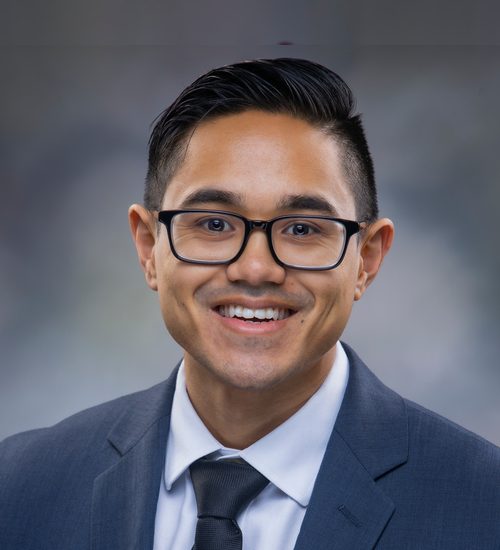
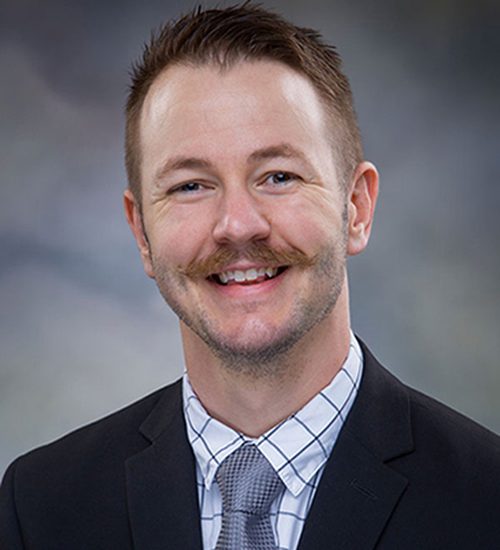
Uterine fibroid embolization at ARV Centers is performed by Board Certified Vascular and Interventional Radiologists. You’ll meet the doctor performing your procedure at your consultation — and we’re glad to coordinate with your OB/GYN before and after.

After your procedure
You go home with the doctor’s cell number.
When you go home, you take the on-call doctor’s cell phone number with you. Not an answering service — the doctor.
And you don’t have to wonder whether to bother us: we call you the next day to check in. Every patient, every procedure.
Before you leave, you’ll get this card
Your procedure:
On-call doctor:
Cell phone: written by hand, before you walk out
Call me if anything worries you.
Patient stories
Woman to woman, in their own words.
Three of our patients chose to tell their fibroid stories on camera — what they’d been told, what they chose, and what changed.
Their words, not ours.
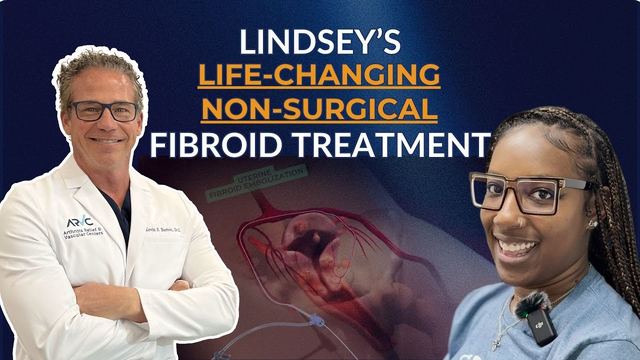 Fibroids · UFE
Lindsey’s life-changing non-surgical fibroid treatment Watch on YouTube →
Fibroids · UFE
Lindsey’s life-changing non-surgical fibroid treatment Watch on YouTube →
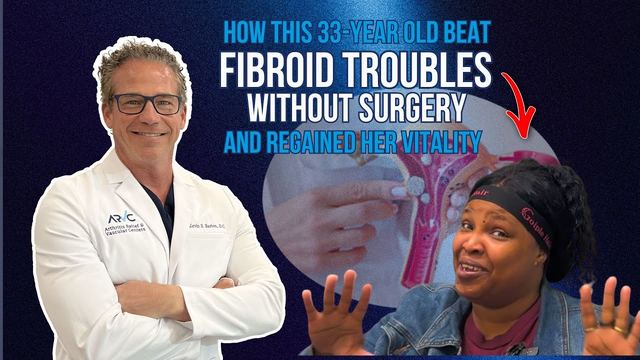 Fibroids · UFE
“How I beat fibroids without surgery” Watch on YouTube →
Fibroids · UFE
“How I beat fibroids without surgery” Watch on YouTube →
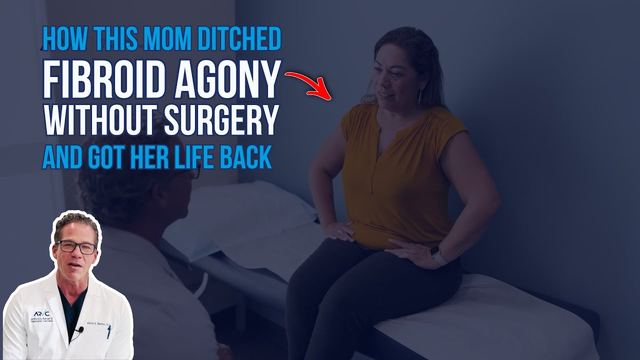 Fibroids · UFE
A busy mom’s secret to feeling normal again Watch on YouTube →
Fibroids · UFE
A busy mom’s secret to feeling normal again Watch on YouTube →
Every patient’s story is their own. Results vary. These are real ARV Centers patients, sharing their experiences with their permission.
Straight answers
Questions patients actually ask.
“Is this experimental?”
No. The technique dates to 1970s Paris, has treated fibroids since the early 1990s, uses FDA-cleared devices, has been tested against both hysterectomy and myomectomy in randomized trials published in the New England Journal of Medicine, has ten-year follow-up data, and is covered by most insurance plans — including Medicare and Medicaid. If a treatment were experimental, your insurer wouldn’t pay for it.
“Will my insurance cover it?”
Most plans cover UFE, including Medicare and Medicaid, and we’re in-network with most insurance plans. We do a complimentary benefits check before any procedure. No surprises.
“Why didn’t my OB/GYN mention it?”
Different specialty, different referral world — not bad intent. We’re glad to coordinate with your OB/GYN, and many stay involved in your care afterward.
“How is this different from an ablation?”
Ablation treats the uterine lining to reduce bleeding; it doesn’t shrink fibroids. UFE treats the fibroids themselves — the bleeding and the bulk, pressure, and bloating.
“What about my anemia?”
When the bleeding stops, iron levels recover. Many patients see their energy return over the months after treatment as their blood counts rebuild.
“How soon will I know it worked?”
Bleeding usually improves within the first cycles. Most women notice significant change in the first four to six weeks — if you could feel the fibroid before, you’ll often feel it soften and shrink. The most substantial shrinking happens between six and twelve months.
“Do I need a referral?”
Not for your initial consultation — call us directly. We do a complimentary benefits check before any procedure, and if your plan requires a referral or prior authorization for treatment itself, we’ll help you get it.
Free patient guide
Not ready to call? Take the guide instead.
Our free fibroid guide explains what fibroids are, every treatment option — from watchful waiting to hysterectomy, including the ones nobody mentioned — and the questions worth asking any doctor, including us. Written by our physicians. No appointment required, and no follow-up phone call unless you ask for one.
We’ll email your guide plus occasional patient education. Unsubscribe anytime. Privacy policy.
Bring every question you’ve been saving. You’ll leave knowing every option — all of them.
Bring your imaging if you have it. You’ll leave knowing exactly what’s going on and what we’d do if you were family. Call us directly, or send this form and we’ll call you to schedule. We do a complimentary benefits check before any procedure. No surprises.
210-405-1335Consultation hours
- Monday–Thursday8:00–5:00
- Morning · last consult11:30 AM
- Afternoon · last consult4:30 PM
- FridayProcedures only
Closed on major holidays.
3212 Napier Park, San Antonio, TX 78231
Stand-in image (Map © OpenStreetMap) — the live site embeds the interactive Google map here
Schedule a fibroid consultation
No referral needed for your initial consultation.
Rather book by phone? Call (210) 405-1335.