
For women in San Antonio diagnosed with adenomyosis — hoping there’s a treatment that spares the uterus
UAE cuts off the blood supply that keeps adenomyosis alive. Your uterus stays.
Treat the tissue. Keep the uterus.
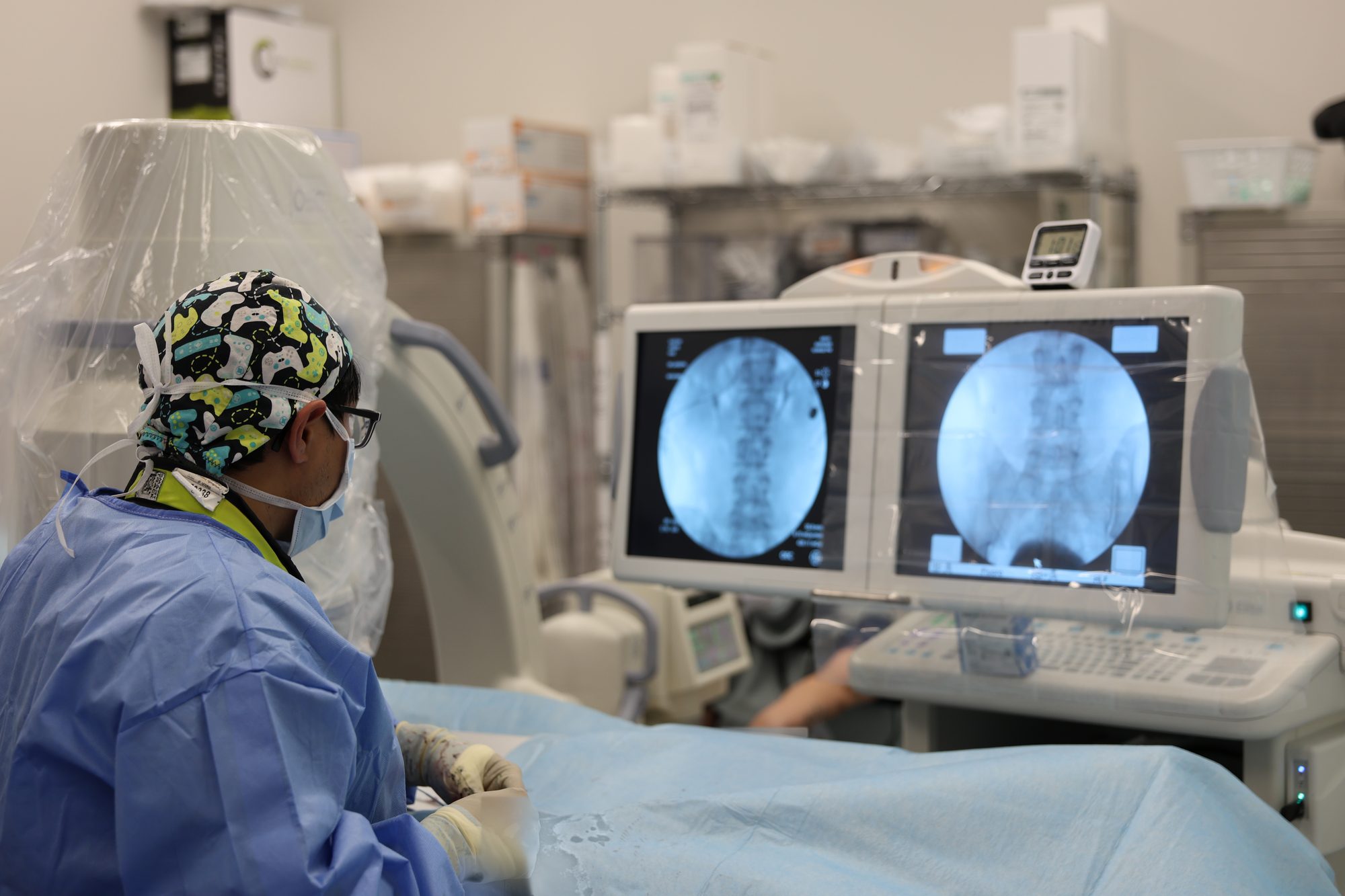
Arthur S. Joseph, D.O., M.P.H., board-certified vascular and interventional radiologist performing a Uterine Artery Embolization in our in-office angiography suite.
Uterine artery embolization — UAE for short — is a same-day, uterus-sparing procedure for adenomyosis, performed through a pinhole in the groin by a board-certified interventional radiologist, in our own IR suite. No surgery, no hospital stay. Covered by most insurance plans, including Medicare and Medicaid — and we’re in-network with most plans.
Covered by most insurance, including Medicare & Medicaid No referral needed for your initial consultation
How people find this page
Maybe your OB/GYN finally said the word — adenomyosis — and embolization came up as the alternative to a hysterectomy. Maybe you read about UAE on our adenomyosis page. Or maybe you found it yourself at midnight, three search terms past “period pain like labor.”
If you’re still at the “what is adenomyosis?” stage, start with our adenomyosis page — it explains the condition and all three treatment paths.
This page is for the next question: what the procedure actually does, what the studies actually show, and what the day is actually like.
The procedure
The whole idea in four sentences.
Adenomyosis is uterine lining growing where it doesn’t belong — inside the muscle wall of your uterus — swelling and bleeding every month with nowhere to go. That misplaced tissue stays alive the way any tissue does: through its blood supply. UAE blocks it. Starved of blood, the diseased tissue shrinks and scars down — while your uterus stays where it is.
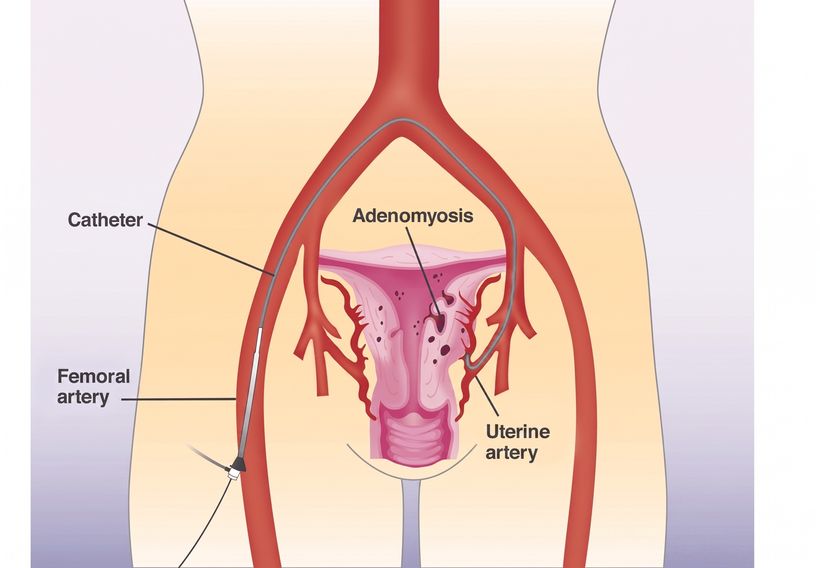
Here’s how. Through a pinhole in the groin — no incision, no stitches — an interventional radiologist threads a tube thinner than a phone-charger cable toward the uterus. Live X-ray imaging guides it into the uterine arteries: the vessels feeding the diseased tissue inside the muscle wall.
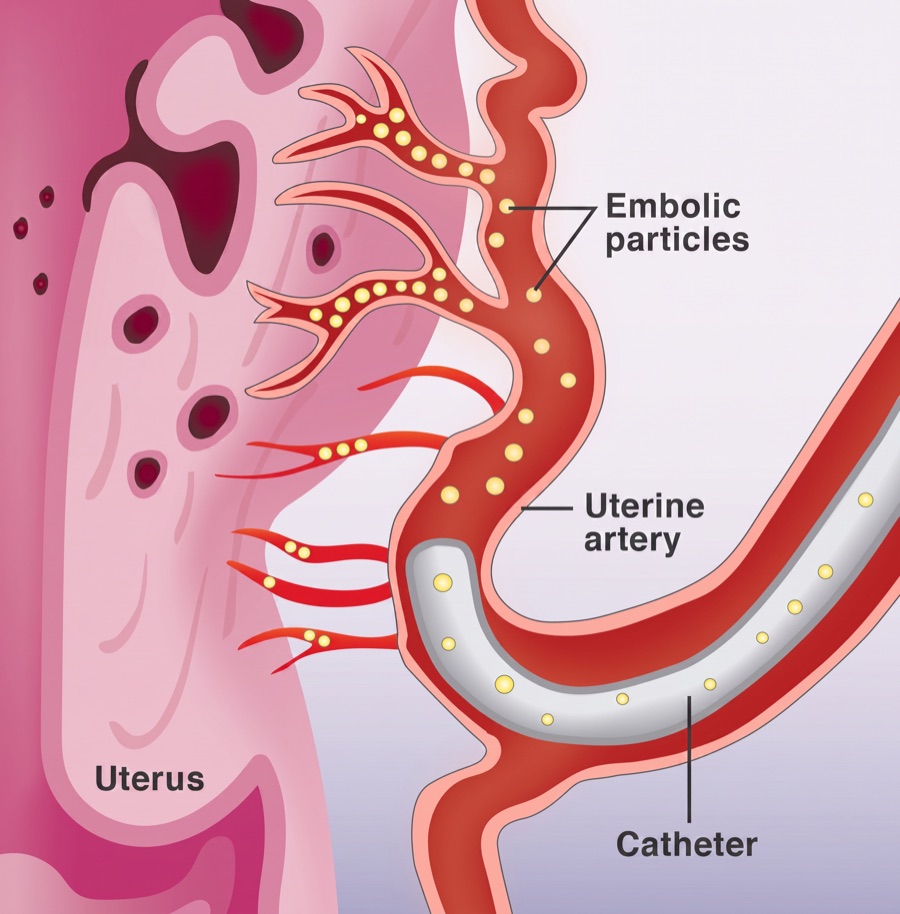
Then microscopic spheres — each smaller than a grain of sand — are released into those small arteries, sealing them off. The supply line is cut. Over the following weeks and months, the tissue it fed shrinks and scars down — and with it the swelling, the crushing cramps, and the heavy bleeding it caused.
Nothing is cut out. Nothing is removed. Least of all your uterus.
 UAE · No surgery
“Before you get a hysterectomy… stop!” Watch on YouTube →
UAE · No surgery
“Before you get a hysterectomy… stop!” Watch on YouTube →
Procedure day
In our office. Home the same day.
Before anything is scheduled: you’ve had a consultation, your imaging has been reviewed, and your benefits have been checked. You know where you stand — medically and financially — before you commit to anything.
The morning of: you come to our office — not a hospital. The procedure happens in our own interventional radiology suite, with the team you met at your consultation. You’ll have fasted beforehand, and you’ll bring a driver — no exceptions: the sedation means you can’t drive yourself home. You’ll get the exact instructions, in writing, well before the day.
During the procedure: you’re sedated and comfortable, and the procedure itself takes about 45 minutes on average. It doesn’t hurt — the pain conversation with UAE is about the first night afterward, not the procedure, and we’d rather you hear that from us now than discover it at home.
Afterward: you recover with us for about an hour. Then you go home — the same day.
The first night brings cramps much like your period. As the treated tissue reacts, the uterus cramps — much like your menstrual cycle, or the pain you’ve already been having. You go home on our pain-management protocol, with the medication and an hour-by-hour plan that keep you comfortable.
That evening: you have the on-call doctor’s cell phone number in your pocket. Not an answering service — the doctor. And the next morning, we call you to check on you. Every patient, every time.
The weeks after: cramping fades over the first days, and the improvement itself builds over the following weeks and months — this is diseased tissue shrinking and scarring down, not a drug wearing off. Bleeding typically improves in the first cycles; the deep, dragging pain eases as the tissue quiets. Plan on taking three to five days off work — five is the comfortable version, and plenty of women are back at three, depending on how physical the job is. We’ll help you pick the right number for yours. You’ll have written instructions, a scheduled follow-up, and a phone number that reaches a doctor — so at no point are you at home wondering whether what you’re feeling is normal.
The published evidence
The research — uncropped.
9 in 10
women who initially responded were still doing well at an average of 52 months — more than four years — in the longest follow-up study published.¹
80%
cumulative success at four-plus years once the women who relapsed along the way are counted — the uncropped version of the same study.¹
44 of 50
women who chose UAE in the European head-to-head with hysterectomy still had their uterus a year later.²
>85%
of the women we treat for adenomyosis in our own practice feel substantial to complete relief of their symptoms — in line with the published results.
Start with the research problem: for decades, adenomyosis was mostly diagnosed only after a hysterectomy, when a pathologist looked at the tissue. A disease diagnosed by removing the organ doesn’t accumulate many trials of organ-sparing treatments. So here is what the published record actually shows.
The durability study: the longest follow-up published tracked women for more than four years after UAE for adenomyosis. Of those who initially responded, 9 in 10 were still doing well at an average of 52 months — symptom scores fell from severe to mild (58.9 to 20.0), and quality-of-life scores more than doubled (40.3 to 86.3).¹
The head-to-head with hysterectomy: in 2025, a European study (QUESTA) published one-year results for 101 women with symptomatic adenomyosis who chose either UAE or hysterectomy and were followed prospectively. Quality of life improved significantly after both treatments, with comparable one-year scores — and 44 of the 50 women who chose UAE kept their uterus.² The authors’ conclusion: UAE “is a valid less-invasive alternative to hysterectomy, with preservation of the uterus.”²
What we won’t claim: that UAE is a cure for adenomyosis. But it is the only reliable uterine-sparing treatment for adenomyosis.
Borrowed strength — the technique itself: UAE for adenomyosis isn’t a new invention; it’s an established procedure aimed at a second target. The technique was pioneered in Paris in the 1970s to stop life-threatening bleeding after childbirth, has treated fibroids since the 1990s, and uses microscopic spheres FDA-cleared for uterine fibroid embolization since 2002.⁵ For fibroids, ACOG — the OB/GYNs’ own professional college — recommends it at their highest evidence level for women who want to keep their uterus.⁴ Same arteries. Same materials. Same interventional radiologists. The full fibroid track record lives on our uterine fibroids page.
 Fibroids vs. adenomyosis
 — what every woman needs to know Watch on YouTube →
Fibroids vs. adenomyosis
Fibroids vs. adenomyosis — what every woman needs to know Watch on YouTube →
Sources: 1. Ma, Brown & Liang, Aust N Z J Obstet Gynaecol 2021 — 91 women, mean 52-month follow-up: 82/91 (90%) of initial responders maintained success; cumulative success 80%; mean time to relapse 31 months; UFS-QOL symptom severity 58.9→20.0, quality of life 40.3→86.3; no apparent earlier menopause. 2. Trommelen et al. (QUESTA study), Acta Obstet Gynecol Scand 2025;104(8):1558–74 — 101 women (50 UAE, 51 hysterectomy), prospective comparative design: both arms improved significantly at 1 year with comparable quality-of-life scores; greater pain relief and higher satisfaction after hysterectomy; 6 of 50 UAE patients had a secondary hysterectomy in year one. 3. Mailli et al., CVIR Endovascular 2023 — evidence review: better outcomes in combined adenomyosis-fibroid disease; effectiveness lower than in pure fibroid disease. 4. ACOG Practice Bulletin, Symptomatic Uterine Leiomyomas, 2021 — Level A recommendation for uterine artery embolization in fibroid patients desiring uterine preservation, with counseling on reproductive data. 5. FDA 510(k) K021397, November 2002 — embolic microspheres cleared for uterine fibroid embolization.
Candidacy
Who this is for — and who it isn’t.
UAE may be right for you if:
- Imaging shows adenomyosis — or adenomyosis together with fibroids, which is common, and where results are strongest³
- Hormonal treatments haven’t given you enough relief — or you don’t want to stay on them for years
- You’ve been told hysterectomy is the answer, and you want your uterus to stay yours
It may not be right if:
- Your symptoms have another cause — we look before we treat, every time
- There’s an active pelvic infection, or bleeding that hasn’t been fully worked up yet — those need answers before any procedure
We turn away patients who aren’t candidates for what we do. Routinely.
Your care team
The doctors who perform UAE here.
Uterine artery embolization at ARV Centers is performed by Board Certified Vascular and Interventional Radiologists — and we’re glad to coordinate with your OB/GYN before and after.

Samy A. Al-Bayati, M.D.
Board Certified ·
Vascular & Interventional Radiology
English/Arabic

Arthur S. Joseph, D.O., M.P.H.
Board Certified ·
Vascular & Interventional Radiology

Andrew V. Chesley, M.D.
Board Certified ·
Vascular & Interventional Radiology
English/Español
One number worth asking any doctor before any procedure: how many times have you done this? Here’s ours — more than 300 uterine embolization procedures.
After your procedure
You go home with the doctor’s cell number.
When you go home, you take the on-call doctor’s cell phone number with you. Not an answering service — the doctor.
And you don’t have to wonder whether to bother us: we call you the next day to check in. Every patient, every procedure.
Before you leave, you’ll get this card
Your procedure:
On-call doctor:
Cell phone: written by hand, before you walk out
Call me if anything worries you.
Straight answers
Questions patients actually ask.
“Is UAE the same thing as UFE?”
Same procedure, different target. When embolization treats fibroids, it’s called UFE — uterine fibroid embolization. When it treats adenomyosis, you’ll see it called UAE. The arteries, the materials, and the doctors are the same. Many women have both conditions at once — and that’s actually where results are strongest.³ Our uterine fibroids page covers the fibroid side.
“Is this experimental?”
No. The technique has a half-century history, the spheres have been FDA-cleared for uterine fibroid embolization since 2002,⁵ and ACOG — the OB/GYNs’ own college — recommends the procedure at its highest evidence level for fibroids in women who want to keep their uterus.⁴ For adenomyosis specifically, there’s more than four years of published follow-up¹ and a European study comparing it directly against hysterectomy.² And it passes the test skeptics rightly apply: insurance covers it. Insurers don’t cover hype.
“What goes into the arteries? Does anything stay in my body?”
Microscopic, biocompatible spheres — smaller than a grain of sand, FDA-cleared, and used in uterine embolization for more than two decades.⁵ They’re the very same spheres we use for fibroid embolization — just smaller, sized for the finer vessels that feed adenomyosis tissue inside the muscle wall. They stay where they’re placed, sealed inside the small arteries they closed — vessels that were feeding the diseased tissue. A transparent answer to a fair question — and if you’d like the details down to the product name, ask at your consultation and we’ll gladly walk you through it.
“Does the procedure hurt?”
The procedure itself doesn’t — you’re sedated and comfortable. Afterward, expect one night of cramps much like your period — and our pain-management protocol keeps you comfortable through it. You go home with the medication and an hour-by-hour plan, and we call you in the morning.
“When can I go back to work?”
Most women take three to five days off. Five is the comfortable version; returning at three is definitely doable for most patients, depending on how physical your job is. Recovery follows the same pattern as our fibroid embolization patients’ — one night of period-like cramps, and steadily easier from there.
“Will it push me into early menopause?”
In the longest follow-up study, UAE did not appear to bring menopause forward.¹
“What about fertility?”
If future pregnancy matters to you, tell us first — it changes the conversation. Fertility evidence for embolization in adenomyosis specifically is thinner than for fibroids, so this is a genuinely individual discussion: your age, your imaging, and your timeline. What we can say from the fibroid data: age — not the procedure — is the biggest predictor of fertility afterward. We’ll give you the transparent version for your specific case.
“What if the symptoms come back?”
Some do come back — adenomyosis is estrogen-driven, and in our experience about 15% of patients see symptoms return over ten years, with the risk falling the closer you are to menopause. If it happens, re-treatment can be considered when appropriate. And UAE closes no doors: every other option, including a hysterectomy if you ever choose one, stays fully open.²
“Why didn’t my OB/GYN offer this?”
Embolization is performed by interventional radiologists — a different specialty from your OB/GYN, with a different referral network. Nobody hid it from you; it lives outside the world of the doctors you’ve been seeing. We’re glad to coordinate with your OB/GYN before and after — and to share the published studies with them.
“How many of these have you actually done?”
More than 300 uterine embolization procedures. That’s exactly the right question, by the way — we’d encourage you to ask it of any doctor recommending any procedure. We’ll never be offended by it.
“Is it covered by insurance? Do I need a referral?”
Insurance typically covers embolization for adenomyosis the same way it covers it for fibroids: most plans, including Medicare and Medicaid, and we’re in-network with most plans. We do a complimentary benefits check before any procedure — no surprises. And no referral is needed for your initial consultation; if your plan requires a referral or prior authorization for treatment itself, we’ll identify that during the complimentary benefits check and help you get it.
Free patient guide
Not ready to call? Take the guide instead.
Our free adenomyosis guide explains what adenomyosis is, why it takes so many women years to get a name for it, and every treatment option — from the hormonal IUD to hysterectomy, including the ones we don’t perform — plus the questions worth asking any doctor, including us. Written by our physicians. No appointment required, and no follow-up phone call unless you ask for one.
We’ll email your guide plus occasional patient education. Unsubscribe anytime. Privacy policy.
One conversation tells you if UAE fits your case. If another path serves you better, we’ll say so.
Bring your imaging if you have it — especially an MRI report, if anyone’s ordered one. You’ll leave knowing whether UAE fits your case, and what the transparent odds are for a woman your age. Call us directly, or send this form and we’ll call you to schedule. We do a complimentary benefits check before any procedure. No surprises.
210-405-1335Consultation hours
- Monday–Thursday8:00–5:00
- Morning · last consult11:30 AM
- Afternoon · last consult4:30 PM
- FridayProcedures only
Closed on major holidays.
3212 Napier Park, San Antonio, TX 78231
Stand-in image (Map © OpenStreetMap) — the live site embeds the interactive Google map here
Schedule a consultation
No referral needed for your initial consultation.
Rather book by phone? Call (210) 405-1335.