
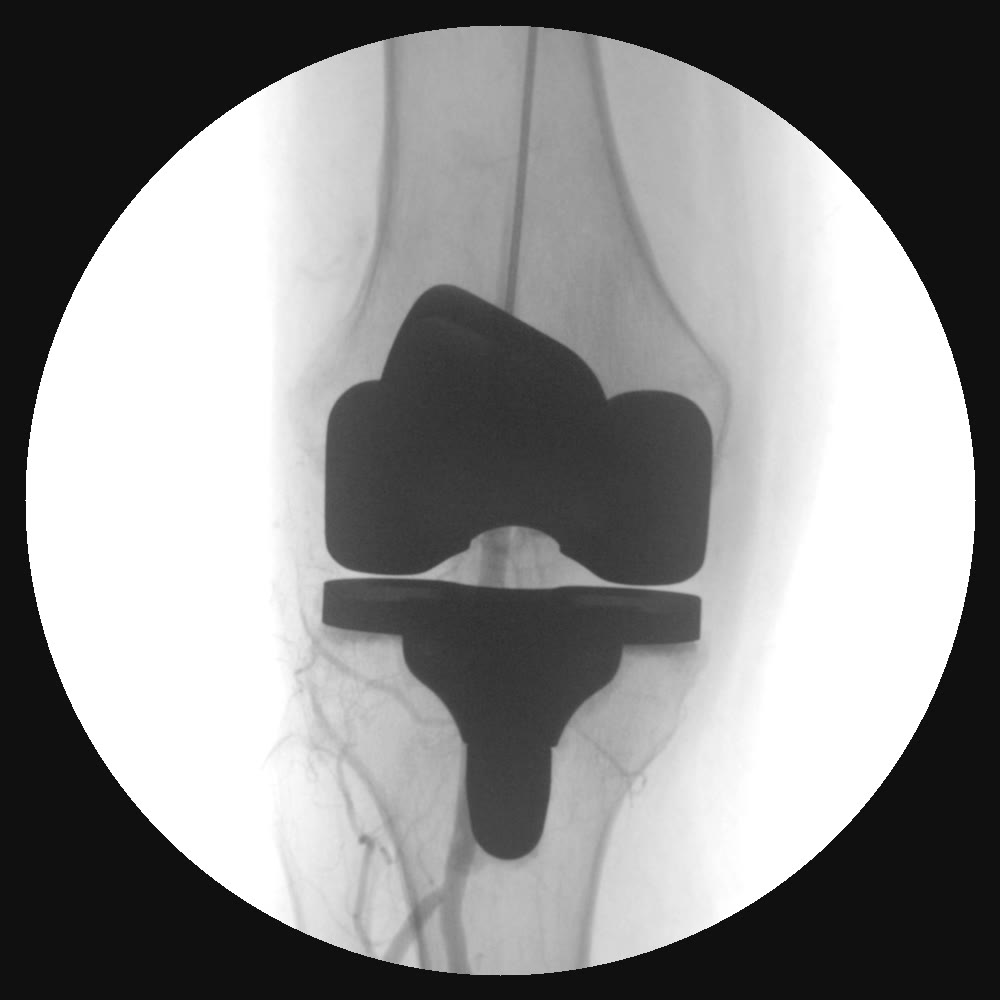
You did everything right. You saw your orthopedic surgeon. You had the knee replaced. You did the physical therapy, all of it, for months.
And here you are more than a year later, still hurting. Your surgeon takes new X-rays and tells you the implant looks perfect — no loosening, no infection, no reason for revision surgery. Which somehow makes it worse: if nothing is wrong, why does it still hurt?
Then come the quiet suggestions. Give it another year. It’s probably scar tissue. Some knees just do this.
If that’s your story, this article is for you — because there is usually a physical reason, and there is a treatment for it that most patients have never heard of.

The number that doesn’t get talked about
Total knee replacement is one of the most commonly performed operations in the United States, and for most people it is genuinely life-changing. Pain goes down, function goes up, it works.
But roughly one patient in five continues to have chronic pain after a knee replacement. That is not a rare complication or a fluke — multiple large studies and systematic reviews land in the same range, and some longer-follow-up work puts it higher.
You are not imagining it. You did not fail. And in all likelihood, neither did your surgeon.
Failing to get the desired outcome is a risk of any operation. What’s unusual about this one is how many people are left in it with nowhere obvious to go.
Why a knee can still hurt when the implant is perfect
A knee replacement does exactly what its name says: it replaces the worn surfaces of the joint — metal and plastic where the cartilage used to be.
What it doesn’t remove is the joint’s living envelope: the synovium, the soft lining that had been inflamed for years before your surgery ever happened.
In most knees, that lining settles down once the joint is resurfaced. In some, it never gets the message. Years of arthritis drove it to grow a web of abnormal new blood vessels — doctors call this pathological neovascularization — and new pain nerve fibers grew alongside them. That tissue keeps doing what it has done for years: generating inflammation, swelling and pain, implant or no implant.
The clinical names for it are residual synovitis and persistent periarticular inflammation. And unlike the implant, it’s something that can still be treated.
First things first: the implant has to be cleared
This is the part we want you to hear even if you never call us. Pain after a replacement has a short list of surgical causes that must be ruled out first — by an orthopedic surgeon, with imaging and sometimes lab work.
- Is it loose? A loose or shifting implant causes pain that embolization cannot fix. It needs a surgeon.
- Is it infected? A low-grade infection around an implant can smolder quietly for years. It’s ruled out with lab work, and joint fluid testing when indicated.
- Is it aligned, intact and stable? Malalignment, instability and component wear are surgical problems. If one of them is driving your pain, the right conversation is a revision.
We won’t treat over an implant problem. If your replacement needs a surgeon, we’ll tell you so and help you get there. That orthopedic evaluation is not optional and we are not a substitute for it — we are the next step after it.
What genicular artery embolization does
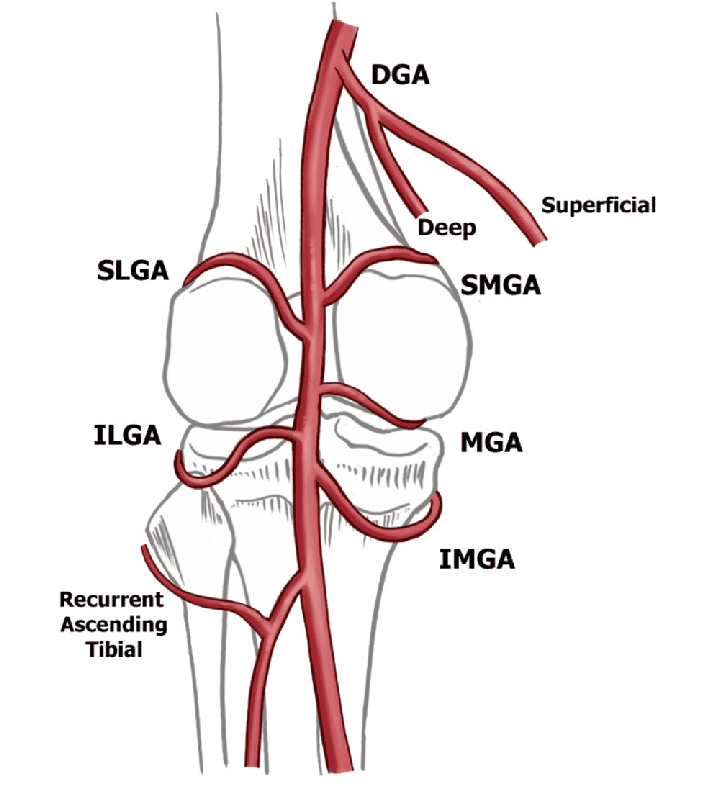
Genicular artery embolization (GAE) goes after that abnormal blood supply directly. It is performed by an interventional radiologist — a physician trained to work inside blood vessels under image guidance. Nothing enters your knee joint. There is no incision and no general anesthesia.
- A pinhole. The doctor numbs a spot at the top of the thigh and makes a pinhole opening in the artery. No incision, no stitches.
- The map. A catheter thinner than a strand of spaghetti is advanced through the arterial system to the vessels supplying the knee. Dye flows, and live X-ray shows which vessels are abnormal — the ones feeding the inflamed, over-supplied tissue generating your pain.
- Selective treatment. Only those abnormal vessels are treated. The catheter never enters the joint space, the implant, or the bone it’s fixed to.
“Are you cutting off the normal blood supply to my knee?”
No — and almost every patient asks it, so it deserves a straight answer. Normal blood flow to the joint is not disrupted. The healthy vessels that nourish the bone and normal tissue are left completely alone. Only the pathological vessels that formed in response to years of inflammation are targeted.
What goes in, and what doesn’t stay
Rather than permanent synthetic particles, we use a temporary embolic agent: a medication (imipenem/cilastatin) mixed with X-ray contrast. Together they form microcrystals about the size of a grain of sand, which lodge in and plug the abnormal vessels — then dissolve naturally within about half an hour.
The vessels are treated, the inflammation resolves, and the embolic material itself is gone. Nothing permanent stays behind, which also lowers the risk of treating a vessel that wasn’t the target. You already have hardware in your knee; we’re not adding more. In the study that compared these temporary crystals head-to-head against permanent beads, relief at two years was just as good.
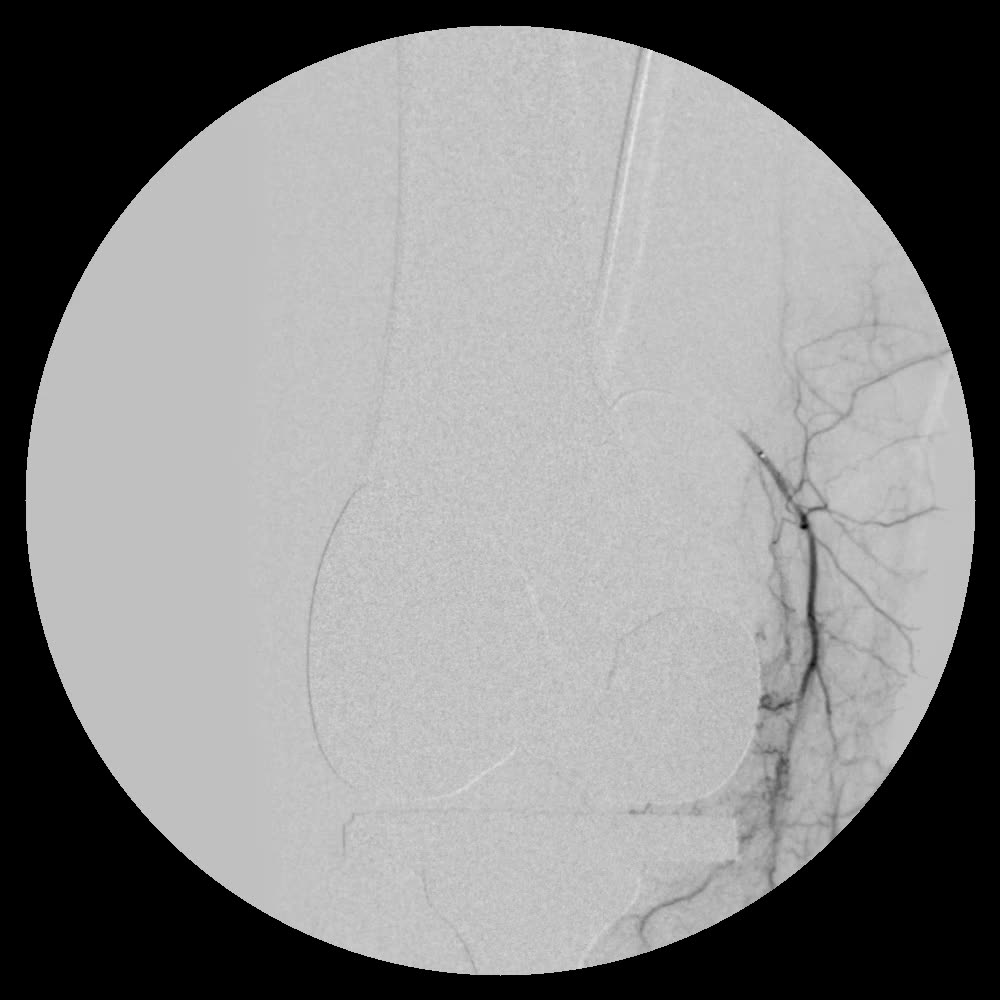
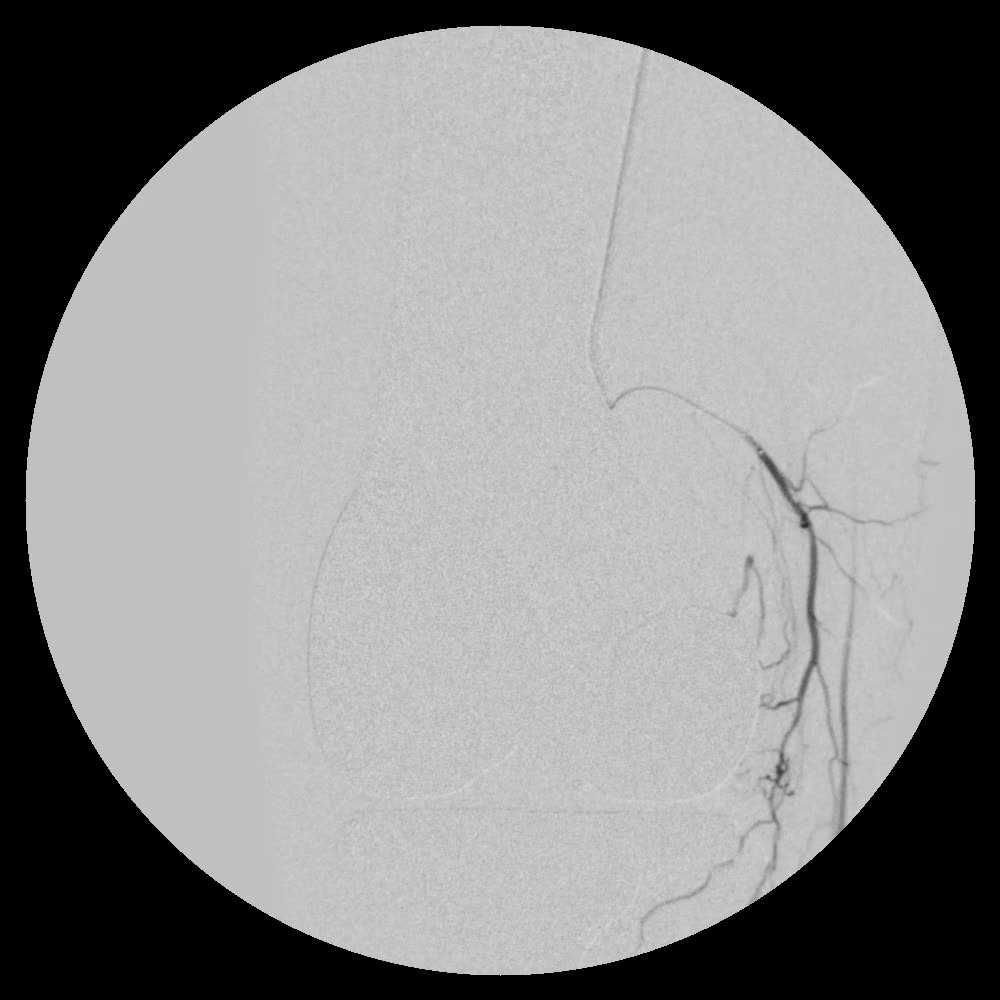
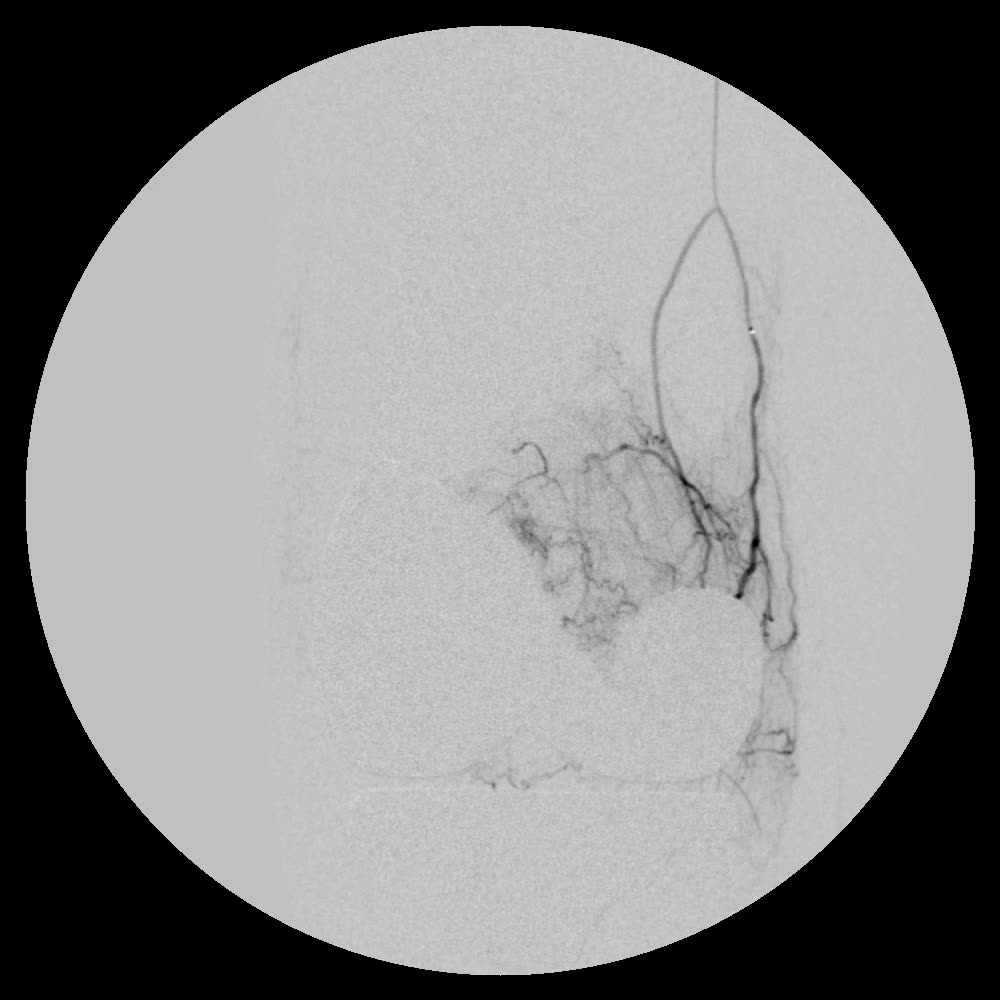
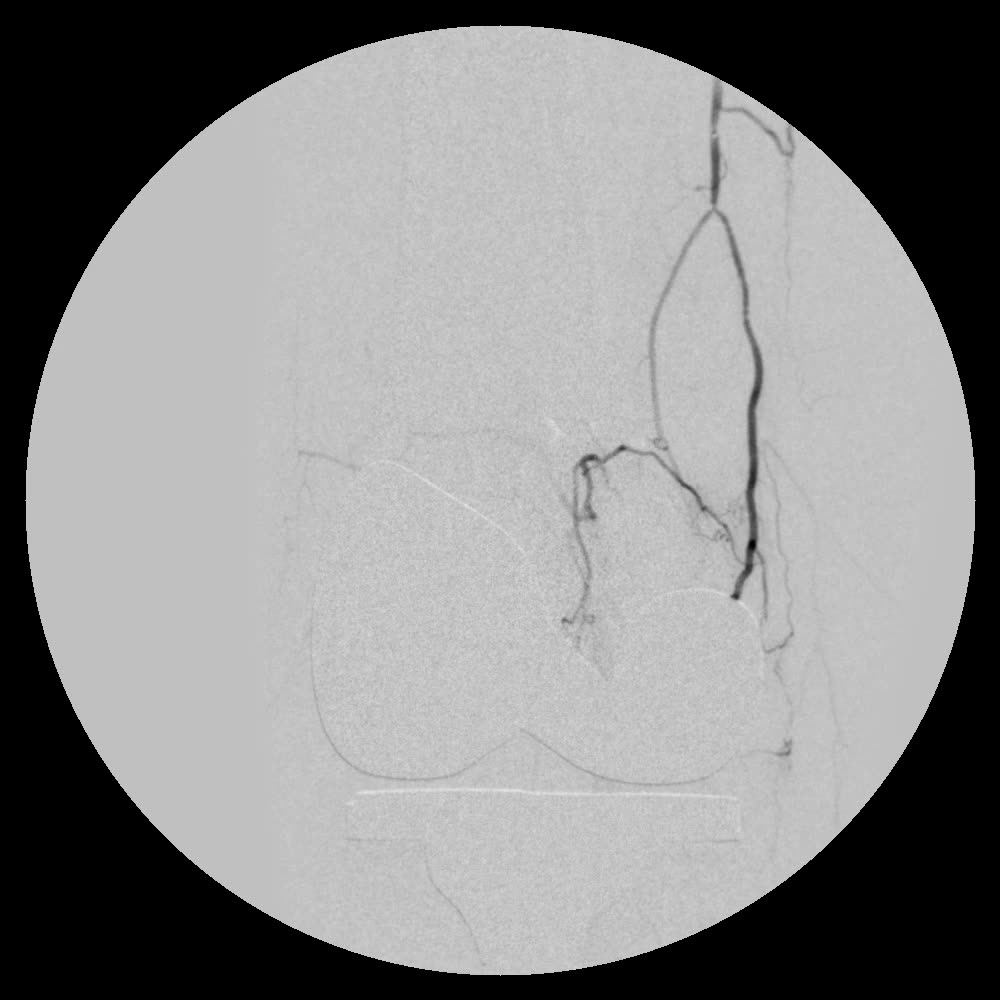
Angiograms from a genicular artery embolization performed at ARV Centers, San Antonio, in a patient with persistent knee pain after a total knee replacement — implant confirmed stable before treatment. Eight arteries feed the knee’s lining; these are two of them. Patient identifying information removed. Individual results vary.
What the day is actually like
When patients hear “catheter” and “artery,” they picture a hospital stay, an operating room and days in bed. It isn’t that.
GAE is performed in our own office-based procedure suite. You are not admitted anywhere. For sedation we use twilight sedation — you’re relaxed and comfortable but not fully under, breathing on your own. Most patients say they barely remember it, and many sleep through it.
The only discomfort most people notice is the pinch and brief burning of the numbing medicine at the access point. You shouldn’t feel the catheter move, and you shouldn’t feel anything at the knee. Some patients do feel an ache like their own arthritis during the treatment itself — oddly reassuring, because it often means the right vessels are being treated.
The procedure runs about an hour; plan on three to four hours with us all told, including prep and recovery.
Recovery
There is essentially no downtime. You get up, get dressed, recover in the office for about 45 minutes, and go home with your driver. Take it easy the rest of that day — nothing strenuous. The next morning you can resume normal daily activity: walking, errands, light work. For heavy exercise, heavy lifting or sport, wait about five days.
No weeks of physical therapy just to recover from the treatment. No restrictions on daily activity. For patients who have already been through a knee replacement and its long recovery, this is the part that is genuinely hard to believe until they experience it.
What the research shows
Embolization of the knee is not new or fringe — it has more than a decade of research behind it, including randomized sham-controlled trials and pooled analyses across hundreds of knees. What is newer is aiming it at a knee that has already been replaced. Here is that specific literature.
| Study | What it found |
|---|---|
| Hospital for Special Surgery series — recurrent swelling after replacement | 14 of 18 replaced knees had their swelling resolve completely, confirmed on ultrasound at final follow-up. |
| Multicenter series — persistent post-replacement pain | Pain scores fell from 7.0 to 3.4 out of 10. Function scores improved alongside them, and 6 in 10 patients cut back on pain medicine. |
| Prospective pilot study — knees that still hurt after replacement | Pain on walking fell from 73 to 38 out of 100 at six months, with about 7 in 10 patients reaching a meaningful improvement in quality of life. |
| 2026 repeat-treatment study, 55 patients | A second embolization brought 36% more patients to a meaningful improvement, in knees where imaging showed the treated vessels had reopened. |
In those studies, no implant complications occurred. No joint damage. The hardware was unaffected.
Two things we’ll tell you plainly. In the published series a minority of patients had temporary skin discoloration near the knee or a short flare of pain in the first week; both settled on their own. And some knees need a second treatment — when the first one fades, it is usually because the vessels have reopened, and treating them again works.
Treating persistent pain after a total knee replacement is now one of the most common procedures we perform. In our experience, most of these patients get real, meaningful relief.
Who this is for
Two things must be true before GAE is considered in your case:
- You are more than 12 months out from your knee replacement — enough time for normal surgical healing to have completed.
- Your orthopedic surgeon has evaluated you and confirmed three things: the implant is stable and not loose or malpositioned; there is no infection; and no revision surgery is recommended.
Beyond that, the picture is the familiar one: the X-rays look fine, nobody can tell you why it still hurts, and injections, therapy and medication haven’t given lasting relief.
It isn’t right for you if the implant is loose, infected, malpositioned or worn — those are surgical problems, and we’ll say so. Nor if the stability workup hasn’t been done, or if you have certain circulation problems or advanced kidney disease.
If you want to find out
You don’t need a referral from your orthopedic surgeon for an initial consultation. And if you ask them about GAE and get a blank look, that isn’t a mark against them — awareness of this procedure is still spreading through the orthopedic community, and it lives in a different specialty with a different referral network.
At a consultation we’ll review your imaging and your surgical history and assess whether the soft tissue around your knee shows the inflammation GAE targets. One number worth asking any doctor before any procedure: how many of these have you done? Ours is more than 700 genicular artery embolizations.
Living with chronic pain after a knee replacement is one of the most frustrating situations a patient can be in. You made a big decision, you went through a major operation, and you deserve relief. You’ve already done the hard part — let us help with what’s left.
Read the full page on GAE after knee replacement — including two patient stories and the complete before-and-after gallery — or book a consultation.
Written and reviewed by the physicians of Arthritis Relief & Vascular Centers. This article is general health education, not medical advice, and reading it does not create a doctor–patient relationship. Every case is different — talk with a physician who has seen your imaging and examined you before making a treatment decision. If you are having a medical emergency, call 911.