
Most people know what varicose veins in the legs look like. Blue, twisted, bulging cords behind the knee or down the calf. And anyone who has them knows they don’t just look bad — they hurt. A heavy, dull ache that builds through the day, worse after hours on your feet, better the moment you lie down and put your legs up.
Now picture that same ache deep inside your pelvis. Same heaviness. Same pattern — worse by evening, better lying down. Except nobody can see the veins causing it. Not you, not your doctor, and often not the scans you’ve already had.
That is pelvic congestion syndrome. In plain terms, it is varicose veins on the inside — and because they are hidden, women often go months or years before anyone puts a name to the pain.
You may also see it called venous-origin chronic pelvic pain, or a pelvic venous disorder. Those are the newer names doctors use for the same problem.
Why varicose veins hurt, in the legs or in the pelvis
Your veins carry blood back up to your heart. In the legs, that means working against gravity all day. To manage it, veins have tiny one-way valves. Blood moves up, the valve closes, and it can’t fall back down.
When those valves wear out or stop sealing, blood slips backward and pools. The vein stretches to hold it. Over time it becomes wide, twisted and swollen — a varicose vein. The stretching and the pressure are what you feel as that heavy, aching, tired sensation.
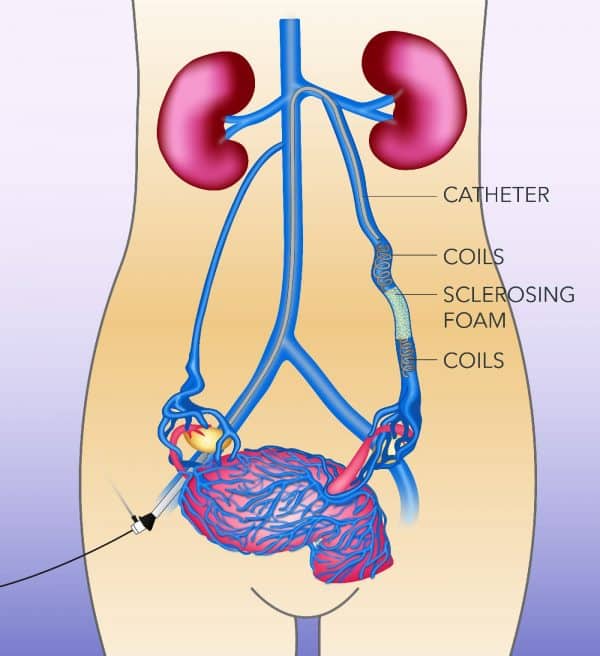
Your pelvis drains the same way. The ovarian veins run from each ovary up toward the kidneys, and they rely on the same one-way valves. When the valves fail — most often in the left ovarian vein — blood flows backward into a web of veins around the uterus and ovaries. Those veins swell and press on the nerves and organs around them.
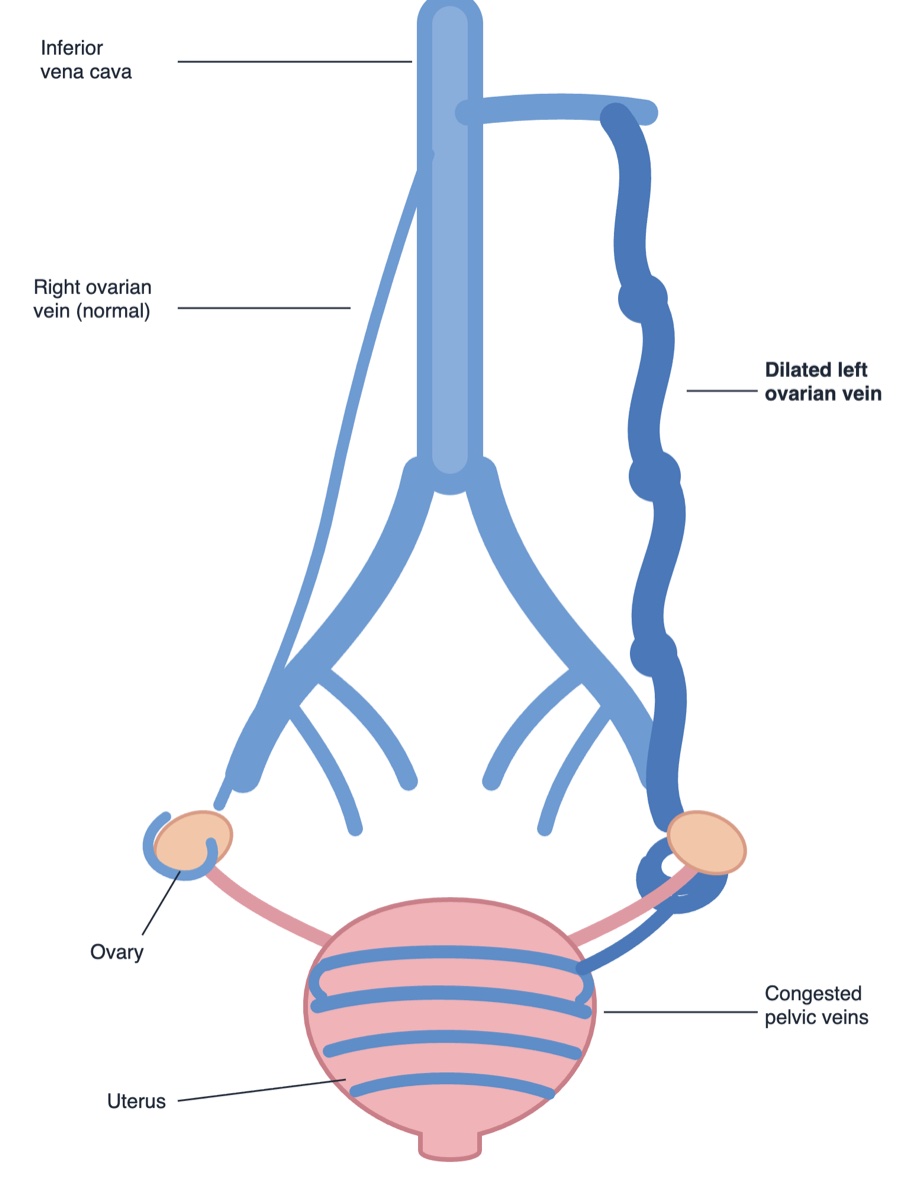
Pregnancy is a big part of why it happens. During pregnancy, the veins in your pelvis can hold up to 60% more blood than usual, and hormones relax the walls of the veins. After one or more pregnancies, some valves never fully recover. That is why pelvic congestion syndrome most often affects women between about 20 and 45 who have had children — though it can happen without pregnancy too.
The difference between legs and pelvis: one you can see
Leg varicose veins are unsightly, and that is the one thing about them that helps. You can see them. You point at them, your doctor looks, and the conversation starts right there.
Pelvic varicose veins give no such clue. There is nothing to point at. What you bring to the appointment is a description — an ache, a pressure, a pain that is hard to put into words — and a description is easy to file under “we couldn’t find anything.”
Sometimes there is a visible sign, if anyone thinks to look for it. Many women with pelvic congestion also have varicose veins in unexpected places: the vulva, the buttocks, or the back and inside of the upper thighs. Those veins are often fed from the pelvis. If you have them, tell your doctor — it is one of the most useful clues there is.
What pelvic congestion feels like
Here is the pattern women describe, over and over:
- A dull, heavy ache low in the pelvis that has lasted six months or more.
- Worse the longer you stand or sit, and worst at the end of the day.
- Better when you lie down. Many women feel fine first thing in the morning.
- Pain during or after sex — often an ache that lingers for hours afterward.
- Worse just before or during your period, but rarely gone completely between cycles.
- Pressure on the bladder or bowel, or a feeling of fullness in the pelvis.
- Lower back pain or aching in the legs that rides along with the pelvic pain.
If your pain is better lying down and worse by dinnertime, that detail matters. It is the same gravity pattern as varicose veins in the legs.
That last point about your period is worth a closer look. With endometriosis, pain usually comes and goes with the cycle, with pain-free stretches in between. Pelvic congestion pain tends to be there most of the month, flaring before and during the period but never fully letting up. It isn’t a test on its own — but it is a clue worth telling your doctor about.
Why it takes so long to diagnose
Women with pelvic congestion syndrome often describe the same road. Years of appointments. The ultrasound, the bloodwork, sometimes a CT or an MRI. Maybe a laparoscopy. And at the end of each one, some version of: “Everything looks normal.”
In one published series of women eventually diagnosed with pelvic congestion, symptoms had lasted anywhere from six months to twenty years before anyone found the cause — seven years on average. And about one in four found their way to a vein specialist on their own, without a referral.
That delay isn’t because anyone stopped caring. It comes down to three things:
- Most scans are done lying down. Pelvic veins swell when you’re upright and shrink when you’re flat. An ultrasound or CT done on your back can catch the veins at their smallest.
- Laparoscopy usually misses it. During a laparoscopy you are lying flat and the belly is filled with gas, which squeezes the veins shut. In published reviews, laparoscopy came back negative in 80 to 90% of women who did have pelvic congestion.
- Most pelvic pain workups look for other things first. The standard workup is built to find cysts, endometriosis, fibroids, adenomyosis and infection. Veins are a vascular problem, and they sit outside where that workup is designed to look.
If you have been told your scans are normal and the pain is still there, that doesn’t mean the pain isn’t real. It may mean nobody has looked at your veins yet.
A diagnosis of exclusion — and why that’s a good thing
Pelvic congestion syndrome is what doctors call a diagnosis of exclusion. That means the other possible causes of pelvic pain have to be checked and ruled out first, before anyone settles on the veins.
That can sound like more waiting. It’s actually what protects you. Pelvic pain can come from many places, and sometimes from more than one at once. The list a careful workup goes through includes:
- Gynecologic causes — endometriosis, uterine fibroids, adenomyosis, ovarian cysts or masses, and pelvic infection
- Bladder and bowel causes — interstitial cystitis, irritable bowel syndrome, and other digestive problems
- Muscle, joint and nerve causes — pelvic floor muscle tension, the low back and hips, and nerve irritation
- Vein compression — in some women a vein higher up is being squeezed, such as the left renal vein (nutcracker syndrome) or the left iliac vein (May-Thurner syndrome), and that pressure is what backs blood up into the pelvis
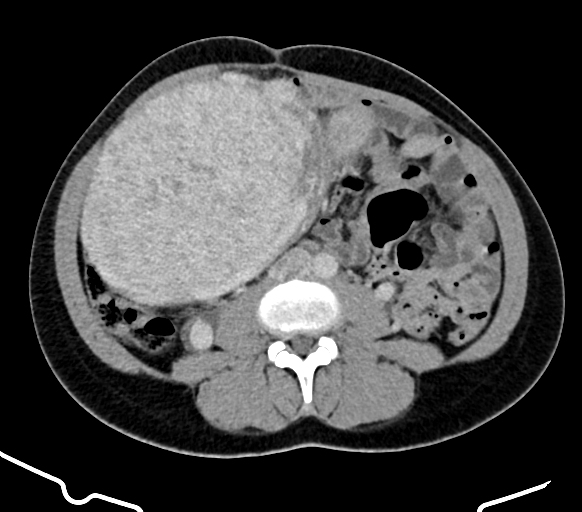
There is one more reason the order matters. Swollen pelvic veins show up on scans in plenty of women who have no pain at all. One study compared women with chronic pelvic pain to women without it. Faulty pelvic veins turned up in 62% of the women with pain — and in 19% of the women without it. So the veins are strongly linked to the pain. But a scan showing wide veins, by itself, doesn’t prove they are the cause.
That is why we don’t treat off a picture alone. We put your symptoms, your history and your imaging together first. When everything else has been checked and the pattern points to the veins, that is when treating them makes sense.
Seeing the veins: the venogram
The test that shows pelvic congestion most clearly is a venogram. A thin catheter is guided into the veins, a small amount of contrast dye is injected, and live X-ray shows exactly how the blood is flowing — including whether it is running backward.
On a venogram, the problem is easy to see. A wide ovarian vein carries blood the wrong way, down into a tangle of swollen veins around the uterus. That tangle is the congestion.
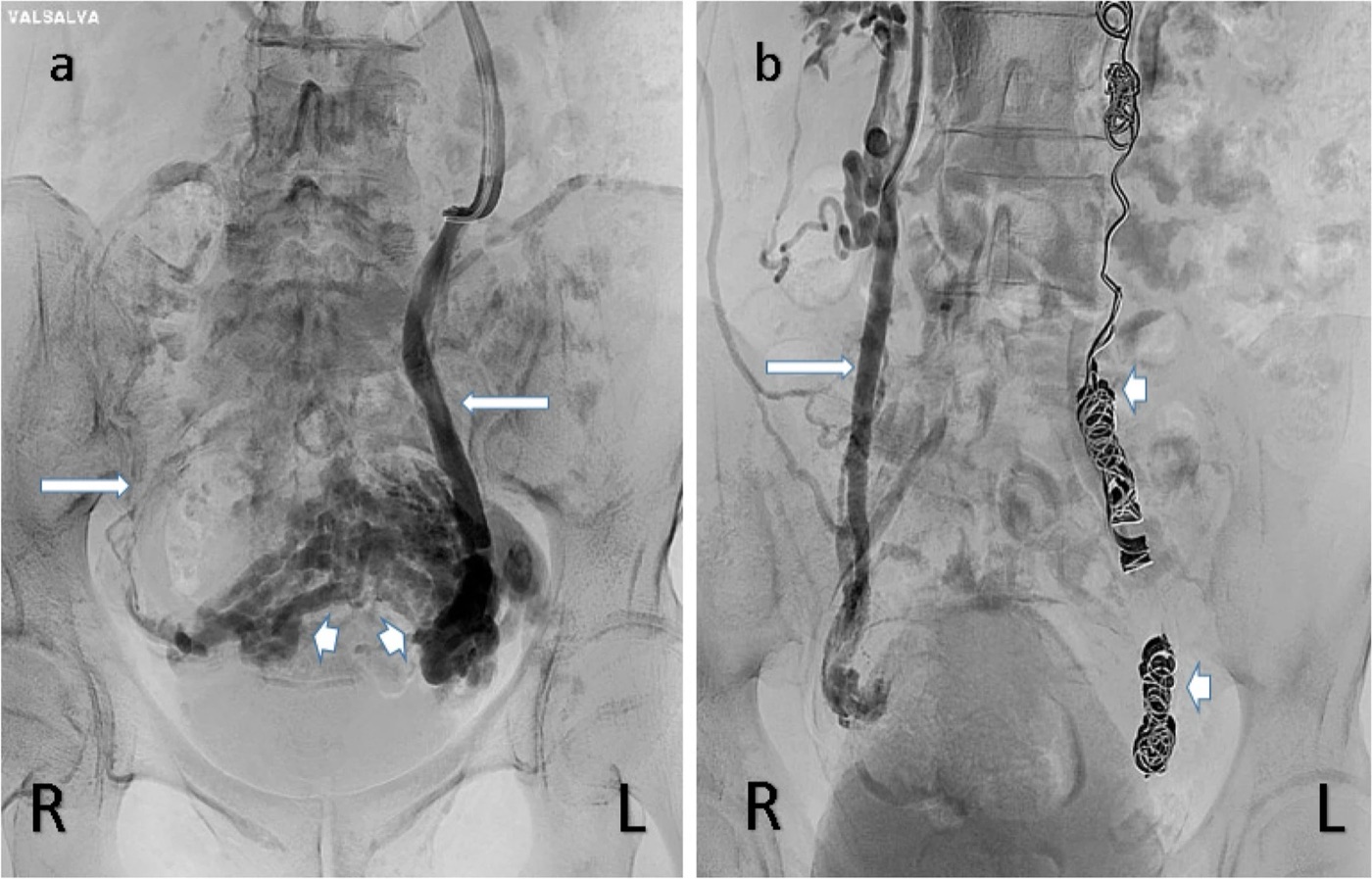
Here is the part that makes this practical. When the venogram confirms the diagnosis, the treatment can happen in the same session, through the same catheter. One visit, not two.
How we treat it: pelvic vein embolization
Think about how leg varicose veins are treated today. Nobody strips veins out through long incisions anymore. The faulty vein is closed from the inside, the body reroutes blood through healthy veins, and the pressure goes away.
Pelvic vein embolization works the same way, for the veins you can’t see. It is done in our office by a board-certified interventional radiologist, under image guidance:
- You’re comfortable, not asleep. Twilight sedation through an IV — relaxed and drowsy, breathing on your own. No general anesthesia and no breathing tube.
- A pinhole, not an incision. The skin at the top of the thigh is numbed and a thin catheter goes into the vein through a tiny puncture. Nothing is cut and there are no stitches.
- The map. The venogram shows which veins are flowing backward in your pelvis.
- The treatment. A medicated foam is placed to seal the tangle of smaller swollen veins, and tiny metal coils close off the faulty main vein. Blood reroutes through the healthy veins around them.
- Home the same day. The whole procedure takes about an hour. You rest with us for a short while afterward, then a driver takes you home.
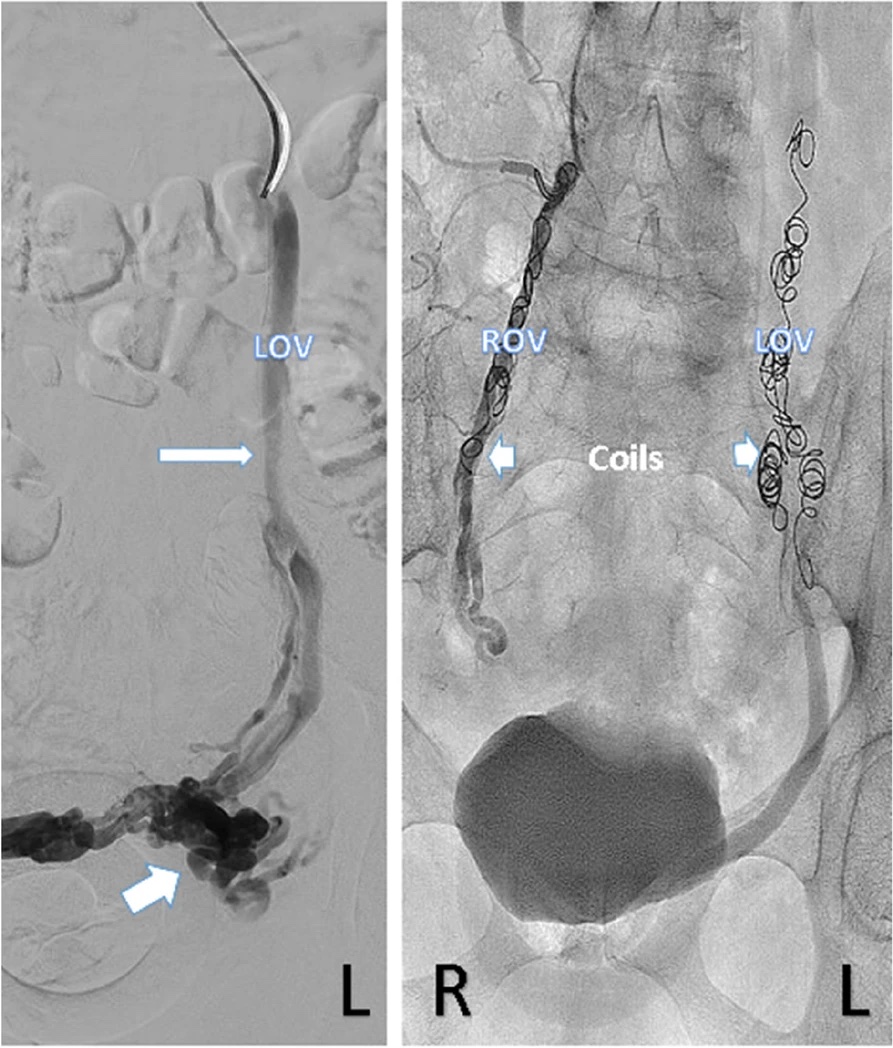
Venogram images reproduced from the published medical literature. Individual results vary.
“If you close those veins, where does the blood go?”
It is the first question almost everyone asks. Your pelvis has many veins, and the faulty ones weren’t doing their job anyway — they were letting blood fall backward. Once they are closed, blood drains through the healthy veins that were already there, the way it is supposed to. The swelling and pressure ease, and so does the ache they were causing.
“Do the coils stay in?”
Yes. The coils are made of the same kinds of metal used in many medical implants, and they stay in place for good. You won’t feel them. The foam does its job and is absorbed by the body.
Recovery: more like a period cramp than a surgery
This is the part women are most surprised by. There is no incision to heal and no hospital stay.
- Home the same day. You sleep in your own bed that night.
- Mild cramping for a day or two. Most women describe it as feeling like a menstrual cramp. Over-the-counter pain medicine usually handles it.
- Back to work the next day for most women.
- Go easy on heavy lifting for a few days while the small puncture in the thigh heals. Ordinary daily activity starts right away.
Compare that with treating the same pain surgically. Hysterectomy has been used for pelvic congestion, and it means general anesthesia, a hospital stay, and weeks of recovery — and in published studies, about a third of women still had pain afterward. Embolization goes straight to the veins and leaves your uterus and ovaries where they are.
What the research shows
In a randomized trial published in 2023, women with chronic pelvic pain and faulty pelvic veins either had the veins closed with coils or had a venogram only — the same catheter procedure, without the treatment. At one year, the women who were treated had significantly lower pain scores and better quality of life than the comparison group, with no major complications reported. The trial was smaller than planned — 60 women — because COVID stopped enrollment early.
Across larger reviews of published cases, the procedure succeeds technically in nearly every patient, and roughly 7 to 9 out of 10 women get meaningful, lasting relief. Symptoms can return in some women over time, and when they do, the veins can be looked at again. A larger, sham-controlled trial is under way now.
Is this you?
A consultation is worth it if:
- You’ve had a heavy, aching pelvic pain for six months or more
- It gets worse the longer you stand or sit, and better when you lie down
- You have pain during or after sex that doesn’t have another explanation
- You’ve had the usual workup, and it hasn’t explained the pain
- You have varicose veins on your vulva, buttocks or upper thighs
- You’ve had children, and the pain started or got worse afterward
Bring whatever imaging and records you already have. We will go through your history, look at what has already been ruled out, and tell you plainly whether your veins are a likely cause — and what we would do next.
You have probably spent a long time being told what your pain isn’t. The next step is finding out what it is.
Written and reviewed by the physicians of Arthritis Relief & Vascular Centers. This article is general health education, not medical advice, and reading it does not create a doctor–patient relationship. Every case is different — talk with a physician who has seen your imaging and examined you before making a treatment decision. If you are having a medical emergency, call 911.