
Maybe you’ve planned your days around your period for years. You know where every restroom is. You wear dark clothes and carry a spare. You’re tired all the time, and your last blood test said you were anemic.
Then you were told your options. Most women hear two: have a hysterectomy or a myomectomy, or keep living with it. So most women keep living with it. Not because the symptoms are fine, but because major surgery feels like too much to take on.
There is a third option. It’s called uterine fibroid embolization, or UFE. It has no incision, no general anesthesia and no hospital stay. It treats every fibroid at once, and you keep your uterus.
The short version
UFE shrinks fibroids by blocking their blood supply. It is done through a pinhole at the top of the thigh, under twilight sedation, in our office. You go home the same day and are usually back to normal in less than a week. In a study of 1,285 women treated in an office setting like ours, heavy bleeding improved in 96%. Our physicians have performed more than 350 UFEs in the last three years.
Is this you?
UFE is for women whose fibroids are causing:
- Heavy periods — bleeding through pads and clothes, periods that last for days longer than they should
- Anemia from all that blood loss — the tired, short-of-breath feeling that iron pills never quite fix
- Pelvic pain and cramps that take over part of every month
- Pressure and fullness — a belly that looks pregnant, pants that don’t button
- Pain during sex
- Frequent urination and constipation from large fibroids or an enlarged uterus pressing on the bladder and bowel
If you read that list and saw yourself in two or three of the lines, keep reading.
Why so many women choose to wait
When the choice is major surgery or nothing, waiting makes sense. Women tell us the same three reasons, over and over.
The risk. A hysterectomy or myomectomy is an operation under general anesthesia, with incisions, often a hospital stay, and the risks that come with any major surgery.
The time. In published studies, women took about 30 to 40 days on average to get back to their usual activities after a hysterectomy. Most women with jobs and families can’t simply step away for a month or more.
Losing the uterus. Many women just don’t want to. And many have heard other women describe how they felt after a hysterectomy — emotional changes, worries about bone health, problems with the pelvic floor later on. Some of those concerns have real research behind them:
- Pelvic floor. A Swedish study of more than 165,000 women found that women who had a hysterectomy were more than twice as likely to later need surgery for stress urinary incontinence — the bladder-support operations many women know as a bladder lift.
- Heart health. A Mayo Clinic study followed women for about 22 years after a hysterectomy, even when their ovaries were kept. It found about a one-third higher rate of coronary artery disease than in women who did not have one. The link was strongest in women who had surgery at 35 or younger. This kind of study shows a link, not proof of cause — but it is the reason ACOG, the national OB/GYN society, says women should be counseled about long-term health risks before a hysterectomy.
A myomectomy keeps the uterus, but it is still surgery. And fibroids often come back after it: in one study, about half of women had new fibroids on ultrasound within five years.
Most women aren’t choosing between two treatments. They’re choosing between surgery and putting up with it. UFE changes that choice.
The third option: uterine fibroid embolization
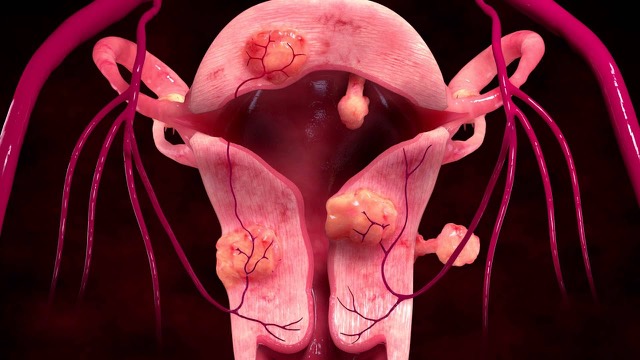
Fibroids grow because they have a rich blood supply. UFE blocks it.
The doctor guides a thin tube, called a catheter, through an artery to the uterus. Tiny particles, smaller than grains of sand, go into the small arteries that feed the fibroids. With no blood, the fibroids shrink and soften. The healthy uterus around them keeps its blood supply and stays where it is.
Because the particles travel to every fibroid that has a blood supply, UFE treats all of your fibroids in one procedure — large and small, in any spot. No fibroid is cut out, so there is nothing to stitch and no scar on your belly.
Does it work?
Yes, for most women. The Society of Interventional Radiology reports that about nine out of ten women who have UFE see their symptoms improve a lot or go away completely.
The numbers are just as strong when UFE is done in an office, the way we do it. In a 2025 study of 1,285 women treated in an office-based setting:
- 96% had less heavy bleeding
- 94% had less pelvic pain
- 94% had less pressure and bulk
- 94% had less fatigue
- 92% had less urinary frequency
And the relief lasts. In a long-term follow-up five to seven years after UFE, more than 80% of women still had their fibroid symptoms resolved or improved.
Why haven’t I heard of this?
UFE has been around for decades — the first results were published in 1995, and the particles we use are FDA-cleared for uterine fibroids. Yet most women have never heard of it. In one survey of OB/GYNs, UFE was the first option offered less than 2% of the time.
Much of the reason is who does it. Fibroids are usually found and treated by a gynecologist, and gynecologists are surgeons. The treatments they perform are the ones they trained in: medication, myomectomy and hysterectomy.
UFE is different. It is an endovascular procedure — done from inside the blood vessels, using a catheter and live X-ray — and it is performed by an interventional radiologist, not a gynecologist. A gynecologist can’t do UFE in their own practice. Offering it means sending you to a different specialist.
That’s why so many women only ever hear about surgery. It isn’t that UFE doesn’t work. It’s that it lives in a different specialty — ours. And you don’t need a referral to see us.
How we do it
Every UFE at ARV Centers happens in our own interventional radiology suite, in our office — not a hospital.
- Twilight sedation. An IV relaxes you and makes you drowsy. You breathe on your own. There is no general anesthesia and no breathing tube.
- A pinhole. The doctor numbs a spot at the top of your thigh. The catheter goes in through a pinhole opening — no incision, no stitches.
- The treatment. Using live X-ray, the doctor maps the arteries feeding your fibroids and places the particles. Both sides, every fibroid, one procedure.
- Home the same day. You rest with us for about an hour, then your driver takes you home. You sleep in your own bed that night.
Most of our patients are back to their normal routine in less than a week. There’s no surgical wound to heal and no stitches to come out.
The cramps — and what changed
If you’ve read about UFE, you may have read about the cramps. As the fibroids lose their blood supply, the uterus cramps, much like a heavy period. It is a sign the treatment reached its target, and it is worst in the first 18 hours or so.
This is where things have changed. Every patient goes home on our pain plan, which now includes Journavx — a non-narcotic medication, approved by the FDA in 2025, that blocks the pain signal in the nerve itself, before it reaches the brain.
And we don’t wait for the cramps to start. You take your first dose of Journavx the day before your procedure, so it is already in your system. You take a second dose just before the procedure, in pre-op. By the time the cramping begins, the medicine is already working, and it covers that first stretch. Added to the rest of the plan, it has been a game changer: our patients feel a fraction of the pain women had on the older medications alone.
You go home with the medicine, an hour-by-hour schedule, and the doctor’s cell number, and we call you the next morning. Our recovery article walks through the pain plan day by day.
UFE and surgery, side by side
| UFE | Hysterectomy | |
|---|---|---|
| How it’s done | A pinhole at the top of the thigh | An operation to remove the uterus |
| Anesthesia | Twilight (IV) sedation | General anesthesia |
| Where it happens | Our office | A hospital or surgery center |
| Where you sleep that night | Your own bed | Often the hospital |
| Back to normal life | Less than 1 week | About 30–40 days on average |
| Your uterus | Stays | Removed |
And UFE closes no doors. If it doesn’t give you everything you need, every option you have today is still there afterward.
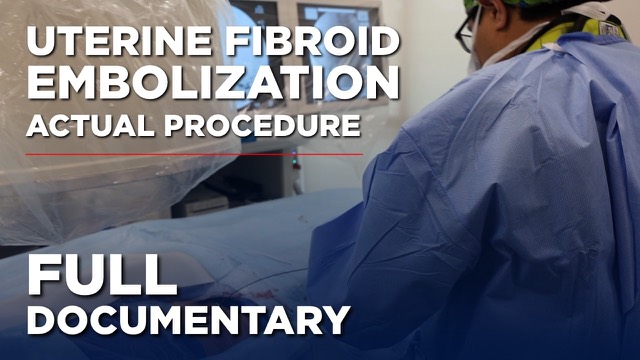
See a real UFE for yourself
Reading about a procedure is one thing. Watching it is another. These two videos were made with our team and our patients.
Is UFE right for you?
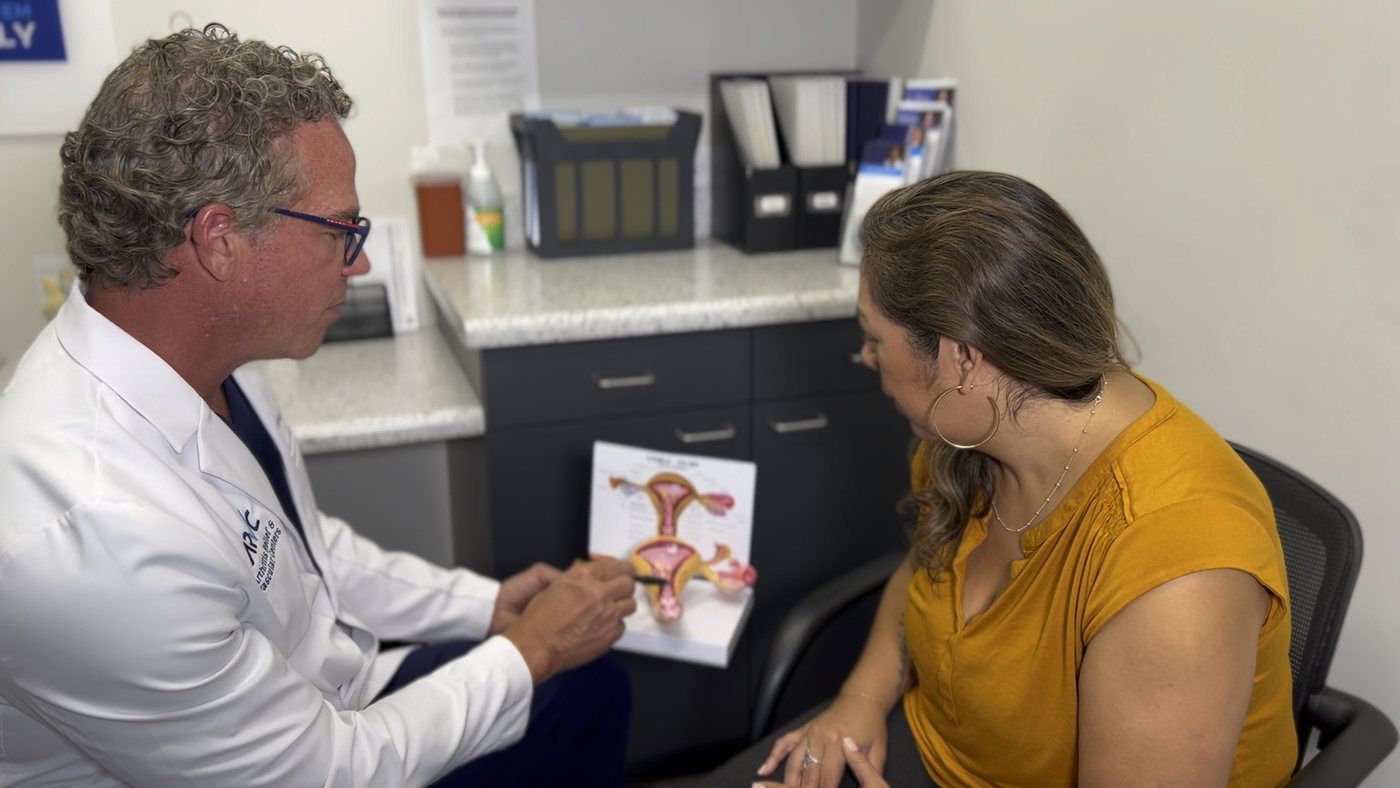
Not every woman is a candidate. The size, number and location of your fibroids all matter, and so does your health history. That’s what a consultation is for. You’ll sit down with a provider, go over your ultrasound or MRI, and find out whether UFE fits your fibroids before you decide anything.
Our physicians have performed more than 350 uterine fibroid embolizations in the last three years. No referral is needed for your first visit, UFE is covered by most insurance plans, and we do a complimentary benefits check when you come in.
If you’ve been searching for an alternative to hysterectomy or myomectomy, this is the one to look at first. The full UFE page shows the procedure step by step, or you can book a consultation on our calendar below.
Sources: Society of Interventional Radiology, patient information on uterine fibroid embolization. Geschwind JF, et al. Diagnostics (Basel). 2025;15(6):739. Walker WJ, Barton-Smith P. BJOG. 2006;113(4):464–468. Altman D, et al. Lancet. 2007;370:1494–1499. Laughlin-Tommaso SK, et al. Menopause. 2018;25(5):483–492. ACOG Practice Bulletin 228 (2021). Fedele L, et al. Hum Reprod. 1995;10(7):1795–1796. Kubiszewski K, et al. J Vasc Interv Radiol. 2023;34:1430–1434. Return-to-activity figures after hysterectomy as summarized in Am Fam Physician, 2017.
Written and reviewed by the physicians of Arthritis Relief & Vascular Centers. This article is general health education, not medical advice, and reading it does not create a doctor–patient relationship. Every case is different — talk with a physician who has seen your imaging and examined you before making a treatment decision. If you are having a medical emergency, call 911.